Historic Personalities of the Lower Naugatuck Valley
by Dorothy A. DeBisschop
Copyright, Dorothy A. DeBisschop, Oxford, Connecticut, 1973.
Permission to copy, post and reprint freely granted, as long as this copyright notice is included.
-
PREFACE
The proper study of history is biography - the lives of those who lived in the past show the total history of their times. From this collection of biographies, one develops an historic overview of the development of the Lower Naugatuck Valley. The biographies are a representative sampling of Valley leaders, from 1667 until 1910. Included are persons from the following Connecticut towns:
- Seymour
- Oxford
- Beacon Falls
- Ansonia
- Derby
- Shelton
-
TOBY THE INDIAN AND COLONEL EBENEZER JOHNSON
Perhaps one of the best known features of the Seal of the Town of Beacon Falls, adopted on that town's Centennial in 1971, is Toby the Indian. A well- known landmark in that town is called "Toby's Mountain," in memory of this Narragansett Indian. The history of this man is one which covers the history of the entire area and is closely tied with Col. Ebenezer Johnson, one of the early settlers of Derby. Johnson was a leading citizen in affairs civic and military and was wealthy by the standards of his day. He owned extensive land tracts, including much of what today is Seymour, Oxford and Beacon Falls. But he most often remembered as the man who freed his Indian slave, Toby.
It may surprise some readers that not only Negros but Indians were held as slaves in New England. Slavery was recognized in England, and the colonists brought the institution to this country. Under the laws of the colonies, persons might be sold into slavery for crimes committed, or they might be enslaved after taken captive in battle, regardless of race or color. In addition, black slaves were kept from generation to generation, as were Indians. However, the English generally did not allow white persons born of slave parents to remain in slavery.
The Connecticut General Court had established rules regarding the ownership of slaves. The laws specifically gave owners of Indian slaves who were captured in war the right to ship them out of the country for sale, if the slaves attempted to escape their master.
Orcutt and Beardsley, in their History of Old Derby, state "Of Indians captured in war, a considerable number were sold into slavery, but what proportion it would be impossible to say. It was a defensive measure to which the colonists were impelled by the fact that they were 'contending with a foe who recognized none of the laws of civilized warfare.' It was resorted to in the war with the Pequots, and again in the war with King Philip."
To understand the story of Toby, it is first necessary to know the background of his owner, Col. Ebenezer Johnson, who, as one of the leading men in the old Town of Derby, had much influence upon its history. He is believed to have been born in Fairfield, Connecticut, and to have moved to Derby around 19 years of age, in or about the year 1667. One of the earliest records of Johnson in his role as public servant was his part in a purchase of Indian lands in 1678. He purchased land of the Indians east and southward from Rock Rimmon, and this land was later divided between Johnson and Samuel Riggs. This area of land included Rimmon Road and the Skokorat Road vicinity of Seymour.
It was the custom of the English settlers to purchase the land of the Indians, and in numerous cases the land would be purchased from several different Indians at various times, in order that the colony had a clear legal title to the lands which they settled. It remains questionable whether or not the Indians had a true concept of the sale of lands. Their nomadic life had not prepared them for the idea of intensive cultivation on the lands. Some of the Indians, when they signed documents of sale, apparently believed they retained the right to hunt on those lands. Here historians express wide varieties of opinion. Beardsley wrote as follows:
"A careful perusal of the Indian deeds will reveal the masterly ability of the red man to sell land over and over without ever buying it, and the wonderful depth of the white man's pocket to pay for Indian lands. The price paid at first being apparently worth every dollar and cent, and button and bead, that the land was worth, or that they were able to pay. Whatever the treatment of the Indians in America, Derby has paid them for all she ever had of them, caring for them as citizens and neighbors, and burying as brothers. The early settlers of Connecticut, either from a sense of justice or in regard to expediency, made it a rule to extinguish the titles of the natives by actual purchase, and when the value of money of that day is taken into consideration, the unimproved condition of the land, and the fact that the Indians reserved either large sections as hunting grounds, or else the right to hunt and fish everywhere just as before they sold it, it can hardly be said they were unjustly treated."
However, a noted authority on Connecticut Indians, John DeForest, wrote in another vein in his History of the Connecticut Indians:
"In these deeds the sachems allege various reasons for parting with the land: sometimes it is 'out of love and affection for the grantee'; sometimes 'on account of many benefits and kindnesses heretofore received'; sometimes for a 'valuable consideration' now paid, or perhaps only promised. These grants often covered each other, often contradicted each other, and were the source of innumerable quarrels and litigations between the English and the Indians and between the English and each other.
"The sachems at times complained, that advantage was taken of them when they were intoxicated, to beguile them out of lands which they never intended to part with."Whatever the relative merits of the opposing viewpoints listed above, it can be certain that the relation of the English and the Indians were a source of continual concern in the towns. Fearing of Indian problems, the colonies developed local militias.
In 1685, Ebenezer Johnson was appointed Lieutenant of the Derby Train Band. The appointment was made by the General Court, the legislative body of the Colony, comparable to today's State Legislature. The rank of Lieutenant was the highest given any person commanding a train band with less than sixty-four men, which was the case in Derby.
The Train Band, a title shortened from Training Band, was created for the purpose of military training of the local citizenry, so they would be prepared in case of Indian problems. The Train Bands were also called into service to look after interests of the colonies.
Prior to Johnson's appointment in Derby, there had been military drilling in the town, but Johnson worked diligently to upgrade the Train Band. Under his leadership, arrangements were made for the town to provide the powder and ammunition for the Train Band - this was previously left up to the local men to provide as best they could. Johnson also established regular training programs which were held twice a year.
In 1688, three years after his appointment, Johnson had apparently out-stripped his neighbors in Derby in terms of wealth, having enjoyed the benefits of a cash salary from the Colony, at a time when most of the people of Derby were still dependent on bartering. In that year, Johnson appears to have acquired land in Quaker Farms, Oxford. William C. Sharpe wrote in 1885, that "a well preserved document found at Quaker Farms some years ago gave a description of a layout of 170 acres at Quakers Farm, for Lieut. Johnson, made March 27, 1688."
Other major land transactions which involved Ebenezer Johnson were numerous and included the following:
In April, 1700, Ebenezer Johnson and Samuel Riggs bought from the Indians the tract of land north of Little River, which extended eastward, as well as twenty acres of meadow and upland in the Chestnut Tree Hill area in Oxford.
In 1702, he was one of the signers of the Camp's Mortgage Purchase located west of the Naugatuck River and the falls, which included a tract of land three miles square in the Great Hill region in Seymour.
In 1708, there was a division of land in Pines Bridge, with Johnson taking the land east of the Naugatuck River in Beacon Falls.
There is a record that in 1703, a vote of the Derby Town Meeting was made that Capt. Ebenezer Johnson "have liberty to take up land in the Quakers Farm purchase, land not previously laid out, he to take up said land, according to His list that was when ye land was pitched upon, viz: 1689, & upon ye foregoing termes have ye like privilege with his neighbors there."
In addition to this material wealth, it is apparent that Johnson enjoyed the respect of his fellow citizens. Abel Gunn, keeper of Derby's early records, noted that the Derby Town Meeting voted him its highest privilege, that he be allowed a special seat of honor, on the highest seat in the front of the hall. He also was given a similar privilege for Sunday morning worship, sitting in front, facing the congregation.
Johnson also served as a delegate to the General Court for the Town of Derby forty-six times. He was appointed Sargeant major of the New Haven militia in 1704, and in 1710 he went on an expedition to Port Royal at the age of 61 years.
One of the services of Col. Ebenezer Johnson was performed out of the local area, and this perhaps explains why local historians have not fully explored the subject. This involves Johnson's part in the Indian wars, especially the struggle with the Narragansetts known as King Philip's Wars.
War was formally declared against the Narragansett Indians on November 2, 1675, by the United Colonies of New England, and troops raised by Massachusetts, Plymouth and Connecticut were called the Army of the United Colonies of New England. In this war Connecticut's quota was 350 white men plus 150 Mohegan and Quinnipiack Indians. The Connecticut troops consisted of five companies under the command of Major Robert Treat, who was later to become Governor of Connecticut Colony.
The Connecticut troops marched from New London to the battle site, which was in the present area of West Kingston, Rhode Island. The Indian fortress was barricaded by logs, and what is known as the Swamp Fort Battle ensued. Historian Charles H. Townshend, wrote of the battle as follows:
"The fight was long and bloody. At length the Connecticut troops under the command of the valiant Maj. Robert Treat charged over the logs and rushed the fort. Three hundred Indian warriors perished; three hundred more died of their wounds and from cold; and nearly the same number, together with the women and children were made prisoners. Major Treat is said to have been the last man to leave the fort."
Historian George Madison Bodge wrote of the battle, "Of the losses to the enemy there can be no reliable account. Captain Oliver says 'By best intelligence we killed 300 fighting men and took say 350 and above 300 women and children'."
"Indian prisoners afterwards reported 700 killed," the historian adds, and comments, "The conduct of the Mohegan and Pequot allies is represented by Captain Oliver as false, they firing into the air, but securing much plunder. I have found no other notice of their part in the battle."
This historian lists among the English volunteers in the campaign a Captain Ebenezer Johnson. Some accounts list the death of Johnson in that campaign, but Bodge and others list Johnson as a survivor, and as further evidence of that, he is listed as one of the survivors who drew Cedar Swamp Lots following that incident.
At this point, it would be well to review Oliver's comment that the Mohegan allies secured much plunder. In that statement is the taking of prisoners and their subsequent treatment of them. The treatment of the Narragansett prisoners of the Mohegans is described in the book of Seymour native John DeForest, History of the Indians of Connecticut. That work, published at the start of DeForest's career, is still regarded as the most complete and accurate account of Connecticut Indian history. The following paragraphs are quoted from the Seymour resident's history:
"Among the prisoners of the Mohegans was an active young warrior, who had distinguished himself by his courage, and whom they demanded permission to put to death by torture. The English consented; 'partly,' says Hubbard, 'lest their denial should disoblidge their Indian friends of whom they had late made so much use; partly that they might have ocular demonstration of the savage, barbarous cruelty of the heathen.'
"The young captive, unappalled by the dreadful fate which awaited him, stood up after the fashion of Indian warriors, and boasted his exploits . . . . ."
Following these paragraphs DeForest outlines in vivid detail the slow death by torture which was inflicted upon the young Narragansett. When one considers the story of Toby the Indian, it must be viewed in light of this Mohegan torture of Narragansett prisoners.
The exact method of procurement by which Col. Johnson obtained Toby the Indian has been the source of confusion among area historians.
An early historian, writing what is one of the first accounts of the securing of Toby, gave a history of the capture of Toby, which locates the scene of the battle at Rock Rimmon. This appears to be in error, as there are papers signed by Johnson which state the Indian slave was secured from New London.
However, it should be noted that Dr. Benjamin Trumbull was a respected congregational clergyman and a noted historian, born in Hebron Connecticut in December, 1735. He graduated from Yale in 1759 and died in February, 1820. The following is Trumbull's account of the capture of Toby:
"It is said of the Colonel that he seemed to believe in everybody and to fear nothing. His courage and kindness of heart is shown in the legend of Tobie. When Captain Johnson went with a squad of soldiers to subdue some Indians in the direction of Rimmon, he accomplished his work as thoroughly as was his custom inasmuch as there was not an Indian left upon the battlefield, unless dead. The fight ended only at dark and the Captain and his men slept upon the field. Early in the morning while the Captain was viewing the ground of his exploit the evening before, he suddenly felt something clinging to his feet. Rimmon was noted for its rattlesnakes and he probably expected to be called to another kind of battle, but looking down he saw a little Indian boy, who was looking at him most pitifully; the Captain took the lad home with him and kept him, afterwards giving him the land in the direction where he had first seen him at Rimmon. Tobie likewise received a grant of land all of which he applied for a patent in the year 1713 when others did. Tobie, by his life, although short, did credit to his patron and when dead it was found he had left his land to the family of Colonel Johnson except a portion he had willed to Timothy Wooster."
This tradition was fairly wide-spread at one time, and its general acceptance must have been the reason that Seymour's historian, William C. Sharpe, made such a point to dispute the story.
William C. Sharpe published THE SEYMOUR RECORD, and was a well-known historian in these parts. He was educated in the public schools in Seymour and completed his studies at Wesleyan Academy, Wilbraham, Mass. In 1868 he opened a printing office in Seymour, and three years later established the RECORD, which became one of the best weekly papers in the state. Sharpe's first love remained history, and much of his newspaper was devoted to area history. In addition Sharpe published numerous books on area history, including the Towns of Seymour, Oxford and South Britain.
Sharpe spent much time searching old records to make the basis of his history features. The following paragraphs from History of Seymour show his method of historical research, and also deals with the subject of Toby:
"In the old records of Derby are occasional entries of Indian slaves . . . . The following entry is written 'verbatim et literatim': 'these may certifi whom it may consarn that tobee an Ingan that lived with me I had a moheg Indian at new london 30 7 years agoo. he lived with me 12 years and is now and has bin a free man ever sine. october the 6 1713. EBENEEZER JOHNSON' "It is thought that Col. Johnson came into possession of Toby in 1688, the year of the beginning of King William's war, and perhaps Toby was one of the northern Indians in alliance with the French, taken prisoner in that war. A tradition has been handed down that Col. Johnson, with his forces, surrounded an Indian village, and cut down, as they supposed, every one in it, and early the next morning as the Colonel was walking over the scene of the fight, a little Indian boy ran out of the bushes and clung to his leg with such a pleading look that the Colonel spared him, and brought him to his home by the Naugatuck. The manuscript quoted above seems to conflict with this interesting narrative," Sharpe concluded.
Sharpe, well-versed as he was on the history of the white settlement of the area, may have been in error when he assumed the story conflicted with the document Sharpe found in the records.
It should be noted that the document is dated October 7, 1713, and that 37 years previous was about the time of the Swamp Fort fight, when Col. Johnson was in service under Robert Treat. If we take Trumbull's account into mind, but disregard the location which he ascribed to it, the story becomes more plausible, and the tradition and the documents would appear to be in agreement.
It would appear there is enough circumstantial evidence to support such a presumption. It should be noted that the expedition to the Swamp Fort fight began at New London, the same town cited in the signed record which Sharpe published. It is stated in that document Johnson secured the Indian boy of a Mohegan - which happens to be the tribe which cooperated with the English in that battle which resulted in the capture of 300 or more Narragansett women and children.
It should be noted that Toby was a Narragansett Indian and was designated as such in the land records when he later obtained his land grant in Beacon Falls.
Given the weight of these circumstantial parallels, it is possible that Trumbull and the legend of the Indian boy throwing himself at the feet of Col. Johnson to plead for mercy, are substantially correct.
Any young Indian boy who had witnessed the treatment of his fellow tribespeople at the hands of the Mohegans might have appealed to the white man for mercy and to escape possible torture from the Mohegans.
Based upon the high esteem which Col. Johnson commanded from his peers, it seems likely that such an appeal from a young boy might be successful.
While there is no proof this was how Toby came to be a slave of Ebenezer Johnson, it is - in this writer's opinion - an assumption which fits in with the available records and also conforms to the early tradition. Ebenezer Johnson is known for his ownership of several slaves, and is most remembered for his aid to Toby. The Indian was freed in 1688, and in 1693, through the influence of Johnson the Paugasuck Indians sold to Toby a large tract of mountainous land lying in the northwestern part of what is now Beacon Falls. This land was purchased for 10 pounds cash and a barrel of cider and included High Rock. This land was legally confirmed to Toby in 1713, and here Toby resided until his death in 1734.
During his lifetime on Toby's mountain, Toby the Indian apparently became a special friend to young boys in the area.
Among long-term residents of Chestnut Tree Hill, several families have related to the author a tradition of boys visiting Toby. Different families have stories of members of their early family, as young boys, walking to Toby's Mountain. There was a special significance attached to Good Friday, when boys from the Chestnut Tree Hill area packed hard boiled eggs to share with Toby.
Upon the death of Toby, the mountain became the property of white men again, as the Indian left the land to three sons of Colonel Johnson and to Timothy Wooster.
Another Indian slave of Ebenezer Johnson played a part in the early history of Beacon Falls. This history is given by J.L. Rockey:
"It appears singular that another Indian slave of Colonel Johnson should be connected with a land purchase in Beacon Falls, but such is the fact. One of his maid-servants was a young squaw, Sarah, who was desired by an Indian for his wife, and she was sold to him in 1709. This dusky lover was named Chetrenasut, and he secured his bride for a consideration of L310s. of money and all that tract of land 'Lying in a place called Nayumphs, bounded northerly with Beacon Hill river, easterly with Milford, westerly with the Naugatuck river and south with Lebanon River.' This region was afterwards called 'Nyumphs,' and was the northwestern part of Bethany, set off to Beacon Falls when that town was formed. It includes the main part of the town, on which are not its most costly improvements."
Another Indian who was owned by Johnson was named Dinah, who was purchased by him for sixty pounds given to Joseph Gorham of Stratford, on June 8, 1722. At the time Dinah was said to be about twenty-six years old.
A second document regarding Dinah, which was made by Johnson's widow, is by the second wife of Johnson.
Mary A. Austin wrote of the document, "It must have been a wag of an attorney that drew up such a testament." The document is quoted below:
"For the parental love and good will which I have towards my beloved son Timothy Johnson of Derby in the county and colony aforesaid, and for others good and well advised considerations me thereunto give, grant, and confirm unto my beloved son Timothy Johnson, him, his heirs and assigns forever: that is to say one Indian woman called Dinah and also a feather bed that he now hath in his posession, and by these presents I the said Hannah Johnson do give, grant and confirm and freely make over the above named Dinah and feather-bed with all their privileges and profits, and unto him the said Timothy Johnson, his heirs, and assigns, forever to have and to hold; to occupy, use and improve; as he the said Timothy Johnson, his heirs, and assigns, shall think fit without any interruption, trouble, or molestation in any manner or way given by me, the said Hannah Johnson or any of my heirs, executors or administrators or by any other person or persons from, by, or under me. And further more I the said Hannah Johnson do by these presents for myself, my heirs, executors and administrators covenant and promise to the said Timothy Johnson his heirs and assigns that we will forever warrant and defend him, the said Timothy Johnson, his heirs and assigns in the peaceable and quiet possession and enjoyment of the above named Dinah and the featherbed against the lawful claims and demands of all persons whomsoever, etc."
Beardsley said of this document, "At no time in the history of American slavery has the recognition of human beings as chattels been more complete than it was in this old document, in which 'the Indian woman Dinah,' and 'the feather bed' are classed together in so unceremonious a way.
There can be no doubt that Ebenezer Johnson had a great influence upon the old Town of Derby, and it may be noted that he married Elizabeth Wooster, daughter of Edward Wooster, who was one of the prominent men of Derby. Also worthy of mention is Rockey's notation that Johnson was licensed as an ordinary in 1687, becoming the first tavern keeper in that town. He was also at one time Selectman of Derby.
-
THE LEXINGTON ALARM MARKS THE COMING OF THE REVOLUTION
The Battle at Lexington and Concord began on April 19, 1775 marking the opening skirmishes of the American Revolution.
On that date, a detachment of British troops marched from Boston to seize military stoves alleged to have been collected at Concord for use of the colonists. The British were met upon the road by the Americans and a bloody encounter took place, precipitating the Revolutionary War.
An alarm was immediately spread to all neighboring areas, including points as far as Charleston, South Carolina and throughout New England by horsemen riding from town to town. The message was taken to Connecticut by the Massachusetts Committee of Safety at Watertown, during the progress of the fighting, at about ten o'clock on the morning of Wednesday, April 19, 1775. The message which he carried included a written document which read, "The bearer, Israel Bessel, is charged to alarm the country quite to Connecticut, and all persons are desired to furnish him with fresh horses as they may be needed."
So Israel Bessel rode to and throughout much of Connecticut warning the Connecticut residents of the situation outside of Boston. By Thursday, April 20th, the word was received in the eastern part of Connecticut Colony and reached the capital of Hartford before that night and New Haven on Friday the 21st and from there was sent through Fairfield and Stamford and into New York.
The following description is quoted from Connecticut in the Revolution, published with a list of military records by the Connecticut Secretary of State:
"Prepared to a certain extent for such an alarm, a large number of able-bodied men in Connecticut hurried off to Massachusetts. The wording used in the records of the day, 'marched for the relief of Boston,' expresses alike the extent of their sympathies and the nature of the service intended. The response to the alarm was not the official action of the Colony, nor, on the other hand, an impromptu movement of individuals without organization. An 'uprising,' of armed men might have partaken of a mob character, and the militia regiments as such could only be called out by the governor or legislature. It was rather a movement of the townsmen marching under their militia organizations. The gathering thus became orderly as well as spontaneous, and represented the town spirit shown previously in protests and resolutions. It appears from the records that in some cases the companies or train-bands collected and marched off under their officers without further orders; in other cases, the colonels taking the lead, called out a certain number of men and directed them to march forth-with to the point of danger; in a few cases volunteer companies were organized for the special service; in addition, many individuals, not belonging to the militia, joined in the march, either providing for themselves or going with the companies.....
"The number of men who are reported in the records to have marched in the Lexington Alarm was about four thousand. The duty was necessarily temporary and brief. Some of the companies returned home before reaching Boston, as their presence was not needed. Upon the organization of regiments for service during the year, many of the same men enlisted and continued for different terms during the War. At the May session of the Legislature their service was recognized and the men paid for the time as given on the following lists, the originals of which are on file in the State Library, Rev. War, Vol. II."The list of men from the old Town of Derby is found below:
- Jabez Thompson, Major
- Nathaniel Johnson, Captain
- John Humphrie, Sergeant
- Turrel Whitemore, Private
- Levi Hotchkiss
- Abraham Murray
- Bowers Washburn
- Hezekiah Johnson
- Joseph Hemstead
- Samuel Allen
- Samuel Hallep
- Joseph Pease
- Thomas Clark, Captain
- John Riggs, Sergeant
- Asael Johnson, Private
- David Johnson
- John Fairchild
- Edward Bassett
- Oliver Chatfield
- Isaac Tomlinson
- Levi Towbridge
- Adam Vorce
- Nathan Smith, Captain
- Bradford Steel, Lieut.
- Jabez Pritchard, Sergeant
- Benjamin Tomlinson, Private
- John Smith
- John Bassett
- Isaac Durand
- Jonathan Lyman
- Gideon Tomlinson
- Hezekiah Wooden
- Nathan Mansfield.
There are records which indicate the participation of four other area persons and perhaps the fact that their names do not appear above is explained by their non-membership in one of the regular units. These men may have been among those who "not belonging to any militia, joined in the march, either providing for themselves or going with the companies."
The additional names among this group include John Chatfield, Jr. of Oxford; and three members of the Holbrook family - John Holbrook and two Daniel Holbrooks, each of whom eventually attained the rank of Colonel.
Derby supplied a high portion of her men for this march, and the men of Derby had supported the cause of liberty prior to this march. The old Derby records are interesting for their references to local support for the Colonel cause. The earliest record of action of the town meeting on this topic is explained in Orcutt and Beardsley's History of Old Derby as follows:
"The first recorded action of the town of Derby took place at a legal town meeting, November 29, 1774. It was after the closing of the port of Boston, in consequence of the famous tea-party which occurred in Boston on the 16th of December, 1773, and in punishment the government declared the port of Boston closed. Upon this, public meetings were held throughout the Colonies, renewing the agreement against the use of tea and expressing sympathy with the people of Boston. At the meeting in Derby, Daniel Holbrook, Esq., was chosen moderator of the meeting."
At this meeting extracts of the Continental Congress in Philadelphia were read, and the town meeting voted that they considered this "a wise and judicious plan." A committee was selected to carry out the plan, and the members were authorized to choose two of their number, should a county congress be called.
As the Colony of Connecticut became more concerned about the state of affairs between Great Britain and the Colonies, a law, passed in April, 1775, authorized the raising of one-fourth of the militia for the special defense of the colony This force was sent to Boston immediately after the fighting at Lexington, "to the relief of Boston," as a result of the Lexington Alarm. The listing of the men who took part follows:
Major Jabez Thompson:
Major Jabez Thompson was the highest ranking officer of the group which marched from the old Town of Derby. Thompson appears to have lived in the Oxford area, as there are several records which indicate an early Oxford residence.There is a record of Jabez Thompson being admitted to the Oxford Congregational Church on March 25, 1750. In addition, he is believed to have been buried in the Hawkins Cemetery.
Thompson held the highest position among the Lexington Alarm contingent from the town of Derby, with three captains and 29 other men who ranked below him.
He also served in First Regiment later in 1775, under General David Wooster, of Derby. On December 11, 1775, the Derby Town meeting named Col. Jabez Thompson to the Committee of Inspection. Apparently Thompson had come to the area at least for the winter, and he served on the committee which oversaw the movements of any suspected Tories in the area.
However, he again returned to active military service, and his name appears on the rolls of those killed in retreat from New York. The list cites Lt. Colonel Jabez Thompson of Derby as killed in New York on September 15, 1776.
Captain Thomas Clark:
Captain Thomas Clark commanded one of the three units which went from Derby to the relief of Boston. Clark is also believed to have resided in the area which later became Oxford. He is buried in the Oxford Congregational Cemetery on Governor's Hill Road. Other Oxford records indicate he was married three times in Oxford, first to Susannah, and following her death to Eunice Riggs on February 14,1769. The second marriage ended upon the death of Eunice, and he again married, this time to Mrs. Hannah Curtiss on January 28,1795, who applied for admission to the Oxford Congregational Church on January 16, 1757, and died on October 3, 1803.Thus, at the time of Clark's death in Oxford on April 5, 18l1, at the age of 82, he had outlived three wives, despite his active military service in the American Revolution. When he died, he had been a member of the Oxford church for 54 years, having joined that congregation on January 16, 1757, with his first wife.
His epitaph read, "Piety, Benevolence, Virtue and Industry adorned, the life of Thomas Clark, Esq. whose remains are here deposited."
As his epitaph suggests, Clark was noted for civic and ecclesiastical participation in the community. One of the earliest records of his role in the church is his membership on the committee which arranged the settlement of the Rev. David Bronson in 1764. Bronson was the second settled minister of that church.
Clark's military career began locally, and he was captain of the first military district of Oxford, when the greens were used for drilling by Oxford men. So, when the state authorized towns to organize their militia for use by the state, Clark naturally assumed a role of leadership in the Derby militia.
Even at this early date, Clark was known in Derby for his patriotism and his devotion to the cause of freedom. As early as November 29, 1774, he was elected by the Derby Town Meeting to a special committee. The committee was authorized to elect two of its members to be Derby delegates to a county congress, should one be established.
At the outbreak of hostilities, Clark marched with his band to Lexington, and he spent the next seven years working and fighting for his country's independence. He was among those who took the Freeman's Oath of allegiance to his colonial cause in 1777 in Derby, and in December of that year the Derby Town Meeting named him to a committee to help provide supplies for the soldiers. He also appears on the list of guards at Horseneck, which was one of the duties which the Town Meeting assumed as a measure of local defense.
On January 8, 1780, Captain Clark enlisted in the Continental armies, and signed on for the duration. He was in Colonel Canfield's Regiment at West Point in September, 1781, when a number of Derby men were serving there.
John Fairchild:
John Fairchild is another person who marched to the relief of Boston in the Lexington Alarm, in Captain Clark's unit.There is little information available on this man's service. However, early Oxford Congregational Church records indicate that a John Fairchild, son of Abial Fairchild, Jr., was baptized at that church on January 15,1758. Further records indicate this man died in the army on September 12,1776 at the age of 18. Local groups interested in Revolutionary history have been unable to locate the grave of this man - so it may be that the lad was buried out of state.
There is another record which indicates a John Fairchild served at Fort Washington, from August 13, to December 25, although that fort was taken by the British on September 16,1776. It may be possible that Fairchild was at the fort and lost his life in the struggles prior to the fall of the fort - however, in that case the discharge date would naturally be in error. This remains a remote possibility because of the general state of confusion which probably followed the capture of the fort by the British.
Isaac Tomlinson:
Isaac Tomlinson was born on April 7, 1749, and marched to the relief of Boston in the Lexington Alarm at the age of twenty-six years. He died on January 15, 1817, and he was buried in Great Hill Cemetery in Seymour.Although he was buried at Great Hill, there are a few records in the Oxford Congregational Church pertaining to Isaac Tomlinson, which may be the same man. He is listed as marrying Mary Hawkins on December 19, 1775, and admitted to church membership on December 8,1776 with his wife Mary.
Records of his military service indicate he marched to Lexington in Captain Clark's unit, which was predominantly Oxford and Seymour men.
He is also listed in the third company of the First Regiment of 1775, under General David Wooster. The captain of the company was Jabez Thompson, whom he marched under in the Lexington Alarm. Tomlinson is recorded as enlisted on May 15 and discharged on December 20, 1775. This unit marched to New York in the latter part of June and encamped at Harlem. In September the regiment took part in operations along Lakes George and Champlain. The unit spent October at St. John's and afterward was stationed in part in Montreal. Reportedly, much sickness prevailed in this unit and many of the men were in poor health throughout their tour of duty.
Asael Johnson:
Asael Johnson is listed as a private in Captain Clark's group. There are no further military records listed in the Connecticut Records of a man with this same spelling of the first name. However, there is a record of a man with a name so similar that it is possible they are one and the same. As the listing of Connecticut Revolutionary men was made from hand-written payroll copies, it is possible that the name was misspelled on one of the original rolls, or that it was misspelled when it was placed on the permanent records now in Hartford.The author had found a record of Asa Johnson, who was the son of Ebenezer Johnson. He is said to have died in captivity at New York, as a prisoner of the British on December 24, 1776. According to the military records, Asa Johnson was taken prisoner at Fort Washington on November 16, 1776. From the local records it would appear that the young man survived only five weeks of imprisonment.
Adam Vorce:
Adam Vorce marched from the old Town of Derby to Lexington, in Captain Clark's unit. His name appears on the rolls of the Third Company of the First Regiment of 1775, under General Wooster.He enlisted on May 16 and was discharged on December 20, 1775. His unit marched to New York in June, 1775 and encamped at Harlem. In the fall the unit took part in activities along Lakes George and Champlain. In October the unit fought at St. John's and later went on to Montreal. Although there was much sickness in the unit, Vorce was not one of those who had to be furloughed out early because of poor health.
Vorce apparently spent the winter months of early 1776 in Derby and re-enlisted on June 25, 1776. He saw service in Captain Couch's Company in Fort Washington and was there when the Fort was captured on November 16, 1776. He was taken prisoner, and there is no record of his ever returning to the area alive.
Edward Bassett:
Edward Bassett was born in 1751, and was buried at the Riverside Cemetery on Zoar Bridge after his death on January 21, 1841. Although his burial was in Oxford, there are no extant records which show an Oxford residence. It is most likely he was from the Seymour area of Great Hill.Bassett marched to Lexington in the alarm of 1775, and later served as a guard at Horseneck, which was under the jurisdiction of the Derby Town Meeting. In addition, Bassett saw three separate tours of duty during the American Revolution.
Bassett was a member of the First Regiment in 1775, serving in New York under General Wooster, and spending the fall in the Great Lakes area. He completed his tour of duty in Montreal. Like others who served in this regiment from this area, he served from May 16 to December 20, 1775.
On June 25, 1776, Bassett enlisted again, joining Col. Couch's Company of Col. Bradley's Battalion, General Wadsworth Brigade. He was discharged on January 11, 1777.
He enlisted again on May 19,1777 in the Second Troop of Sheldon's Light Dragoons for the duration of the war.
His gravestone is now standing in the Riverside Cemetery, being one of those moved from the Zoar Bridge site when the Zoar Dam was built. The stone has a figure of a hand pointing to heaven on it.
Levi Towbridge:
Levi Trowbridge was a resident of the area which later became Oxford and is buried in the Oxford Congregational Cemetery. He served for two days in the Lexington Alarm, and there appear no further records of military service.He was admitted to the Oxford Congregational Church on March 18, 1784 with his wife Hannah.
Oliver Chatfield:
Oliver Chatfield was the son of John and Anna Chatfield, from the old Town of Derby. However, Oliver's son, Oliver 2nd, was baptized at the Oxford Congregational Church on December 19,1758. From this, we may infer that the father, Oliver Chatfield, was an established resident of the Oxford area at that time, and it is probable he was still an Oxford resident when he marched to Lexington. He was buried in Hawkins Cemetery, Oxford, which adds credence to such an assumption.William Sharpe, in his Chatfield Family Genealogy, lists Oliver as one of five members of the Chatfield family who served in the American Revolution.
He was in the Third Company of the First Regiment, serving under Jabez Thompson,, in a tour of duty which encompassed Harlem, New York, the Great Lakes and Montreal.
This tour of duty lasted from May 19 to December 2. This discharge date is several weeks prior to the release of most of the men in the unit. It may be an indication that Chatfield had suffered one of the illnesses which was common in the unit and was discharged early for that reason.
However, Chatfield re-enlisted in Captain Johnson's Company of Col. Douglas' Regiment, Fifth Battalion in June of 1776, and served there until December 25th. During that time the Regiment was at the Battle of Long Island on August 27 and engaged in the retreat to New York on August 29 and 30. The company was in New York at the time of the British attack on September 15 and was again forced to retreat. The unit also saw service at the Battle of White Plains on October 28.
Oliver Chatfield also had duty as a guard at Horseneck in Derby.
He had two wives, the first named Abiah, and his second, Zerviah. His children were Oliver 2nd, born October 16, 1758; Daniel, born January 16, 1761; Patience, born March 2, 1765; Abijah, born October 5, 1767; Elizabeth, born November 22, 1769; and Joseph, born June 30,1772.
David Johnson:
David Johnson is listed as one of those who marched from Derby to the relief of Boston in the Lexington Alarm. It is difficult to trace the military career of this man with certainty - because the name was common and a number of men had signed on for Revolutionary service with that name. Several David Johnsons listed their residence as Derby.The David Johnson who marched to Boston was born in 1756. He is buried in Pines Bridge Cemetery, Beacon Falls. Of his military record, we know the same David Johnson who marched from Derby to Boston also served in General Waterbury's State Brigade.
In searching other records for notice of this David Johnson the author found in old records of the Oxford Congregational Church the baptism of a David Johnson, son of David and Ester Johnson, baptized on February 29,1756. As that was the year of the birth of the Lexington Alarm soldier, it appears probable that these were his parents.
There is a record of a David Johnson marrying an Elizabeth Hotchkiss on June 23, 1776; at this time the Lexington marcher would have been 20 years old, and this may be his marriage.
Other military records indicate he was in Parkers' Company, having enlisted on May 20, 1777. He was reported missing on December 7, 1777, and returned on August 19, 1778. He was discharged in May of 1780. Although there are no records to indicate the reason for Johnson's disappearance, it should be noted that a large number of men in this group were taken prisoner by the British on December 7, 1777, when the Revolutionary group had a particularly poor day in the field.
There is a basis for assuming that the David Johnson of Derby which is listed in the above record is the man buried in Pines Bridge - for he served with other men from New Haven County. However, the author has been unable to certify with certainty that this was the same man buried in Pines Bridge Cemetery.
There is also a David Johnson who is listed as taking the Freeman's Oath in Derby in 1777 and also one who served at Horseneck. It is impossible to determine if this was the young man or his father, as both had the same name and were in the area during that time. The father died on December 28, 1778, at about the age of 45.
Sergeant John Riggs:
Sergeant John Riggs, who marched with Captain Clark in the Lexington Alarm was well-known in the Oxford area. He later attained the rank of Captain, and eventually assumed the title of Esquire. He was born in Derby on April 4, 1743, son of Lt. Joseph and Mabel Riggs of Derby. He married Elizabeth Hawkins, the daughter of Zachariah and Sarah Hawkins on December 22, 1767. His wife was born on January 10, 1746 and died on October 3, 1815.Riggs was admitted to the Oxford Congregational Church from Derby on August 1, 1771, with his wife Elizabeth. He died on June 18, 1814 at the age of 71 and was buried in the Oxford Congregational Cemetery on Governor's Hill Road, Oxford.
During his lifetime he attained high rank both for his military accomplishments and his civic involvements. John Riggs was captain of the first military district in the parish of Oxford prior to the Revolution. In April of 1775, he marched with the Derby men to the relief of Boston. Following that time, his military career was spent in the Connecticut area, serving the cause of independence.
At the time the British invaded New Haven, Riggs was Captain of a unit which served in that city. The British invaded New Haven on July 5, 1779, and the unit spent six weeks serving as guards in the Fairfield, Stratford and New Haven area after the raid, as the colonists feared another approach of the enemy. At this time, he was part of Major Smith's regiment.
Riggs attained the rank of Captain in the 2nd Militia Regiment.
During the Revolution, he spent much of his time in the Oxford - Derby area, and was on a number of committees appointed by the Derby Town Meetings. In 1778 he was named to a committee to provide clothing for the soldiers. In June, 1780, a Derby Town Meeting appointed Captain John Riggs to enlist the continental soldiers and pay their bounty.
Following the successful completion of the American Revolution, Riggs became active in another effort for "independence," - the separation of Oxford Parish from the old Town of Derby. He was one of those who worked for many years at this effort, of which it was said Oxford residents labored seven years for their independence, the same time it took to win independence from Britain.
The final arrangements for the separation of the two communities was made by a committee, which included John Riggs. After Oxford was incorporated, John Riggs was moderator at the first election held at the Congregational meeting house. Riggs was elected Oxford's Town Clerk, and he also was on the first Board of Selectmen which consisted of five persons.
Captain Nathaniel Johnson:
Captain Nathaniel Johnson led a group of men primarily from the areas which later became Seymour and Beacon Falls. He is buried in Pines Bridge Cemetery, Beacon Falls. He was the great grandson of the Col. Ebenezer Johnson who freed his Indian slave Toby.Captain Nathaniel Johnson was the son of Alexander and Hannah (Riggs) Johnson, and married Rebecca Parsons in 1779. He resided on the east side of the Naugatuck River just over the Ansonia Town Line, apparently moving to the Beacon Falls area later in life. He was born in 1758 and died in September, 1845, at the age of 87. At the time of the Lexington Alarm he was 23 years old.
Johnson's name appears in Derby Town records in relation to the Revolutionary War efforts. In December of 1778 he was named to a committee to provide clothing for the soldiers. In 1782, Johnson was authorized to collect the tax which had been laid by the town to collect the soldier's bounties. He also served as a member of the committee of enlistment.
Johnson saw further service in the American Revolution after his march to Lexington. He is listed as a Captain of the First Company of General Wadsworth's Brigade, Fifth Battalion, which was raised in June of 1776 to reinforce Washington's army at New York. The group served in the city and was in the battle of Long Island and the retreat back to New York. In October, the unit was in the Battle of White Plains. The term of service was from June, 1776 through December 25, 1776.
Nathaniel Johnson remained in this vicinity after the American Revolution and was one of the early workers in Trinity Episcopal Church, Seymour. He was named to a committee to furnish materials for the building of the first church, by an early meeting of that church on February 27, 1797. He was also named to a committee on January 28, 1816 to raise funds so that the church could be completed and consecrated.
Sergeant John Humphrie:
John Humphrie is listed as a Sergeant in the Lexington March from the town of Derby. He is buried in Trinity Episcopal Church Cemetery. John has been overshadowed in local history by his famous brother, General David Humphreys. The reader will note that the spelling is different, and it was common in those days for spelling to be inconsistent. Both Sergeant John and General David were children of the Rev. Daniel and Sarah (Riggs) Humphreys. Sergeant John Humphrie was born January 3, 1744, and married Rachel Durand. John was a farmer and continued in this area until his death on February 18, 1832.His participation in civic affairs included an assignment from the Derby Town Meeting in 1782 to work with Lt. Joseph Riggs to lay out a road from Derby to Woodbury.
His military record, besides the Lexington Alarm and service in the local militia, includes participation in Col. Canfield's Regiment at West Point in September, 1781.
Private Turrel Whitmore:
Turrel Whitmore, a name which is variously spelled on several documents, resided in Seymour. He kept a tavern there which achieved a notoriety because it was the place where the plot to rob Captain Ebenezer Dayton was laid, a story which is outlined in full detail in the book Chauncey Judd. In some records he is listed as Ebeneezer Turel Whitimore. He was the son of Francis and Elizabeth (Bassett) Whitimore, and came to Derby from Killingly.Whitmore took the freeman's oath of allegiance to the Colonial Cause in 1777. In addition to his service at Lexington - Concord, he is listed as a member of the Third Company of General David Wooster's First Regiment, serving at the siege of Boston. He was inducted on May 7 and discharged on December 7, 1775. He is listed as a private, serving under Captain Jabez Thompson.
Levi Hotchkiss:
This man built a home in Seymour in 1774 and was presumably a resident of that area at the outbreak of the American Revolution.His name appears in the records of the Derby Town Meeting of March 8, 1780, when he was named to a committee to enlist state and continental men and pay their premiums.
His military service included his march to the relief of Boston, his participation in the Sixth Regiment of the Connecticut Line, and records show that Levi Hotchkiss of Derby was promoted to Com. Ensign on January 1, 1777, and achieved the rank of Lieutenant on March 21, 1779. He resigned from his position on May 1, 1779.
Abraham Murrey:
Abraham Murrey served two days in the relief of Boston and is listed as a guard at Horseneck. He is also included in a list of men in the Third Company of General Wooster's First Regiment, serving from May 15 to December 20, 1775, during which term the unit saw service at the Siege of Boston.The following year Murrey served in the New York City area, in the Fifth Battalion, Wadsworth's Brigade in Captain Johnson's Company. During this term Murrey participated in the Battle of Long Island and at White Plains.
Bowers Washburn:
Bowers Washburn was a member of an early Oxford family whose name was variously spelled - commonly using "Washband" or "Washburn." Bowers was the son of Ephriam and Miriam Washband. The land on which the Oxford Congregational Church is located was originally land of Ephriam Washband. His son, Bowers, served in the American Revolution and was one of the original members of the Union Episcopal Church of Humphreysville, which later became Trinity Church.Bowers was born on June 18, 1745, and died on November 24,1827. He was born and died in what was then Oxford, but is now Beacon Falls. He married Eunice Wheeler - who was the widow of David Wheeler, who died in the Revolutionary War. She died in Humphreysville on Feb. 19, 1823, at the age of 66 years. The couple had two children - Polly, who married James Beardsley of Great Hill, and Nancy, who married Levi Riggs of Rimmon Hill.
The participation of Washburn in the Lexington Alarm is the only recorded activity by this man in the American Revolution. He is buried in Pines Bridge Cemetery.
Hezekiah Johnson:
Hezekiah Johnson was a resident of the old Bell School District of what is now Seymour. In 1769 he acted as a witness to the donation of land by Joseph Johnson to the school district. The land was east of Pearl Street. He continued to reside in that vicinity and was listed as a resident of that school district as late as 1804. He died on November 15,1826, at the age of 70 years, and was buried on the Rimmon Burial Ground.Johnson was one of the men who served under Captain Nathaniel Johnson at West Point in 1776 at the Battles of Long Island and White Plains. He was also listed as a member of the Militia under General Gates to the Northward in 1777.
He is buried in the cemetery of the Seymour Methodist Church.
strong{Joseph Hemstead:}
Joseph Hemstead, of the old town of Derby, marched to the relief of Boston and served two days in that area. This author has been unable to find any other records of the man's participation in the community or in the American Revolution.Samuel Allen:
Samuel Allen spent two days in service at Lexington-Concord. Although there are a number of Samuel Allens listed in the Records of Connecticut men, none appear to be the area man who served in the Lexington Alarm. There is a record of a Connecticut man residing in New York in 1818, who may possibly be the same man.Samuel Hallep:
Samuel Hallep also spent two days at the relief of Boston, and there appear no further records of his activities. However, as his name was on the list of those that were eligible for payment for their services, he presumably survived that encounter and simply did not re-enlist for military service.Joseph Pease:
Joseph Pease spent two days in the Lexington-Concord Alarm and is also listed as serving from July 1, 1780 to December of that year in the Second Regiment of the Connecticut Line.Captain Nathan Smith:
Nathan Smith led one of the units which marched to the relief of Boston in the Lexington Alarm of April, 1775. Immediately after this service, Smith joined the Third Company of the First Regiment and served at the Siege of Boston.There is a record of Nathan Smith of Derby being promoted from Captain to Major in May of 1779. In that year, Captain Nathan Smith served in Lieut. Col. Sabin's Regiment in the New Haven Alarm. One of the men serving in his unit was Lieut. Bradford Steele.
Lieutenant Bradford Steele:
Lieutenant Steele is variously known in history books as Captain Bradford Steele, or Bradford Steele, Sr. to distinguish him from his son Deacon Bradford Steele, or Bradford Steele, Jr. Both men served in the American Revolution and were jointly associated in business. The Lieutenant who marched to the relief of Boston was the father, at that time a Lieutenant. The Lieutenant was a prominent local citizen and in November, 1774 was elected by the Derby Town Meeting to a committee which was to elect a member of the committee to serve as delegate to a county congress, if one should be held. In March 1780, he was appointed with Mr. Gideon Johnson to a committee to take care of the Indian lands. Captain Steele was one of the early members of the first Congregational Church in Great Hill Seymour, signing the original papers in 1789.Lieut. Steele was among those who marched to the relief of Boston and then saw service as 1st. Lieutenant in the Third Company of the First Regiment at the Siege of Boston. Steele served from May 1, to December 1, 1775. He was promoted to Captain and served at New Haven during Tyron's raid of that city.
Captain Steele also played a part in the history of Chauncey Judd and was one of the patriots who pursued the traitor Graham from his hiding place in Oxford to the Housatonic River.
In 1798 Bradford Steele was carrying on a business at the mouth of Little River, with a fulling mill and dye shop at the foot of the bin and a finishing shop at the top of the hill east of the church. This business was shared with his son and other partners.
Some of this land and buildings were later sold to General David Humphreys, who used it for his woolen mill, for which Humphreysville became noted.
Sergeant Jabez Pritchard:
Jabez Pritchard was a Seymour man whose life was lost in the American Revolution but whose memory was long preserved by his fellow soldiers because of his generous nature. Pritchard resided on Mountain Road and served under Captain Bradford Steele in the Lexington Alarm. He served from May 7 to December 10,1775, as a Sergeant in the Third Company of General David Wooster's First Regiment. The company served at the Siege of Boston.He was apparently a competent soldier, as he received several promotions during his brief military life. On January 2, 1776 he was made Ensign and on June 18th of that same year he became 2nd Lieutenant.
Pritchard was in command of the guard at Horseneck, a guard duty which was under the jurisdiction of the Derby Town Meeting. A list of those who served as guards at this site were preserved after his death by Deacon Bradford Steele, son of the Bradford Steele who marched to Lexington with Pritchard.
Pritchard served near Fort Independence. William C. Sharpe described his capture, in Seymour, Past and Present, as follows:
"In the conflict which occurred there Lieut. Pritchard, with others, was taken prisoner and confined, first at King's Bridge, then in New York, and afterward on a prison ship in the North River. His commission was taken from him, and in consequence he was not allowed the consideration accorded to other officers, and was so ill treated that, like most of the other prisoners on that infamous ship, he survived but a short time."His generous character may be inferred from the fact that he might have escaped being taken prisoner but that he would not abandon a wounded comrade, and that he afterward divided his funds with a fellow prisoner, to which act of liberality Bradford Steele ascribed his own survival by means of the provisions which he was thus enabled to purchase."
The Bradford Steele mentioned above was Deacon Bradford Steele.
Pritchard was born on Feb. 18, 1740-41, and married Eunice Botsford on October 31, 1764. Pritchard died sometime in 1777 and was buried in Trinity Cemetery, Seymour. His widow married Elisha Steele, the brother of Captain Bradford Steele.
Private Benjamin Tomlinson:
Benjamin Tomlinson was a man with a short record of military service, but a longer record of participation in community affairs, especially those of the Great Hill School District.He served first in the Lexington Alarm and then served in the Third Company of General David Wooster's First Regiment during the Siege of Boston. He was enrolled in that unit from May 15 through December 20, 1776. The only further military records are his mention on the list of Pensioners. The fact that he received a pension indicates that he was not well-off financially.
Tomlinson. served as moderator of the Great Hill School District Committee in November of 1769, and also in 1772, 1775, and 1777. He was born in 1718 and died on April 4,1793 and was buried at Great Hill Cemetery.
John Smith:
Of this particular John Smith, it is difficult to learn much with certainty, as there are John Smiths all over the place in the early records. As there were no social security numbers to aid in identification, it is impossible to follow.The John Smith in the Lexington Alarm served in Captain Nathan Smith's Unit for two days. The early Oxford records are full of John Smith notations. There was a John Smith of Derby who married Abigail Gunn of Waterbury on March 15, 1759. Another married Molly Bristol on November 27, 1791. Also in 1791, Grace Wooster of Quaker Farms married a John Smith.
There is evidence for the supposition that the John Smith who served in the Lexington Alarm was the same John Smith of Derby who served in the Siege of Boston, as the John in the Third Company of General Wooster's First Regiment of 1775 was also a Private and served under Jabez Thompson, Bradford Steele and Jabez Pritchard - essentially the same group of men who marched to Lexington-Concord.
John Bassett:
John Bassett was the son of Captain Samuel Bassett of Great Hill, who was a well-known merchant and farmer of that area. John was born on November 14, 1751, and died in the Revolutionary War. While little is known of his activities in the war, he was a private in the Lexington Alarm of 1775, and by November, 1780, he had earned the title of Lieutenant. At that time he was named to a committee to complete the quotas for the Town of Derby, which was a sort of drafting committee.He served with Captain Fitch from March to October of 1776. He is believed to be buried in Hawkins Cemetery, in Quaker Farms, Oxford.
Isaac Durand:
Isaac Durand spent two days in the Lexington Alarm, and was also listed on the Pritchard list as a guard at Horseneck. In addition, he served at White Plains as a private in Captain Nathaniel Johnson's Company of the Fifth Battalion, Wadsworth's Brigade. This group saw service during the Battle of Long Island, retreated to New York and eventually served at the Battle of White Plains, on October 28, 1776.Jonathan Lyman:
The name Jonathan Lyman is familiar to students of Oxford history, who know Jonathan Lyman as the first minister of the Oxford Congregational Church, whose death ensued from a fall from his horse while making parish calls in 1763. His epitaph on the gravestone in the Congregational Cemetery reads, "He served the Church of Christ as Pastor in Oxford 18 years."The man listed as marching from the old Town of Derby to the relief of Boston appears to have been the son of Rev. Lyman. There are several records which indicate that the children of the clergyman remained in Oxford after his death. Comfort Fox married Noah Russell Lyman, son of Rev. Mr. Lyman of Oxford on Feb. 13,1771. In addition, there is a record of Mary Lyman, daughter of Rev. Lyman, who died on June 3, 1775 in Oxford at the age of 17 - so it is certain some of the family were in the area at that date.
Jonathan Lyman, the son, served in the Lexington Alarm, in the Third Company at the Siege of Boston, and as guard at Horseneck. He was believed to have been buried in the Oxford Congregational Cemetery.
Gideon Tomlinson:
Gideon Tomlinson served for two days in the Lexington Alarm and later was listed as a corporal at the Siege of Boston in the Third Company of General Wooster's First Regiment, 1775. The following year he was in the Fifth Battalion of Wadsworth's Brigade in the New York Area in Captain Nathaniel Johnson's company.He was reported missing on September 15, 1776, the date of the British attack on New York, when the Colonial army was forced to retreat hurriedly. He was never heard from again and was presumed dead.
Hezekiah Wooden:
Hezekiah Wooden appears to have resided in Seymour and Oxford at various times during his life. His military record includes service in the Lexington Alarm under Captain Nathan Smith, and as a guard at Horseneck.Local records indicate Wooden signed the 1789 papers for the organization of the Seymour Congregational Church. He was listed as a resident of Seymour in the records of school districts in 1779.
In addition, there is a record of Hezekiah Wooden marrying Eunice Perkins of Derby on January 5, 1775 in Oxford.
Nathan Mansfield:
Nathan Mansfield, who was one of the founders of Trinity Church in Seymour, spent two days in the Lexington-Concord area under Captain Smith.Mansfield, who lived on Squantuck Road and was a carpenter by trade, built many of the houses in old Derby. He a nephew of the Rev. Richard Mansfield. Nathan Mansfield was born on November 30, 1748 and died on November 5, 1835. He married Anne Tomlinson and buried in Squantuck Cemetery.
Others who served:
The listing of area men above is based on the Secretary of State's Record of Connecticut Men in the American Revolution. The listing above is based on payroll records. In addition, there were a number of area men who are reputed to have marched to the relief of Boston, but are said to have been left off the list as they did not accept or receive payment for their services. This group includes three members of the Holbrook family and one Chatfield.John Chatfield, Jr., of Oxford, was the son of Lieut. John Chatfield of Quaker Farms and is said to have marched to Boston during the Lexington Alarm.
The Holbrook family was represented by Captain John Holbrook, who was born on August 12, 1726 and died on January 28,1801. He was buried on Great Hill. He seems to have marched to the relief of Boston but never received pay for that service.
In addition, two Daniel Holbrooks are credited with marching to the relief of Boston. Both of these men are buried in the Old Colonial Cemetery in Derby and apparently lived in that area.
-
THE REV. RICHARD MANSFIELD, 1724-1820
The Episcopal Churches in this vicinity have in common a unique and historic clergyman, the Rev. Richard Mansfield, who served as minister to a circuit which extended from West Haven to Waterbury, a distance of nearly 60 miles. In addition, the Rev. Mansfield is known to have made trips as far as Maine, Vermont and New Hampshire in order to minister to members of his churches who moved to those areas of the country.
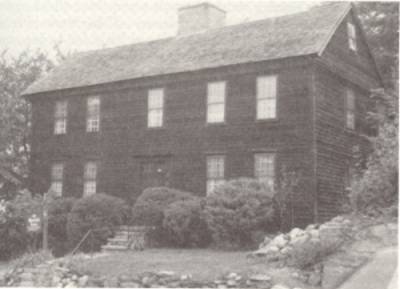
Mansfield was the first rector of St. James Church Derby, Trinity Church in Seymour, and St. Peter's Church in Oxford. Mansfield acted as rector for numerous other churches which were in their infancy.
Richard Mansfield was born in New Haven on October 1, 1724, the son of Jonathan and Sarah (Alling) Mansfield. His father was a deacon in the Congregational Church of that city. His early upbringing was strongly influenced by the Congregational faith, and he was educated to become a Congregational clergyman.
At the age of eleven years, Mansfield had completed studies needed for admission to Yale College but was forced to wait until he was fourteen years of age before entering the school, due to the rules of the college. In 1841, Richard Mansfield graduated with the first honors of his class. For his scholarship, he was awarded a prize which was to lead him away from the Congregational Church to his role as an Episcopalian.
He was awarded a "scholar of the house" premium for entering the best grades on the Greek examination. The award was given through an endowment fund from Bishop Berkeley, an Episcopalian who had provided for a number of gifts to Yale College. The condition to receive the award was for the recipient to spend one or more years at Yale as a graduate student. During the two years which Mansfield spent as a graduate student, he read many of the books which Berkeley had donated to Yale College. This led to his conversion to the Episcopal Church, which was then in its infancy in Connecticut.
For three years after the completion of his studies, Mansfield was employed outside the church. He took charge of Hopkins Grammar School in New Haven. After this time, he resolved to become an Episcopal clergyman.
In those days such a decision was nothing to be taken lightly. Not only was the Congregational Church still the established, state-supported religion, but the Episcopalians faced an extreme difficulty in ordination. As there was no American Bishop in those times, in order to be ordained, a man would have to sail to England - a hazardous and risky venture. Mansfield left for England in 1748, and "it illustrates the degree of Puritan bitterness which prevailed at that time . . . that even his own sister, upon hearing that he had sailed to England to receive ordination from her Bishops, prayed that he might be lost at sea," Beardsley notes in his History of the Church in Connecticut. Upon reaching London, he was ordained Deacon in Kensington Church in London on August 3, 1748 and advanced to the priesthood on August 7, 1748. Mansfield was given an assignment by the Society for the Propagation of the Gospel in Foreign Parts to serve as missionary to Derby and vicinity. This was not an easy assignment, due not only to the large area which his circuit covered, but also to the prevailing situation of the Episcopal Church in Puritan Connecticut.
Connecticut was founded by Puritan influences, who established a state religion in the Congregational Churches. These Puritans had left the mother country, England, so that they might more freely observe their own religion, which differed from the established Church of England. However, upon coming to this country and finding themselves in the majority, they began to practice the same type of oppressive rule of religion by the state which had caused the Puritans to flee England.
"Church and State were as closely united here, at that period, as ever they were in England. The ecclesiastical civil powers were blended together, and liberty of conscience and the theory of human rights existed more in name than in reality. The people were compelled to support the Congregational order, which was the order of faith established by the civil government. Nor was this all. None had liberty to worship publicly in any way, nor could men vote or hold civil office, except in the original Colony of Connecticut, unless they were members of some Congregational Church," Beardsley notes.
It was not until 1708 that the "Act of Toleration," was passed by the Connecticut General Assembly. Under this act, those who soberly dissented from the Congregational order were free from punishment for non-conformity to the church but were not exempt from taxes to pay for the support of the Congregational Churches and the Congregational clergy.
It is against this background which the development of the Episcopal Church, the daughter of the Church of England, must be viewed. The Puritan descendants did not look with favor on the development of the Episcopal Church in Connecticut.
Mansfield's original appointment was a circuit from Waterbury to West Haven, with the center of the circuit in Derby, where he resided.
Mansfield was paid 20 pounds annually for his services to the Derby Church. Other parishes, which were smaller, contributed lesser amounts.
On October 10,1751, Mansfield married Anna Hull, who was then only fifteen years old. The couple lived on Jewett Street, Derby, and in this house the Mansfield's fifteen children were born, a reflection of the early custom of having large families.
It is interesting to note that in those days slaves were kept in this region, and it has been said that the Rev. Mansfield was a slave owner. The Rev. Israel P. Warren wrote in 1874 that Mansfield had a woman named Hagar, who had two sons. One of the sons, Tobiah, was sold by the Rev. Mansfield to Captain Wooster of the area now included in Oxford. Tobiah was a grown man in the service of Wooster at the time of the American Revolution, so it would appear that slaves were owned by Mansfield not too long after his marriage.
Mary Mitchell wrote in 1934 for the New Haven Historical Society, a tract on Slavery in Connecticut, which estimated that in 1755 there were nearly four thousand slaves in the state, with 226 in New Haven County. She said, "Many of the ministers of the New Haven Jurisdiction during this and the succeeding century were slave owners, as were deacons in their churches and other leading citizens . . . It is said that slaves belonging to the ministers were distinguished for their piety . . . As for the ministers it was a fine arrangement. The slaves could do the work on the farms owned by practically all the ministers. Slavery in Connecticut was almost a patriarchal institution, and slaves were generally well treated and often almost as members of the family."
It should be noted in connection to the reference above to the farms of ministers, that Mansfield had nine acres, provided for his use by the Derby parish. With his busy schedule visiting all the families within his large territory, it is not surprising he would have required some sort of assistance in the farming endeavors.
One of the less well known of Mansfield's accomplishments was the introduction of the black walnut tree which was so fashionable in his age. He brought the tree into the Derby area when he returned from his 1748 trip to England for his ordination.
As a clergyman, Mansfield was a tireless worker and reported in 1749, after a year's work in his district that he had in Derby and Waterbury alone one hundred and forty-six communicants, notwithstanding his people had been sharers in the great oppressions arising from the system of taxation." In 1758 the church in Waterbury was taken over by the Rev. James Scovill, due to the continuing increase in the size of that church. At this time the church in Derby and Oxford was receiving many new members.
As the time of the American Revolution approached, the Episcopal clergy faced a new problem - to cope with the sentiments of the Americans seeking liberty. Because of their association with the Church of England, the Episcopal clergy were considered highly suspect by those who supported the American Revolution. Not only were their associations suspect, but the ordination rites of these clergy had included an oath of allegiance to the king. The growing strife between England and her colonies put the Episcopal clergy into a difficult position. A colleague of Mansfield, who went to be ordained in England at about the same time as Mansfield, wrote of the problems a few days prior to the battle at Lexington and told the Society for the Propagation of the Gospel in Foreign Parts, who sponsored the Episcopal missionaries in the colonies, of the difficulties of the time:
"We view with the deepest anxiety, affliction and concern the great dangers we are in, by reason of our unhappy divisions, and the amazing height to which the unfortunate disputes between Great Britain and these remote provinces have arisen, and the baneful influence they have upon the interest of true religion, and the well being of our Church. Our duty as ministers of religion is now attended with peculiar difficulty: faithfully to discharge the duties of our office, and yet carefully to avoid taking any part in these political disputes; as I trust my brethren in this colony have done as much as possible, notwithstanding any representations to our prejudice to the contrary. We can only pray Almighty God, in compassion to our Church and nation, and the well-being of these provinces in particular, to avert these terrible calamities that are the natural result of such an unhappy contest with our parent State, to save us from the horrors of a civil war, and remove all groundless fears and jealousies, and whatsoever else may hinder us from Godly union and concord."
Mansfield, at this time, saw it as his duty to teach the people peaceful submission to the King and the parent country. So successful was he that he reported that out of one hundred and thirty families in his churches at Derby and Oxford, there were one hundred and ten families firmly committed to the King and opposed to the Revolution. From this report, it becomes clear that the Rev. Mansfield had a large following and that his influence was felt throughout the community of the day.
Beardsley writes, "Five or six persons, professors of the Church of England plunged themselves into it (the Revolution), guided, as he thought by the influence of Captain John Holbrook, who 'for many years had entertained a disgust against him and his brethren of the Church, and seemed to have meditated revenge, merely because they did not gratify some private views he had about the place on which to build the Oxford Church"'.
Some of the Connecticut militia collected volunteers from area towns in 1775 to subdue the Tories. They went to Newtown where the Episcopal Rev. John Beach was forced to sign a bond promising not to take up arms against the Revolutionary effort.
"They used greater severity in other places where they visited, and fixed upon the first week in December to disarm the loyalists in Derby, and annihilate their influence. With a view of checking such violent proceedings, a number of his most respectable parishioners waited upon Mr. Mansfield at that critical juncture, and requested him to send to Governor Tryon of New York an account of the sufferings of the Loyalists in Connecticut, and a list of the names of those who were known to be such in his Mission. He complied with their request, and added some suggestions of his own about the manner of reducing the colony to subjection and obedience. The day after his letter was dispatched, a friend, to whom he had communicated the knowledge of it, was seized and carried before the Committee of Inspection, who compelled him to disclose the contests, and thus Mr. Mansfield was criminated in a way that he least expected. To escape outrage, imprisonment, or death, which was meditated against him, he fled from his churches, his family and his home, and found a temporary asylum in the Town of Hempstead, on Long Island. His own narrative of his misfortunes is very touching, especially the part which relates to his domestic affairs. 'At a somewhat advanced stage of life,' said he, 'being fifty-two years old, when I hoped to have spent the remaining years in an agreeable manner, in peace and tranquility with my family, parishioners and friends, and vainly imagined that death only would make any lasting separation, I was forced to flee from home, leaving behind a virtuous, good wife, with one small child newly weaned from the breast; four other children which are small and not of sufficient age to support themselves; and four others which are adults, and all of them overwhelmed with grief, and bathed in tears and but very slenderly provided with the means of support.
What was in this letter which Mansfield sent to Tryon, and suffered so greatly for? Besides the complaints about the treatment being received by the Loyalists, Mansfield said it was his opinion that if the King's troops were present to protect the Royalists, "Several thousand men in the three western counties of the Colony would join him."
Orcutt and Beardsley, in citing Mansfield's troubles during the American Revolution, cite his departure from the colonies, but neglected to convey the contests of the letter which apparently got him into his difficulties. The story of his flight from his parish is given by Orcutt and Beardsley as follows:
"On a Sunday morning while preaching, a guard of American troops marched into his church when the good parson came from his pulpit in 'double quick' and escaping from the sanctuary without his hat, hastened to his home and soon fled to Long Island. . . It is said that his son-in-law (Elijah Humphries) being an officer on a war vessel arrested him in his flight, but it is more probable he became a guarantee for his conduct and obtained the privilege of his return not long after to his home and his pulpit. There is good authority for the statement that his son-in-law obtained the privilege for his brother John to take the place of the guard in the church to see that the devoted Loyalist did not preach against the American cause.
It might be noted that his wife died at the age of 40 on August 29,1776.
After his return to his parishes, with the war still in progress, there continued to be problems for the Episcopalians. Beardsley states, "The clergy could not officiate publicly and use the prayers for the King and the Royal Family according to the Liturgy without exposing themselves to inevitable destruction; and to omit these prayers . . . , was contrary to their oath and views of duty, as well as to the dictates of their own conscience. Therefore, to avoid the evils of this dilemma, at a Convention held in New Haven, July 23rd, 1776, (Mr. Jarvis presiding,) they resolved to suspend the public exercise of their ministerial functions." Norman Litchfield and Sabina Hoyt, in their History of the Town of Oxford, said, "From 1775 to 1778, the old Record book of St. Peter's Church in Oxford contains no word of either parish or vestry meetings, and it may be that during that period, the church was closed."
Litchfield, in his History of Christ Church, Quaker Farms, added a comment about the convention of 1776, and said, "after much deliberation, they devised a form of service which dispensed with the use of the Book of Common Prayer, and which the Convention authorized for use.
Thus the Episcopal parishes in Connecticut operated as best they could during the Revolution and at its close with the victory of the American patriots, had further problems to face. Much of the state's clergy had received financial support from England's Society for the Propagation of the Gospel in Foreign Lands, but this money had ceased during the Revolution, and the parishes were hard-pressed to support themselves. A number of Episcopal families and some clergy fled to the British provinces of Canada. Mansfield was one of ten who remained and met in secret in Woodbury in the last week of March to plan for the future of the Church in Connecticut. The group elected the Rev. Samuel Seabury to become Bishop. For this purpose, Seabury was persuaded to travel to England to seek proper consecration. Through the efforts of Mansfield and the other clergy who remained in Connecticut the tide of migration was stemmed. Mansfield came to be recognized as one of the leaders of the Connecticut Episcopal clergy.
In February, 1787, the clergy met in Wallingford and sought to send someone to Scotland for consecration as co-adjutor Bishop to Seabury. The first choice was the Rev. Leaming who was unable to accept. The second choice was the "guileless and Godly Mansfield," who shrank from the task, pleading his advanced age. Finally the Rev. Abraham Jarvis was elected.
The continuing stature of Mansfield is shown by the action of the Episcopal Convocation held in Newtown, where a College of Doctors of Divinity was established by the Bishop and clergy of Connecticut. Mansfield was one of the first four Doctors named to the council. The council was to serve as the Bishop's council of advice in any emergencies that might arise. Beardsley notes that "Three of the 'first four Doctors,' had the honor confirmed, or rather conferred upon them at later dates, by the corporation of Yale College; and the remaining one, Mr. Dibble, was doctorated by Columbia College, New York."
"Dr Mansfield was obliged to cease preaching some twenty years before his death on account of the failure of his voice. and from that time he could only make the attempt occasionally, when extreme necessity required it. His general health, however, remained unimpaired and his efforts to be useful among his people out of the pulpit was unintermitted till a very late period in his life," notes H. Mansfield in the Mansfield Genealogy.
Despite his vocal limitation, Mansfield continued to be active in Episcopal affairs. In 1803, when he was 79 years of age, he was one of six clergy to urge that each parish be given the right to choose its own Rector and urged that the Rev. Rogers be admitted to the Convention. The effort failed, and the Connecticut Convocation requested the Standing Committee in New York to revoke his ministry, on the grounds that he had presented a certificate signed by the name of Rev. Philo Perry, which had not been written nor signed by him. After a lengthy church review, it was concluded that Rogers had fabricated the document, and he was discredited.
However, Mansfield remained a respected member of the clergy, and in June, 1819, Mansfield presided over the election of the bishop. Beardsley notes, "The venerable Dr. Mansfield, of Derby, verging upon a century, met his brethren for the last time on this occasion and presided over their deliberations." The convention elected the Rev. Thomas C. Brownell as Bishop.
Mansfield died at his home on April 12, 1820 at the age of 96, having seen the church change from a struggling minority, persecuted and despised, to an accepted church in area communities.
-
GENERAL WILLIAM HULL
General William Hull was born in 1753 in Derby. He was educated in the local schools and entered Yale at age 15. He graduated from that institution at age 20 and was elected Captain of a Derby militia company.
He was preparing to join the regiment of Colonel Webb, when his father died, leaving him considerable property. He refused to take any of it, saying "I want only my sword and uniform." He joined the regiment and marched to Cambridge. The following year the regiment took possession of Brooklyn Heights.
Hull was an intimate friend of Captain Nathan Hale. At the personal request of Washington, he was made acting field officer during the Battle of Trenton. Soon after promoted to Major of the 8th Massachusetts regiment, he was also in the Battle of Princeton and was promoted rapidly for bravery and effective service.
In 1776 he was appointed Major General of the Massachusetts militia. In 1805 he was named governor of Michigan, and in 1812 he was assigned to command the Northwestern army.
His surrender of Detroit was greatly censured by the public of his day. There was a court martial which condemned him to death, but the sentence was withdrawn by the President on account of "General Hull's brilliant service during the war of the Revolution.
Hull claimed he was innocent and that the fault lay with the authorities in Washington. Twelve years later he gained access to the papers and records of the War Department in Washington which showed he was a victim of misunderstanding and incompetence in Washington. He published an account of these records and was fully vindicated. He received a late recognition from the government.
-
TORIES AND PATRIOTS - THE WOOSTER FAMILY OF DERBY
About two hundred years ago, when the American colonists and the British were just beginning their long struggle, there was a great division of American sentiment. Especially in this area, there were strong pro-British feelings. These feelings often collided with the patriot fever which was beginning to be felt in this area. This division of belief - this difference in patriotic loyalties - led to many conflicts, even among family members.
The American Revolution did not start as a war for independence. At the beginning of the struggle, most colonists viewed it as an effort to assert their rights as Englishmen. There were few so radical as to call for independence. Most of the men who marched to Lexington and Concord had little thought of national independence, at least at that time. The struggle was viewed as an internal affair among Englishmen. Many of the colonists who participated in the struggle then considered themselves as loyal Englishmen, and most of them thought their differences could be settled without a separation.
It was after many long months of strife and warfare that the idea of proclaiming independence took form. The opening of the hostilities was in April of 1775, and it was not until July, 1796 that the Continental Congress declared American independence. The struggle had begun almost as a family quarrel - the mother country and her colonies not agreeing on the form of their government and the parental rights and duties of England over her colonies. The colonists themselves were not unanimous in their opinions concerning the dispute. While the question was theoretical, and military action was not in progress, the presence of those on the side of the British crown was tolerated. But when the family quarrel turned into a Revolution, the presence of the Tories was not so well accepted by the patriots of the area.
As the differences between the mother country and the colonies broke up a family-type relationship between England and her settlements in the New World, so also the bitterness of the struggle between Tory and Patriot often hurt families in the colonies. One area family which was well known for both its Tories and Patriots was the Wooster family of old Derby.
The Wooster family is common in this area. It was established many years prior to the American Revolution. The Wooster in this area was Edward Wooster, who settled Paugasset (now Derby) in 1654, with three other families. Ever since that time, members of the Wooster family have lived in this area. The first Wooster, Edward, lived in a house on the east side of the Naugatuck River, near the old Episcopal Cemetery at Old Towne, Derby. He married first Elizabeth French and then Tabithia Tomlinson. He was in business of hop raising.
Children by his first wife included Elizabeth, who married Col. Ebeneezer Johnson; Mary, who was the first white child born in Derby; Thomas, who married Phebe Tomlinson; Abraham, who married Mary Walker; Sylvester and Ebeneezer. The father, Edward Wooster, died on July 8, 1689, at the age of 67 years.
Edward's son Abraham married Mary Walker on November 22, 1799. Abraham Wooster became a weaver and settled at Farmill River in Stratford soon after his marriage. About 1719, he moved to the Quaker's Farm area of Oxford. He had several children, including Ruth, Joseph, Abraham, Sarah, Mary, Hannah and David. Of these, his son David became famous as a military man and eventually achieved fame as a Patriot hero. General David Wooster lost his life in the defense of Danbury, Connecticut, when it was attacked by the British in the American Revolution.
Other parts of the family tree were involved in the Tory side of that struggle. Edward's son, Lieutenant Thomas Wooster, was a brother of Abraham and an uncle of David Wooster. Lieutenant Thomas Wooster had six children - one of them was Thomas Wooster, born Feb. 18, 1692. The son Thomas married Sarah Hawkins and they had eight children.
Among his eight children were five brothers, who were Tories. One of them, Captain John Wooster, was born in December, 1719. This Wooster was known as Captain for his role in the local militia and not for service in the colonial armies which were assembled against the British.
Many interesting anecdotes of his life in Oxford have been handed down from generation to generation. He married Eunice Hull on June 18, 1746. He was associated with Captain Bradford Steele (who was a patriot from Seymour), Ebenezer Keenery, and Joseph Hull, Jr. in the first manufacturing business in Seymour. They manufactured scythes and did other blacksmithing business. Previous to the establishment of the blacksmithing business, they set up fulling mill, a sawmill and a grist mill. The land was purchased from the Indians, and the deed was signed by Joseph Chuse and John Howd as chief men of the tribe.
At the time of the American Revolution, Captain John Wooster lived at the corner of Park Road and the Oxford Turnpike, now known as Route 67. He lived in an old house which was on the site now occupied by the home of Mr. Frank Folger and Mrs. Frances Sitar.
The old house was a popular tavern in Oxford, known as the Captain John Wooster Tavern. More or less across the street was another tavern, owned by another brother, Thomas Wooster. In the Captain John Wooster Inn or Tavern several Tory incidents took place, as related in the story of Chauncey Judd.
Before going into the Tory activities of Captain John's little inn, we must digress to include a few interesting anecdotes of Captain John's life. Park Road got its name from one of Captain John Wooster's idiosyncrasies. Captain John owned a special wildlife area in which he alone could hunt deer. It was called "The Park." J.W. Barber wrote in his 1838 "Historical Collections," of the park. He said:
"About one mile and a half south of the center is the 'Park', formerly a place for deer. . . A Mr. Wooster owned and enclosed about one hundred acres of land for the purpose of keeping deer. It is said that he had the exclusive privilege by law of restraining any person from hunting deer in the limits of 'the park'. Upon the outside of part of the enclosure, there was a kind of precipice, from which the deer, when pursued, would sometimes leap into the enclosure, much to the mortification and disappointment of unprivileged hunters."
Another noteworthy aspect of Captain John's life includes his ownership of slaves. He owned several slaves throughout most of his life in Oxford, usually keeping a couple and one or two others to help run the tavern. Slaves were not too unusual in Oxford, but they were generally a possession restricted to the wealthier classes. It seems that the town folks did not take too kindly to Captain John's Tory proclivities, and it may be they resented his wealth. For whatever reason, the townspeople of Derby met at a town meeting in January, 1781. The meeting voted to authorize and direct the selectmen to give Captain John Wooster a certificate to free and emancipate his Negro men, on the condition that they enlist in the state regiment for the term of one year.
In view of the fact that Captain John was known for his British sentiment, it seems hardly likely that he would have willingly given up his slave to have him fight in the Colonial Army. It would appear the townspeople were more eager to have the Negro man serve in that army than Captain Wooster was to have him leave. It may be the home folks decided to take this action because Captain Daniel Holbrook had offered to free his slaves to serve in the state regiment.
Captain John's brothers with Tory interests were Henry Wooster, Sr., who lived about a mile south of Whittimore Tavern in Seymour; Thomas Wooster of Oxford Road; Daniel Wooster of Derby, and David Wooster of the area known as Gunntown, which was at one time part of Oxford and was later included in Naugatuck.
The brothers Henry and David each had a son named after themselves. These two sons, who were cousins, were among the band which took part in the Chauncey Judd kidnapping.
As the reader may perceive, Henry Wooster, Sr., Capt. John Wooster, Thomas Wooster and David Wooster (all brothers) were the sons of General David Wooster's cousin, Thomas Wooster. Shown diagrammatically, the family tree might be represented as such:
Edward Wooster, born in England in 1622, among first settlers of Milford, 1642, and first settler of' Derby in 1654. Among his children were: Abraham Wooster, who came to Stratford in 1667 and was a weaver.
His son was:Lieutenant Thomas Wooster, who married Phebe Tomlinson.
Their son was:General David Wooster, born in 1710. He died a Revolutionary hero at Danbury in 1777, at the age of 66 years. Thomas Wooster, born on Feb. 18, 1692. He was a cousin of General David Wooster. Had eight children, including five tory brothers who were: - Captain John Wooster.
- Henry Wooster, Sr. (His son Henry, Jr.)
- Daniel Wooster
- David Wooster, Sr. (His son David, Jr.)
General David Wooster was born on March 2, 1710-11 to Captain Abraham Wooster and his wife Mary. He was born at Oronoque in Stratford. About 1719, when David would have been eight or nine years old, the family removed to the Quaker Farms area in what is now Oxford. His family occupied a building known as the Mansion House. It was located near Munson's Corners and sold to Samuel Wooster, Jr., with a farm and saw mill, in 1733. At that time David Wooster would have been about twenty-two years of age.
In view of the fact that David Wooster graduated from Yale in 1738, it would appear that most of his life prior to attending the college in New Haven, was spent in the Quaker Farms area in Oxford. The year after he graduated he joined the provincial army. In 1745 he was a captain under Colonel Burr at the capture of Louisburg. Later in the French War, he was commissioned colonel and later brigadier of the colonial militia. After the war he went into business at New Haven.
Wooster also had an opportunity to visit Europe as a result of the French War. He was given the responsibility of a cartel ship bound for France and England. He was not allowed to land in France, but received a friendly reception in England.
He was presented to the King and is said to have been a favorite of the court and of the people. He was given a captaincy in the English regiments, with half pay for life.
Returning to New Haven, he became the Royal Collector of Customs at the Port of New Haven, which provided further income in addition to his captaincy and his merchantile efforts. However, his business began to fail, and he was in financial difficulties at the outbreak of the American Revolution.
He was sixty-five years old when the Revolution got underway. He was appointed Major General of six Connecticut troops in 1775 and recruited from the New Haven County areas. He marched these men to New York and encamped at Harlem. During the summer he also commanded troops on Long Island, whose duties were mainly guarding the livestock.
There was some trouble concerning promotions by the Continental Congress when it began to commission Generals. Wooster was named a brigadier General and some of his junior officers were given a higher rank. He was especially upset by the appointment given to Israel Putnam, whose activities in Boston had helped earn him public recognition. Wooster bitterly resented the promotion of Putnam above him, and he appealed to Connecticut's Governor Jonathan Trumbull. The governor was either unwilling or unable to intercede on Wooster's behalf with General Washington.
Wooster was ordered into Canada in September, 1775 and saw service in Montreal as military governor and was in charge of supply. There Wooster was a party to a variety of bickerings among the command of the Americans. Some historians believe the operation was doomed to failure anyway because it was begun too late in the season, was uncoordinated and without adequate men, munitions and money. Wooster was eventually relieved from his command, and a Congressional investigation followed. The investigation completely exonerated Wooster, but he was never again given a Continental command.
However, Wooster's popularity remained in Connecticut, and he held the rank of General in the state militia and was charged to defend the borders of the state. He was at his home in New Haven in April, 1777 when raiders attacked Danbury. Wooster and General Benedict Arnold - who was still one of the "good guys" in the American service at that time - went to Danbury.
The following is excerpted from an article published in the April 1777 Connecticut Journal:
"On Friday, the 25th instant, twenty six sail of the enemy's ships appeared off Norwalk Islands . . . . by 10 o'clock they had landed two brigades, consisting of upwards of two thousand men, and marched immediately for Danbury.... The handful of Continental Troops were obliged to evacuate the town, having previously secured a part of the stores, provisions, &c. The enemy on their arrival began burning and destroying the stores, houses, provisions &c. On the appearance of the enemy, the country was alarmed. . .. General Wooster and about four hundred were detached under General Arnold and General Silliman on the road leading to Norwalk. At 9 o'clock A.M. intelligence was received that the enemy had taken the road leading to Norwalk. General Wooster was advised and pursued them, with whom he came up about 11 o'clock, when a smart skirmishing ensued, in which General Wooster, who behaved with great intrepidity, unfortunately received a wound by a musket ball, thro' the groin, which it is feared will prove mortal ...
"The enemy's loss is judged to be more than double our number, and about 20 prisoners. The enemy on this occasion behaved with their usual barbarity, wantonly and cruelly murdering the wounded prisoners who fell into their hands, and plundering the inhabitants burning and destroying everything in their way ...
Wooster died in Danbury on May 2nd, and was laid to rest in a local cemetery. Following his death, Congress voted funds for a monument to the general, but this was never built. A monument was eventually built by the Hiram Lodge in 1854.
Wooster is considered the "Father of Freemasonry in Connecticut," for his role in establishing the first masonic lodge in Connecticut in 1750. Wooster was master of that lodge for a number of years.
North Callahan, writing in Connecticut's Revolutionary War Leaders, is especially harsh in his judgment of Wooster. He states, "The Dictionary of American Biography quotes two authorities as characterizing Wooster as 'A general of a hayfield,' and stating that he was 'dull and uninspired, garrulous about his thirty years of service ... tactless, hearty rather than firm with his undisciplined troops who adored him, at times brutal toward the civilian population of Montreal.' True, he seemed to have much sickness among his soldiers, which doubtless did not help matters."
He was a man on the verge of bankruptcy when he was killed at Danbury. There is good reason to view him as a man who had nearly outlived his usefulness and was about to loose his social and economic standing - but was transformed into a Revolutionary hero with the loss of his life at Danbury.
THE CHAUNCEY JUDD KIDNAPPING, AND THE WOOSTER TORIES
The story of Chauncey Judd was detailed in the book Chauncey Judd, or A Boy Stolen, by Israel Warren. He based his book on accounts given to him by the sister of the boy who was kidnapped, others who were involved in the escapade, and public records. It presents a full book length story of the incident. A good summary of the tale is found in William C. Sharpe's history, Seymour Past and Present. The following account is quoted from that source:
"The Whittemore Tavern was the place where the great robbery was planned by a British officer in March, 1780. At that time two strangers came to remain over night, and soon they were in conversation with a company of young men who frequented the place during the long winter evenings. The name of one stranger was Alexander Graham, who had a commission from General Howe to enlist soldiers for the British army. He was a leader in the robbery of the house of Capt. Ebenezer Dayton, a brave American patriot who had carried on privateering against the enemy on Long Island Sound. At this time Dayton lived in Bethany six miles away from the tavern mentioned.... Graham succeeded snaring several young men into the plan to rob the captain, on the ground that it would be paying him in his own coin; he robbed the British, and the British officer Graham was going to return the compliment.
"But it was a sad beginning for all concerned as will be seen. The young men had relatives in Gunntown, a district west of Naugatuck, who were also drawn into the scheme., making a company of about eight. On a bright moonlight night they went to Bethany, and as it happened, Capt. Dayton was in Boston and other occupants of the house had moved out the day before, leaving only Mrs. Dayton, the children and servants, which made the task more simple and free from bloodshed. After ransacking the house, they carried off 450 pounds in gold and silver, and large bundles of silk goods.
"Making all secure, and leaving the family and servants bound, they hastened away to their acquaintances in Gunntown, meeting on the way a young man about 16 years of age who had been home with a young lady, the night before, though the hour of meeting was 3 o'clock in the morning. This was Chauncey Judd, who knew the party.
"This meeting was another sad incident in the affair, and Graham sought several times to kill the innocent youth, that he might not betray him. But his friends each time succeeded in deferring the deed. After hiding, undergoing many vicissitudes
and having many narrow escapes from the pursuing officers and vigilance committee, they hid in a barn in a meadow opposite the Staples Washburn place... on the Oxford Road, to wait for the passing of a severe snow storm. Almost famishing they failed to get provisions at Captain John Wooster's, . . . they started through the deep snow in the night over Great Hill with a view to go to Derby, and from thence escape in a boat to Long Island. Captain Bradford Steele pursued on horseback, but the robbers avoided the road and escaped in a whale boat a little in advance of them.
"Hoping to overtake them before they got to the Sound, they found them, but failed in this on account of the width of the river near its mouth at Stratford. However, an old sea captain went into the belfry of the church in Stratford, and watched their course to Brookhaven, where lived a noted tory. This being ascertained, a party of thirty patriots gathered at Derby in two whaleboats, and being well armed rowed down the river and across the Sound, captured all the robbers but one, all being found in deep sleep. Graham knew he would have no mercy. Being handed over to the army after returning to Derby, he was tried, found guilty of treason, having deserted the American cause, and was executed in Morristown. Chauncey Judd, broken down and exhausted, was found in the company with the robbers, and was tenderly cared for by his brothers. The other young men and their helpers were yet to suffer.
"Two were allowed to turn state's evidence; the others suffered fines, or imprisonment, or both. They were sentences to four years' imprisonment in the Newgate state prison. Those persons who aided them were also fined
The young men who met with Graham in the Whittemore Tavern included Henry Wooster, Jr. and David Wooster, Jr. - both nephews of Capt. John Wooster. These young men went with Graham to the robbery of the Dayton house, and were part of the band which sought to escape from the Patriot Pursuers. It was these Wooster cousins who succeeded in preventing Graham from murdering Judd.
One of the places they stopped in their flight was the home of David Wooster, Sr., in Gunntown. At this place the young Judd boy was placed in a cellar well room, where he was hidden, while the band considered how best to deal with the lad.
Fleeing from Gunntown, they hid in Dayton's Den - a rocky area with a natural cleft in which the men hid during one part of their adventure. From there they went down Riggs Street to the main road in Oxford.
They stopped at the Captain John Wooster Tavern. Captain John expressed strong displeasure with the activities of his nephews. He did not argue against the project on matters of principle, but felt that although the project was worthy, it was too risky for his family to be involved. However, he did consent to allow the band to hide in his tavern for the evening. He also aided the group by deceiving those patriot groups which were seeking to find the band.
When the group finally had to leave the Captain John Wooster Tavern, they fled to a barn, which was owned by Captain John's brother, Daniel Wooster. This is the barn which is described as across the street from the Washband place in the Sharpe story.
For their part in the kidnapping they received the following sentences:
Henry Wooster, Jr., fined 500 pounds, sentenced to four years at Newgate Prison; David Wooster, Sr., fined 500 pounds, 9 months in Hartford jail, in addition to heavy damage costs to the Judd family which ruined him financially and caused his homestead to be attached and confiscated by the state; Henry Wooster, Sr., who was not punished and was judged innocent of any part in the scheme; David Wooster, Jr., who was fined 500 pounds, four years sentence at Newgate; Captain John Wooster, was acquitted in a suit brought against him for dangers by Captain Dayton for harboring and concealing robbers; Daniel Wooster, whose barn had been used as a hiding place was not prosecuted, as he played no active role in the plot and apparently did not know the youths and robbers were hiding there.
AFTER NEWGATE IMPRISONMENT... THE WOOSTER TORIES FREE
After the Wooster tories were sentenced to Newgate, they continued to lead an exciting career, with Henry Wooster, Jr. succeeding in an escape from that place. Henry had been able to remove the fetters from his hands at night, and he spent his nights exploring the caverns and tunnels of the
old prison mines. Each morning he would replace the fetters and be checked by the prison guards. Each night he would work on his escape plans. He worked at picking bits of mortar around iron bars which were at the end of a narrow drainage channel. After weeks of hard labor, he was ready to flee. He had a narrow escape. He got into the narrow channel and could not get back into the prison, but was unable to get out the drainage channel. He worked for some time with his feet and finally pushed the stone which was impeding his progress. When all was ready, he and a few others escaped. For some reason David Wooster did not join his cousin Henry in the exploit.
About a year later David Wooster, Jr. petitioned the State Legislature for his freedom. It was granted because he had served two of his four year sentence, and he had agreed to enlist as a soldier in the Continental army, as a condition for his freedom. He was released, and he eventually returned home. The estate of his father had been placed in the care of the town of Waterbury. After the war it was restored to the family, and young David remained in the area and raised several sons: One of them became a Methodist minister and another a local magistrate.
THE RETURN OF THE LAST WOOSTER:
An interesting account of the return of the last Wooster is given in Israel Warren's book. As his volume is out of print, and not generally available, we quote this passage from that book in full:
"Four years after the termination of the war, a traveler, one day in the dusk of the evening, came to the house of Henry Wooster, Sr., in Derby, and asked permission to lodge for the night. He was weary and footsore, he said, and could go no farther. Hospitality in such cases was a habit of New England, and his request was granted. Mrs. Wooster was then engaged in preparing a kettle of hasty pudding for the family supper, and at her invitation the traveler partook of the repast.
"In the course of it he contrived to turn the conversation upon the subject of her own family, and especially of her absent son. She recounted with a mother's partiality his amiable qualities, his manly agility and strength. Won by the interest he seemed in her story, she bewailed the sad occasion of his falling in with a stranger, who had persuaded him to go off on a mad undertaking of revenge on a piratical Yankee captain, in consequence of which he got into prison. After a while he broke out with others, since which she had heard nothing from him, and presumed he must be dead.
"At length he had sufficiently drawn forth these reminiscences of the good woman, the traveler assumed his natural speech and manner, and announced himself as her missing son. At first she was incredulous, and unable to recognize him, till opening the bosom of his shirt, he showed her a mole on his breast. This well remembered mark convinced her of his identity. She fell on his neck, and like the father of the prodigal, wept tears of joy over her long lost boy.
-
COMMODORE ISAAC HULL
Isaac Hull was born March 9, 1773 in the Town of Derby, the son of Joseph and Sarah Bennett Hull. When he reached the age of ten, his father sent the boy to stay with his uncle, General William Hull. Under that arrangement, young Isaac could have more than the two months of education given in the wintertime in Derby.
Hull remained with his uncle for a year in Newton, Massachusetts. Then he went to sea, becoming a ship's boy on a packet going from New Haven harbor to the West Indies.
Once during one of his voyages, he saved the life of his captain and survived a shipwreck.
At the age of 18, he returned to Boston to study navigation. By 1796 Hull was captain of a privately owned merchant ship. On one of his voyages, his ship was captured by a French privateer. His ship was sent to France, and Hull was held prisoner. A British ship rescued him when it captured the privateers' ship. Hull was landed, without a ship or any money at the Port of Martinique.
He was captured a second time by the French and imprisoned in Puerto Rico. He finally was released to a mercy ship from New England. When he was rescued, Hull learned that his employer had failed in business, leaving him destitute again.
On one of his later trips, Hull contacted yellow fever and was returned to Derby, where he stayed all the winter.
On March 13, 1798, Hull was given a commission by President John Adams as Lieutenant in the United States Navy. He was assigned to the frigate, the "Constitution." He reported to Hartt's Naval Yard where the ship was launched October 21, 1797. He began her first cruise in the early summer of the following year.
In 1801 Hull was assigned to the "Adams," a 28 gun frigate. Hull thought that he would take command of the ship when the captain resigned, but someone else was appointed instead.
Hull was unhappy and wrote to the Secretary of the Navy a letter of resignation. A reply was received asking for his cooperation. Hull reconsidered his resignation and continued to serve aboard the "Adams" as Lieutenant.
In 1803 Hull was put in command of the ship "Argus" which was bound for combat against the Barbary pirates. He returned home after the peace was made to learn he had been promoted to captain. Hull and his ship docked in the Potomac, where he was host for a visit by President Jefferson and his cabinet officials.
Hull was subsequently appointed to sit on a Naval Court of Inquiry for the Chesapeake Affair and several other incidents.
In December, 1807, the Embargo Act was passed, prohibiting the sailing of merchant vessel from an American port. This was repealed two years later and replaced by the Non-Intercourse Law, which prohibited English and French ships from entering American ports.
The Embargo Act was sharply condemned in Derby and Shelton, because much of the business fortunes of the community were tied up in shipping. Joseph Hull, father of Isaac Hull, was among the local merchants who suffered large business losses as a result of these laws.
In 1809, Hull went to Boston and asked for a command. He was named to supervise the repair of the "Chesapeake." In the spring he was assigned commander of the "U.S.S. President."
The following year Hull was given command of the "Constitution," the ship which became so famous as a result of Hull's exploits.
Hull sailed the "Constitution" to Europe to pay $220,000 in Spanish dollars on the Dutch debt. Cherbourg, the French port, was blockaded by England, but Hull arrived safely. Ten days later he sailed for Holland where the money was delivered.
On his return trip his ship was fired upon by the British brig, the "Redpole." The British sent an officer aboard to apologize.
He had another experience with English ships on that voyage. A seaman swam from an English ship to the "Constitution." He sought sanctuary on the American ship as an American citizen who had been impressed by the British navy. Hull refused to surrender the seaman, and the British ship left without incident.
War was declared against the British on June 13, 1812, for the continued practice of impressing American seamen and for Britain's support of Indian attacks on the western frontier.
The war was unpopular in New England, but Hull took an active part in the campaigns. In June, Hull and the "Constitution" set sail from New York with a crew of 430 officers and men. They went to the Virginia Capes from Annapolis.
On June 16th, the morning mist cleared and Hull found he had met a British flotilla. Hull knew his only hope was to flee. If that failed, he was determined to make a fight of it. Shots were fired by the British ship "Shannon," but no damage was done to the "Constitution." Two days later, a British ship signaled the main body of British ships in the area, but there was no answer. The British commander then thought they were an American squadron, so he turned away from the "Constitution." This error gave Hull the opportunity for escape. The chase continued for 60 hours with the British holding their position.
By the end of the third day, a rain squall concealed the whole ocean. Just before it hit the ship, Hull had his men take in the upper sails. Then he ordered his sails doublereefed, to appear as if caught in a gale of wind. The British ships quickly imitated the "Constitution" to avoid being swept by the wind. Hidden in the rain and the coming dusk, Hull set her sails again and sailed to safety in Boston Harbor.
New Englanders praised Hull for his seamanship and cleverness in deceiving the British fleet.
Hull awaited orders for his next mission, but no orders were forthcoming. Hull decided to put to sea without orders, as he feared a British blockade of Boston harbor. He left on August 2 and sailed to the Gulf of St. Lawrence where he captured and burned two British brigs. He then recaptured an American ship which had been taken by the English. Hull ordered the ship into Boston.
Hull learned a British ship had been seen in the area. The following day Hull located the British ship the "Guerriere," under the command of Dacres.
The two ships maneuvered for position. The "Guerriere" opened fire about 5 p.m. without drawing any fire in return. The ships came closer and closer. The British shot bounced harmlessly off the "Constitution's" sides, from which she was given the nickname "Old Ironsides."
Three times the lieutenant asked Hull for orders to fire, but each time Hull refused. Shots killed and wounded some of the "Constitution's" crew. Finally an hour after the first shot was fired, Hull gave the order to fire at the ship which was only 50 yards away. At 6:30 the mizzenmast of the British ship collapsed. The "Constitution" continued its firing. The British made an attempt to board the "Constitution," but they were driven back with musket fire. The ships sailed apart with the "Guerriere's" mainmast and foremast falling away. At 7 p.m. she struck her colors and surrendered.
Dacres was taken aboard the Constitution" for the surrender, with his British crew of 272 men. The British ship was set afire and blown up.
On August 30, Hull sent his report to the Secretary of the Navy. He was received in Boston harbor with a demonstration of support. An entertainment was held for Hull and his officers. The Congress of the United States, and many other legislative bodies, voted thanks to Hull.
In the Town of Derby, residents expressed their approval at a town meeting held on April 12, 1812. Col. David Humphreys introduced a resolution of tribute which was unanimously adopted. It read in part;
"Resolved, that Isaac Hull, Esquire, a native of this town, captain in Navy of the United States and lately Commander of their frigate, 'Constitution,' with the aid of his gallant officers and ships' company and the smiles of Providence, having led the van in the career of our naval glory by capturing his Britannic Majesty's frigate 'Guerriere' commanded by Captain Dacres, has in our opinion deserved well of his country and is an ornament to the place of his nativity ...
"Resolved, that joining cordially in the universal applause bestowed by our countrymen on Hull, Jones, Decatur, Bainbridge and Lawrence and their brave and skillful associates in perils and triumphs for their glorious naval achievements, we judge we have a right in our corporate capacity without showing an undue partiality to the first mentioned officer or stepping aside from our municipal duties, to notice more particularly his exemplary merits from better opportunities of being acquainted with them.
"Therefore, voted that Isaac Hull, Esquire, being already constitutionally entitled to the freedom of this Corporation, the thanks of this Town be presented to him in a Box made of heart of Oak, the congenial growth of his native hills."
Hull also received a Congressional Medal.
On January 2, 1813, Hull married Ann McCurdy Hart of Saybrook, Connecticut. They spent their honeymoon in Boston. On March 15, Hull took charge of the Charlestown Navy Yard. He was later transferred to Portsmouth, New Hampshire where the country's largest warship was being built.
In 1815 he was named a member of the new Board of Naval Commissioners to advise the Secretary of the Navy in technical matters. He served two years, then resigned in favor of sea duty.
In 1824 Hull was appointed Commander in Chief of the U.S. Naval fleet in the Pacific and raised to the status of Commodore. He served at Calba Bay for two years and then resigned his position. Hull and his wife stayed in New Haven while waiting for his next assignment.
At that time the "Constitution" was scheduled for scrapping. Oliver Wendell Holmes wrote a poem which appeared in the Boston newspapers. This created such a patriotic disposition the Navy Department backed down. Plans were made for the complete restoration of the ship, and Hull was placed in charge of repairs.
In 1835, Mrs. Hull suffered with a health problem The Hulls spent a year abroad visiting various countries.
When he returned he was made chairman of the Board of Naval Revision. He later became Commander-In-Chief of the U.S. Naval Forces in the Mediterranean. He served for four years and then applied for a leave of absence for failing health. He spent the spring and summer in New Haven, then purchased a home in Philadelphia. At the expiration of one year, Hull was offered another assignment, but he was too ill to serve. He died February 12,1843. He was buried in Laurel Hill Cemetery, Philadelphia with honors suited for a national hero.
-
DAVID HUMPHREYS
David Humphreys was a close personal friend of General George Washington. He was born on July 10, 1752 in Derby (Now Ansonia). He was the son of the Rev. Daniel and Sarah Riggs Bowers Humphreys, the youngest of five children. His father was a graduate of Yale. His mother was called "Lady Humphreys," and was known for elegance in personal appearance.
As a boy, David was greatly interested in books. His father prepared him for college. He entered Yale at age 15, and he graduated in 1771 with honors.
He became principal of a public school in Wethersfield for two years. Humphreys then took up the private tutorage of the younger children of Frederick Phillipse in Yonkers, New York.
In 1774 Humphreys returned to New Haven, earning his Master of Arts degree at Yale. He refused an offer to teach at Yale, choosing instead to instruct a private school in New Haven run by his brother Daniel Humphreys.
After the American Revolution broke out, Humphreys enlisted as a volunteer in the Second Connecticut Regiment, a group of Derby men. The regiment served under Washington's army in New York, having been called after the loss of the Battle of Long Island.
In April of 1777, Humphreys served under General David Wooster in the battle at Danbury, where Wooster was killed. Humphreys took part in a retaliatory raid on the British ships at Sag Harbor. The expedition surprised the British and captured 13 ships, many supplies and 90 prisoners without the loss of a single man.
Humphreys was promoted to the rank of lieutenant colonel. Serving three years on the staff of General Parsons and Israel Putnam, Humphreys made a distinguished record.
In 1781, Connecticut's black soldiers were brought together under one company in Colonel Butler's regiment. This regiment served under the nominal command of Humphreys.
Humphreys was one of the first men in the country to recognize the value of the Negro as a soldier. By his influence and that of his faithful body servant, Jethro Martin, among people of his own race, much enthusiasm was generated for the Revolution among the blacks of Connecticut, who were usually household servants.
On June 23,1781, Humphreys was made aide-de-camp of Washington's headquarters, where he became a confidential friend and advisor to General Washington.
Humphreys planned a kidnapping expedition to New York to capture either General Henry Clinton or General Knyphausen of the Hessians. With Humphreys in command, a group set sail in a barge and two whaleboats on Christmas night in 1781. Due to high winds and heavy current, the boats were driven off course. They finally made their way to Brunswick, New Jersey and returned to camp unsuccessful.
Humphreys was at the surrender at Yorktown and was chosen by Washington to represent the army to the Congress. Washington prepared a report and gave it to Humphreys with the flags of the surrendered British and Hessian troops.
Congress showed their appreciation of Humphreys' services by voting to present him with an elegant sword. The sword was presented to Humphreys in 1876 by General Knox. Congress also voted Humphreys a promotion to the rank of Lieutenant Colonel, retroactive to his appointment as an aide to Washington.
Following the signing of the Treaty of Peace in Paris, Humphreys went to Mount Vernon with General and Mrs. Washington. He offered his services to the Congress and was appointed Secretary of a commission to negotiate treaties of commerce with European countries.
In 1786 Humphreys was elected to attend the October session of the state legislature as Derby's representative. Following that time, he was re-elected to that position regularly.
The General Assembly voted to form a militia to combat Indian warfare on the western frontier. Humphreys was elected commander. The unit was pressed into service at the time of Shay's Rebellion in Massachusetts. Humphreys marched his men to West Springfield, only to find that the state government and the militia had put down the rebellion.
The year 1787 marked the end of his stay at the parsonage in Derby as both his parents died in that year. At Washington's invitation he then made Mount Vernon his home, acting as Washington's secretary.
Following the acceptance of the new Federal Constitution, Washington was elected president. He appointed Humphreys as his personal representative in Europe. Humphreys was the first minister to a foreign government appointed under the new Constitution.
Humphreys served as a diplomat in Madrid and returned to Connecticut in 1802. He and his new wife (the English lady, Ann Frances Bulkely) bought a magnificent home on Beacon Hill, Boston, and began making plans for a manufacturing village in Derby.
On December 13, 1803 he purchased from Bradley Steele Jr. and George Steele land located at Rimmons Falls in what is now the Town of Seymour.
Humphreys imported Merino sheep and began what was to become the first large and successful woolen mill in the country. The story of the Merino sheep and the industrial developments it brought is found in another chapter in this book.
In addition to his business interests, Humphreys was a gifted writer. He carried on a regular correspondence with George Washington which is now in the Library of Congress. He wrote a history book on the life of General Israel Putnam, although his main claim to fame rested with his poetry. He was considered one of the "Connecticut Wits." This group included Joel Barlow, Timothy Dwight, John Trumbull and Lemuel Hopkins. Their writings influenced acceptance of the Federal Constitution in Connecticut.
Humphreys was a member of the Society of the Cincinnati, an organization of officers from the American Revolution. This society was forced to dissolve due to opposition which regarded it as "originating in motives of ambition and intended to imitate the privileged orders of Europe." Humphreys pleaded that the purpose of the organization was charitable - to support widows and orphans of officers who were in need and to aid officers who were unable to make a successful adjustment to civilian life.
At a visit to the village of Humphreysville in 1818, Humphreys suffered his first serious illness - diagnosed as an attack of dropsy of the heart. He died on February 21st. His funeral was held in New Haven with burial in the Grove Street Cemetery.
-
THE MERINO SHEEP AND VALLEY INDUSTRY
David Humphreys is popularly credited with being the first to import Merino sheep into this country. While that is apparently not precisely correct, he was the first successful importer of that breed. His mills at Humphreysville (later Seymour) became famous for the excellence of its work, and his factories were cited as models for the concern which Humphreys exhibited for his employees.
Merino sheep are raised for their wool. Each fleece weigh between 15 to 20 pounds. This fleece can measure up to six inches long across the back and side of the sheep. The importation of these sheep led to the industrialization of Seymour.
While Colonel Humphreys was in Madrid he wrote to an old friend, Dr. Timothy Davis, and asked him to find a good location for a farm. It was the intention of Humphreys to import Merino sheep to Connecticut to establish a farm for himself and to encourage other American farmers to improve their abilities to provide the necessities of the new nation. Humphreys purchased a flock of twenty-five rams (males) and seventy-five ewes (females) from one to two years old. With special permission from the Spanish government and with a small escort of Portuguese soldiers, the flock was driven across Spain and Portugal to Lisbon, where on April 10, 1802, they were boarded on the ship Perseverance, bound to New York. The journey lasted nearly fifty days, with a loss of four rams and five ewes.
In New York, his sheep were transferred to a sloop bound for Derby, where their arrival created a great excitement. It is said that farmers from near and far came to Derby to view the sheep, who were housed at a place known as "Squabble Hole," where they recovered from their voyage. Humphreys is said to have enjoyed talking with the farmers who came to see the flock, and as interest in the Merinos spread, the Colonel agreed to sell some of the sheep. It is a tradition that the sheep were sold below Humphreys' original cost, at $100 each, to those progressive farmers who were anxious to try the experiments in breeding and feeding suggested by Humphreys.
As interest in the breed mounted, prices reached four hundred dollars, when Colonel Humphreys refused to sell, as he was opposed to speculation in the breed. It is reported, however, that prices eventually ran as high as two thousand dollars for a Humphreys merino ram.
The question as to whether these merinos were the first imported to the United States has been raised, as many area persons maintain that Humphreys was the first. However, it appears that Humphreys was wrong when he assumed that his were the first to reach America.
From the book, The Life and Times of David Humphreys, Soldier, Statesman, Poet, "Beloved of Washington," by Frank Landon Humphreys, comes the following paragraphs:
"The honour of bringing into the United States the first merino sheep is a question that has been much discussed. Colonel Humphreys thought that he could claim that distinction, for in writing to Dr. Dexter he says: 'Convinced that this race of sheep of which, I believe, not one has been brought to the United States, until the importation by myself, might be introduced with great benefit to our country.
"Those who have thoroughly investigated the claims made for various persons, state positively that the first importation from Spain was by the Hon. William Porter, of Boston, in 1798. It consisted of two ewes and one ram. They were brought from Spain in the ship Bald Eagle, by Captain Atkins. Mr. Porter gave them to Mr. Andrew Dragrie, of Cambridge. He was unaware of their value and killed them and ate them for mutton. It is said that he afterward paid one thousand dollars for a merino ram of the Humphreys flock."
As a result of earlier importations, the Massachusetts Society for Promoting Agriculture awarded a premium of fifty dollars to Seth Adams of Ohio, for the importation in 1801 of a pair of Merinos, as the first person to bring a superior breed of sheep into Massachusetts. However, they at the same time issued a gold medal to Humphreys, "for his patriotic exertions in introducing into New England one hundred of the Spanish merino breed of sheep."
THE MERINO SHEEP-AN IMPROVEMENT IN WOOL PRODUCTION
The merino breed is what is known as a 'fine wool type" sheep - which means it belongs to a group of breeds which have individual fibers of wool which are much finer and smaller in diameter than other groups of sheep. In addition, there is a greater amount of wool per sheep in this group. Yet, despite these advantages, there are relatively few sheep of this type in New England today. Although these sheep are rugged and can live under unfavorable climatic conditions, while producing a highly desirable fleece, they lack the meat-type confirmation necessary for marketing meat.
While wool from the merino is far superior to that of other breeds, the income from wool accounts for only 25 to 40 per cent of a sheep farmer's income, depending on the breed.
The rest of the income is from mutton, which the other dual purpose breeds provide in greater quantities.
The national average consumption of lamb and mutton is 4 1/2 pounds per person. But some northeastern states have an annual consumption rate of as high as 12 pounds per person. Because of this heavy regional demand for lamb and mutton, the dual purpose breeds have taken over the New England farm region.
It is only with the development of a specialized market for merino wool, for the use of hobbists who are reviving the arts of Spinning and looming that the merino is competitive with the meat-type breeds in this area.
IMPROVED AGRICULTURE LEADS TO NEW INDUSTRY
With the introduction of the improved sheep breed in the area, the farmers of the Valley region provided a large quantity of high quality fleece. Colonel Humphreys was not satisfied to have simply started an improved agriculture - he put his efforts into developing a woolen industry. Humphreys explained his desire to start the industry was both for the benefit of the area farmers and for the young nation, who up until that time had been dependent on foreign nations for its wool supplies.
The date for the establishment of Humphreys' mill has been variously set - but historians generally place the date at between 1808 and 1810. Perhaps the use of two different names for Humphreys' enterprises has added to the confusion of historians on this matter. The business at Humphreysville was originally carried under the name of "T. Vose and Company." Vose had married a niece of Colonel Humphreys. The Colonel provided all the capital for the project and shared with several nephews the profits. In 1810 the partnership was dissolved and by an act of the Legislature a corporation, The Humphreysville Manufacturing Company, was formed with the same partners.
Mrs. Ann S. Stephens, a well-known writer in her day, was the daughter of the plant superintendent - John Winterbotham. She wrote of the Colonel as follows:
"Colonel Humphreys took great interest in the discipline and education of the apprentice boys attached to the factory. Seventy-three of these boys were indentured, I have been
told, at the same time, from the New York almshouse, and others from neighboring villages.
"For these he established evening and Sunday schools, with competent teachers; and indulged his military taste by uniforming them at no light expense as a militia company, drilling them himself. . . . Colonel Humphreys did not forget the literary propensities that had mated him with Trumbull and Barlow in Yale College. He wrote a great deal for the benefit and amusement of the operatives; and the Christmas holidays were frequently celebrated with private theatricals where an original play, of which he was the author, would be performed by the most talented work-people, and he more than once took a prominent part in them."
Humphreys was so taken with his military company of his apprentice boys, that he had an embroidered blue silk banner as their emblem. The flag showed the coat of arms of the State of Connecticut with merino sheep supporting the shield.
THE WOOLEN MILL IN SEYMOUR PROVIDES BASIS FOR INDUSTRIAL GROWTH IN OXFORD
One of the many apprentice boys who settled in the area was Samuel Wire, who established a mill of his own. In November, 1814, he purchased from John W. Wooster a clothiers shop and fulling mill.
According to William C. Sharpe in Oxford Sketches, Part II, "Captain Wire carried on the business there for about thirty years. The wool from sheep on the surrounding farms was brought to the mill to be carded and spun. Many paid for these two processes and then took the yarn home to knit into stockings and mittens, etc., or to be woven on hand looms. Much cloth was, however, manufactured at the mill, principally satinet, which was generally shipped to commission merchants in New York, but was also retailed to the people in the vicinity of the mill."
Another apprentice who settled in Oxford was Isaac Rowe, who purchased the mill at Quaker Farms from the estate of Squire David Tomlinson.
While these and other mills which followed added to the industrial development of the area, many of those who operated the mills made other important contributions to the communities in the field of public service. Samuel Wire represented Oxford in the Connecticut General Assembly for a number of years. He later moved to New Haven, where he held the office of city Sheriff until the time of his death.
SHEEP INDUSTRY AND WOOLEN MILLS SUFFER DECLINE IN LATE 1870'S
Although the area towns enjoyed a period of great prosperity due largely to Colonel Humphreys' introduction of merinos, the good times did not last forever. In the 1870's sheep breeders all over the state began to suffer from sheep kills inflicted by wandering dogs. In Oxford, the 1876 Selectmen's Report noted that $753.50 was paid to farmers who had sheep killed by dogs, and said, "the amount paid for sheep killed by dogs has been larger than ever before known, and if some means cannot be found to prevent such wholesale destruction, sheep culture will be destroyed entirely in our farming towns as neighboring towns are suffering as heavily as we." As economic conditions changed, and with the development of power other than water power, the mills of the area were gradually closed down. With their demise a period of unprecedented prosperity drew to a close.
-
CAPTAIN JOHN HOLBROOK OF GREAT HILL
Captain John Holbrook was an early Valley leader in the local efforts towards American independence. Although many of the rich and Anglican Church members were loyalists, Captain Holbrook broke with others of his class and supported the revolutionary cause. He contributed his time and leadership to local committees and sent four of his sons into the battlefields.
John Holbrook was born August 12, 1726, the only son of John and Abigail (Gunn) Holbrook. As a man he lived on Great Hill in a house which his father built between 1740 and 1745.
His title of captain came from his rank in the local militia of Derby.
He was married first to Esther Nichols, daughter of Nathaniel and Ann (Booth) Nichols of Newtown. His second marriage was to Abigail Beers, widow of Noah Tomlinson. With his two successive wives, he had a total of fourteen children. Of these, only eight survived childhood and became adults.
As early as 1774, the old Town of Derby was supporting the cause of the American Revolution. On November 29, of that year, a special town meeting was held to consider the "doings of the Reputable Continental Congress held at Philadelphia, September 5th 1774." The townspeople agreed that the proposal put forward by Congress was a wise and judicious plan." A special committee was appointed to take action on the proposal. Captain John Holbrook was a member of this committee. It was further provided that if a county Congress should be agreed upon in New Haven County, then the committee would appoint two members of the committee to attend the Congress. A county Congress was never called, and no further action was taken.
In 1775, a special "Committee of Inspection" was formed at a special town meeting held on December 11th. This committee was appointed seven months prior to the Declaration of Independence. The committee was to watch the activities of suspected Tories or Loyalists and limit their travel throughout the area, so as to prevent their giving aid to the King's troops. John Holbrook was appointed to this committee which he served throughout the war.
With the outbreak of Revolutionary hostilities, Holbrook became dissatisfied with the Derby Anglican (Episcopal) Church which was then under the leadership of the Rev. Richard Mansfield - Holbrook was opposed to Mansfield's preaching of submission to the King. This caused him to break from the church which his father had founded. Holbrook joined the Congregational Church in Derby and kept his membership there until 1779.
The Rev. Mansfield attributed his departure from the church to support the Revolution as "guided. .. by the influence of Captain John Holbrook, who 'for many years had entertained a disgust against him and his brethren of the Church and seemed to have meditated revenge, merely because they did not gratify some private views he had about the place on which to build the Oxford Church." (quotation from Beardsley's History of the Church in Connecticut.)
Samuel Orcutt, author of the History of Old Derby, took an opposite view. He wrote:
"It was an imputation of a very small spirit to suppose that Captain Holbrook would leave all he had done for the Episcopal Church, under such pretense to gratify some 'private views' about the location of the Oxford church."
Whatever his motivation, in 1777, when all men of legal age were required to take an oath of fidelity to the Revolutionary cause, John Holbrook took the oath. Those who refused were considered suspect by the Committee of Inspection.
In the autumn of 1778, Holbrook was appointed to a Derby committee to encourage the donation of clothing to the soldiers. It was voted to give each soldier a bounty of ten pounds each, instead of the linen overalls, linen shirts and shoes that were given to them the previous year. This money was raised by local taxation.
Captain John Holbrook had four sons who served in the American Revolution. They were John, Philo, Nathaniel and Abel. Philo was with General David Wooster in Danbury when Wooster was killed. Nathaniel was presented at the surrender of General Burgoyne. He brought home a musket, through the breech of which an English bullet had passed while he was lifting it to aim.
John Holbrook also owned a number of slaves, The old Episcopal records of Derby record the baptisms of Jeffrey, 1747; Moll, 1748; Beck, 1750; Titus, 1752: Dinah, 1756; and Zodac, 1759.
Titus served Captain John Holbrook through the American Revolution. He had a wish to go fight for the colonies. But, as all the older Holbrook sons had gone to war, Titus was needed at the Holbrook farm. Captain John promised Titus his freedom and a tract of land if he stayed throughout the war. He did so, and the land which was given him served as the basis for the name Titus Lane in Seymour.
In 1787, long after the American Revolution had ended, Holbrook was still a community leader. The American states were then considering changes or replacement of the Articles of Confederation, which was the basis of early federal government. A new constitution was proposed by the Congress.
Derby townspeople met and voted their support of the proposed change in government with the following resolution:
"Resolved that this town will instruct, and that it hereby does instruct its representatives in the General Assembly to use their influence to have a Convention called as speedily as possible for the purpose of taking into consideration the Constitution proposed by the Federal Convention, agreeable to the recommendation of Congress; in hopes that the business may be entered upon at an early period by the legislature." The resolution was passed unanimously. Captain John Holbrook and Captain Daniel Holbrook were appointed delegates to the State Convention.
In May, 1779, Holbrook and others applied to the Connecticut General Assembly to form a Great Hill Congregational Church. At that time, the formation of the established churches was by state legislation. The legislation was granted, and the Congregational Church at Great Hill was founded.
Holbrook, at this time, was quite wealthy, owning a thousand acres of land, a saw mill, and much personal property. He contributed the use of his saw mill and timber for the construction of the Great Hill meeting house.
Mary Louise Holbrook, in her book The Holbrook Family of Derby, Connecticut, wrote as follows:
"Captain John was one of the town's most reliable and trustworthy men, with much firmness of purpose and a strict integrity. His judgment was reliable and the younger members of the family sought, prized and relied upon his counsels. He was liberal in his charities but firm and unchangeable for the right as an anecdote will illustrate." When building the Church . . . he gave the committee liberty to cut any timber excepting three trees, which they were strictly forbidden to touch. On looking around they found those trees to be just what they wanted and took them expecting to effect a reconciliation with him. They appointed a meeting. John wouldn't attend - 'they' had forgotten their honor and he would have nothing to do with them."
His anger did not last long, however, and he became a leader of that church. He was elected the first Deacon of the church. He donated to the church a set of communion vessels, which were preserved after the church itself ceased to exist.
In 1783 Holbrook and others were appointed to a committee to establish a burying ground for the Society. The result of their work was the establishment of the Great Hill Cemetery in what is now Seymour.
Captain John died on January 28,1801 at the age of 74 years. He was buried in Great Hill Cemetery.
-
THREE REVOLUTIONARY VETERANS FORM TRINITY CHURCH IN SEYMOUR
Trinity Episcopal Church of Seymour has a long and interesting history. Its development, as Union Church, includes a great deal of the history of the area and highlights the relation of the local people to the history of the emerging nation. The formation of this church in 1797 was, in itself, remarkable. A number of Revolutionary War soldiers joined with others to establish an Episcopal parish (an off-shoot of the Church of England). This was possible due to the high esteem which the Episcopal clergyman of the area, the Rev. Richard Mansfield, was regarded by all, including those who had served in the Colonial armies. The establishment of the Episcopal parish in Seymour was similar to other activities throughout the state on the part of the Episcopal Church.
Writing of the increase of the Episcopal Church, the Rev. Henry Jones wrote, "The increase was largest after Whitfield's first visits to New England, and just before the war of the revolution. During the struggle for independence, and
the separation of the colonies from the mother country, there was a considerable loss . . . The Episcopal Clergy in 1800 numbered 17; the same as immediately before the revolution. The parishes had again multiplied, but so many families had been broken up by the war, or had withdrawn after the declaration of peace in 1783, that the communicants could not have numbered more than 1,500.
"At the adoption of the present constitution in 1818, when the clergy began to report to the convention of the diocese in detail, the communicants were 3,400."
Thus the establishment of an Episcopal parish in Seymour just fourteen years after the close of the American Revolution was part of a general trend of gains for the Episcopal churches, due mainly to a relaxation of the hostile attitudes of the wartime.
Three Revolutionary veterans were active in the formation of this Seymour parish. One of the men was from Seymour, and the others are from areas now in the towns of Oxford and Beacon Falls, but at the time of the establishment of the parish, all the land was part of Derby.
THE WARRANT FOR THE FIRST MEETING OF TRINITY EPISCOPAL CHURCH
According to William C. Sharpe's History of Seymour, the beginning of Trinity Church was as follows:
"At the request of Theophilos Miles, Jonathan Miles, and Benjamin Davis, a warrant was issued by Levi Tomlinson, a Justice of the Peace for New Haven County, directed to Benjamin Davis, an indifferent person, requesting him to give notice to all the inhabitants professing the religion of the Protestant Episcopal Church, residing within certain prescribed limits, to meet at the house of Dr. Samuel Sanford on the 20th day of Feb., 1797; then and there to form an Episcopal Ecclesiastical Society.
"The warrant was dated Feb. 12th, 1797, and was served on thirty-nine persons ...
The warrant served upon those in the area who were Episcopalians, was given to three American Revolution veterans, among others; they were John Griffin, Moses Riggs and Nathan Mansfield.
Although Sharpe does not outline the area which was included in the warrant, he indicates it included Great Hill area in the passage, "As there had been a union of the Parish of Great Hill with the Episcopalians of the new Parish, it was concluded to call the new organization Union Church."
JOHN GRIFFIN OF OXFORD, A MILITARY MAN BEFORE THE AMERICAN REVOLUTION
John Griffin would have figured as a prominent man in Oxford's early history, even if there had been no American Revolution, as he had several claims to history's note prior to the American Revolution.
By tradition, John Griffin is said to have been the first white child born in the area which later became Oxford. Although some historians have discounted this tradition, none has specifically cited a record for an earlier birth of a white child in the area. His memory is preserved in the little roadside rest area on Route 67, Oxford Road, which is known as John Griffin Wayside, a state owned area which includes picnic tables and a scenic view of Little River.
According to Judge Nathaniel J. Wilcoxson's Centennial Address, given on the Oxford Green on July 4, 1876, "The first English person born in Oxford was Lieut. John Griffin, born in 1725, died 1821, aged 96 years. Lieut. Griffin was distinguished as a soldier in the French War, was lieutenant in the army - he spent his summers in campaign service, coming home for the winter and returning to duty in the spring, for three consecutive campaigns, and at last a victor under Wolfe upon the plains of Abraham before Quebec. The facts of his soldier life were given to me by his son-in-law, Wm. Morris."
It is strange to note that Wilcoxson did not detail Griffin's military service during the American Revolution. Probably due to Wilcoxson's omission, the record of Griffin's military history was not recorded by the historian Sharpe, and subsequently was missing in Orcutt and Beardsley's History of Old Derby and the Litchfield- Hoyt History of Oxford.
Wilcoxson made special reference to Griffin's service in the French war, and this was significant, as it made him a member of that group which had previous military training and experience at the outbreak of the American Revolution.
It is apparent that Griffin was more or less a professional soldier, who was aged 15 years when the war was declared on Spain in 1740. The war with Spain soon merged into the war with France, hardly interrupted by the peace of Aix-la-Chapelle in the year of 1748 and ending only in the fall of Quebec in 1759 and of Montreal the following year. At that time Griffin was 34 years old and a seasoned military veteran.
It has been wisely observed that this series of battles on the North American continent was a schooling ground for the American Revolution. The American Colonials were schooled in warfare by the English whom they were serving, and the State of Connecticut was depended upon by the British to supply necessary provisions for his soldiers. It was this training which enabled Connecticut to serve as the "Provisions State" during the American Revolution. Jonathan Trumbull, great-great grandson of Connecticut Governor Jonathan Trumbull, wrote in his biography of his famed ancestor, who was governor during the American Revolution, "During all those twenty years the little colony of Connecticut may be said to have kept herself on a war footing; and her soldiers were present in greater or smaller numbers in almost every engagement in those long wars. By the irony of fate, the very services of the colonies, which should have led the Mother Country to recognize the American as brothers in race as well as brothers in arms, led, instead to the War of the Revolution, the clouds of which began to gather soon after the War with France, which was not officially ended until the treaty of Paris in 1763."
The great financial strains of this warfare which Britain had to assume was one of the primary reasons that England attempted to tax the Amen can Colonies. This issue of taxation without representation was an American rallying point, which helped crystallize the move to overthrow the mother country.
At about the time of the declaration of the war with Spain, the Griffin house on Five Mile Hill was listed as one of the places for posting meeting notices of the Oxford Congregational Society. This would indicate that the Lieutenant came from a socially and economically prominent local family. This was presumably the house on the present Moose hill, which was built by Silas Sperry. Lieut. John Griffin, a member of that family, and perhaps born in that house, is said to have lived later opposite the old Quaker Farms Cemetery, located on Captain Wooster Road.
Griffin was a prominent outdoorsman, with a reputation both for his soldiering and his abilities as a successful deer hunter.
Records of his residence include a statement by Sharpe in Oxford Sketches and Records, Part II. that "John Griffin had land and a home on Good Hill in 1752, as in that year a high-way, three rods wide, was laid out through his land, 'crossing the brook below the dam and running round the south end of the pond,' as appears from the records of the Quaker Farms Purchase, from which it is probable he had a mill there."
Another interesting reference to land owned in Oxford by Lieut. John Griffin is an old deed to the Perry property on Governor's Hill Road, which reads as follows: " ... I, Emma Lounsbury of the Town of Oxford, County of New Haven and State of Connecticut, for the consideration of one dollar and other valuable considerations received to my full satisfaction of Raymond J. Perry of the Town of Oxford, aforesaid, do give, grant, bargain, sell and confirm unto the said Raymond J. Perry, one certaine piece of land lying in that part of Oxford called Governor's Hill, containing three acres more or less bounded on all three sides by land of Mrs. Mary Ann Perry, widow of the late Charles Perry, and on the south side by highway called Tim Drake Roade, it being the same piece which was deeded to me by my mother Mary C. Lounsbury, which was deeded to her by my father Dr. John Lounsbury, which he bought of James McEwen and purchased by him from Russell Hawkins and his daughter Mrs. Sarah Candee, widow of Robert Candee of Naugatuck, Connecticut; and was formerly owned by Lieutenant John Griffin, who built a small house on it soon after the Revolutionary War, which stood over one hundred years, and is now dissolved, the cellar being there yet . .
Efforts to find the cellar hole have been unproductive.
Concerning Griffin's military life, it appears to have begun at an early age and continued throughout his long life. In the Colonial Records, Volume XV, p.341, is a record of the appointment of John Griffin as Lieutenant of the 12th Company of the 3rd Regiment.
His service in the American Revolution includes the following participation:
Lt. John Griffin served in Colonial Parson's Regiment in the fall of 1776, which was part of the 10th Continental Army. After the siege of Boston, it marched under Washington to New York by way of New London and the Sound in vessels, and continued in that area from April until the close of the year. The regiment assisted in fortifying New York City and was ordered on August 24 to the lines around Brooklyn, and engaged in the Battle of Long Island on August 27 and in the retreat from Long Island on the night of August 29, 1776. The regiment was caught in the panic of the retreat from New York on September 15th of that year. The regiment was with the army at White Plains, October 28, and remained on the Hudson, in the vicinity of Peekskill New York, under General Heath until the term of service expired on December 31, 1776.
However, Griffin was released from this tour of duty in November of 1776 and served in Col. Exp. Storr's regiment of militia in New York before spending time in a hospital in Stamford. There is no record of whether he was hospitalized for war injuries or the illnesses which were common in the Colonial armies.
Griffin, having already established a pattern in the French wars of serving, returning home, and then going back for more military service, followed his usual pattern, and after recovery re-enlisted in the Continental army.
In April 1778, he signed up for eight months service in the Third Regiment of the Connecticut line formation of 1777-81. It is interesting to note that this regiment took part in repelling the enemy at Danbury in April 1777.
In the summer of 1778, with Griffin in service, the regiment encamped at White Plains with Washington's main army, and wintered the 1778-79 season at Redding. Griffin was discharged on December 31, 1778, and returned to Oxford.
There is also a record of a John Griffin, who enlisted as a Marien on the State Man of War, the Oliver Cromwell on December 15, 1777, but no address is given for this sea-going individual, and it appears unlikely it was the Oxford man. From his discharge of December 31, 1778, until after the American Revolution, there appears to be little information concerning the local man. If we take the Lounsbury deed seriously - and there is no reason to doubt it - it would appear that Griffin built the home off Governor's Hill Road after the Revolution, but this author has been unable to find details of his activities from December 1778 until the building of his home off Governor's Hill Road.
Whether or not John Griffin served in the American cause from the time he was discharged from the Redding encampment until Cornwallis surrendered on October 19, 1781, this author has been unable to determine. However, there is one document, which may have some indirect bearing on this - John Griffin is mentioned on April 6, 1776, when his wife, Dinah, from North Cheshire, was admitted to the fellowship of the Oxford Congregational Church. It appears that she had recently wed Griffin at that time.
Griffin has earned a place in early area history by his participation in both the French and Indian War and the American Revolution. As noted, he was one of those on the warrant for the formation of Trinity Church. However, his burial, upon his death on Feb. 19,1819, was in St. Peter's Episcopal Church Cemetery in Oxford Center. He was aged 94 years at the time of his death.
MOSES RIGGS OF PINES RIDGE, BEACON FALLS
Moses Riggs was born in 1760, died in Pines Bridge on September 15, 1828, and was buried in Pines Bridge Cemetery, Beacon Falls. He was apparently not a native of this area, and he appears to have enlisted while a resident of Norwalk. He enlisted in May, 1777 and signed on for three years, being discharged on May 25, 1780.
He belonged to the Sixth Regiment, "Connecticut Line," which was recruited mainly in this area, with a rendezvous at New Haven. It would appear that Riggs had some connection with this vicinity at the time of his enlistment. Whether he was related to the Oxford and Beacon Falls Riggs families, or whether he simply owned property in the area is unknown, but he joined a group which was recruited in this area, although he listed his official residence as Norwalk.
The unit, camped at Peekskill, served through the summer of 1777, frequently making expeditions above King's Bridge. The group served in August through October on the Hudson, in Parson's Brigade under Putnam. At this same time, Lt. Griffin was also serving with Parson's Brigade, so it is possible the two area men may have been in each other's company during that portion of the American Revolution.
The group spent the winter of 1777-78 at West Point, and in the summer of 1778 they encamped with the main army at White Plains under Washington. During the winter of 1778-79 the group encamped at Redding. In the operations of 1779, they served with Connecticut divisions on the east side of the Hudson, and part of the group detached to Meigs Light Regiment and stormed Stony Point on July 15, 177.
The company wintered the 1779-80 season at Morristown Huts, New Jersey, and in the summer of 1780, served in the Hudson River area. On the discovery of Arnold's treason, Meigs' Regiment was ordered with other troops to West Point in anticipation of an advance by the British.
Riggs left the group upon his discharge in May of 1780. Riggs apparently reached the rank of private and was listed as one of the pensioners in the pension list of 1818. He lived at that time in the Pines Bridge portion of Oxford which, in 1871, became Beacon Falls.
Riggs had a wife, Betsy, who died on September 12, 1828, at the age of 40. Riggs was at that time 68 years old. Betsy was buried on the Old Rimmon Hill burial ground.
Riggs had a daughter Harriet, born in 1798. As at this time Betsy was only ten years old, it would appear that Harriet was by an earlier wife.
Harriet married Daniel Holbrook, son of Captain Philo Holbrook.
NATHAN MANSFIELD OF SEYMOUR
Nathan Mansfield was born November 30, 1748 and died on November 5, 1835. He is buried in Squantic Cemetery in Seymour. Nathan Mansfield was not a professional soldier and does not appear to have served in any regular units of the Connecticut armies.
He did make a contribution to the war effort, and was later listed as a pensioner as a result of this service. Mansfield was a volunteer who marched to the relief of Boston in the Lexington-Concord Alarm at the outbreak of the war. Mansfield's length of service contrasts strongly with those of Griffin and Riggs - he served a total of two days.
In 1777 he is listed as one who took the oath of fidelity to the Patriot cause in Derby.
While Mansfield's contribution to the war effort, in terms of time, was small, it cannot be discounted, for it marked him as one of the first to take an active part in the American cause. The services rendered were more of the nature of a volunteer than the professional soldiering which was performed by Riggs and Griffin. A great deal of the strength of the Colonial effort and the ability to maintain warfare on a prolonged basis sprang from the willingness of the ordinary citizen to appear and support the Colonial cause when needed, even though much of these were for a limited time period. The Connecticut legislature thought so highly of the services of these volunteers that they were awarded pensions the same as the regular soldiers, and Mansfield is listed as a pensioner living in New Haven County in 1832.
In 1796, Mansfield was listed as one of three committee members for the Great Hill School District. He married Miss Annie Tomlinson of Great Hill, and several of his daughters married into well-known families of that area. His daughter Betsy married Anson Gillette, first class leader of Great Hill Methodist Church; another daughter, Sally, married Cyrus Holbrook.
LOCAL MEN ILLUSTRATE THREE GROUPS
These three men illustrate the degrees of participation in the American Revolution. Each of them was active in his community or neighborhood affairs, either as a public servant or businessman and farmer. Their participation in the American Revolution, in spite of their later affiliation with the Episcopal Church, shows a strong loyalty to the Colonies, as well as a tie to the English based church.
The three men were not the only American Revolution veterans who were listed on the original warrant for the formation of Trinity Church, but they were representative of three different groups who contributed significantly to the American military effort.
John Griffin illustrates the military man who served first in the French and Indian Wars under the British troops and later became active in the Continental Armies, fighting against former allies. It may be safely assumed that these men made a very valuable contribution to the Colonial cause because of their previous military training and experience.
Moses Riggs exemplifies the ordinary citizen who had no previous experience in military affairs, but when the American Revolution came, he signed on for a full term of service. During this time he received his initial training and came to see regular service under Washington and other important American military leaders.
Nathan Mansfield represents a third group of patriots who served in the American Revolution, essentially as volunteers. These men performed many vital services to the American cause. This "grass-roots" support for the patriot effort held off British attacks until the regular troops could arrive on several occasions, and by sometimes marching to the aid of the regular troops or a besieged Colonial city to aid the regulars, they gave extra support to the Continental efforts when in their most desperate straits.
It was through the combined effort of the professional soldiers with their previous military training, the American Revolution patriots who had no prior military service but became regulars for the Colonial cause, and the volunteers who aided the regular soldiers in emergency situations, which made the American Revolution a success.
-
THE REV. ELIJAH WOOLSEY, METHODIST CIRCUIT RIDER IN 1814
The Rev. Elijah Woolsey, a Methodist circuit rider in this area in 1814, preached to a scattered flock. His circuit included the Derby Methodist Church; Pines Bridge, which has since moved and become a Congregational Church; Christ Church, Quaker Farms, which is now solely an Episcopalian Church, the two Methodist Churches in Seymour, formerly known as the Humphreysville M.E. Church and the Great Hill Methodist Society; and the Pleasant Vale Church of Oxford, which is now on the bottom of Lake Zoar and has been superseded by the Riverside Methodist Church.
The first Methodists were members of the Episcopal Church, but by the time Methodism was introduced in this area, it was a separate denomination, known as the Methodist Episcopal Church.
The Methodists were not generally accepted in early times, partly due to a position of the English founder of the denomination, John Wesley. A pamphlet published under Wesley's name, entitled "A Calm Address to the American Colonies," said taxation without representation was not tyranny and colonies should help their king pay for the support of troops for their protection. When the colonists learned of these activities in England, resentment was transferred to the religious movement.
However, many of the Methodists in the colonies did not support this position of Wesley. When most of the clergy of the Church of England's Episcopal parishes were fleeing the colonies, Methodism took place previously held by the Anglican episcopacy, an alternative to the established state supported church.
The earliest apostle of Methodism in this area was Jesse Lee, who came through this area in 1791, several years after the American Revolution. Although during that war Lee refused to bear arms, he had carried supplies for the Colonial cause. His identification with the American cause helped him build the denomination in this area, especially in view of the disfavor which the Episcopal Church was given for its ties with England.
The growth of Methodism was a phenonomen unparalleled by the other religious groups. From the time the Methodist constitution was adopted in 1818 until 1850, the number of Methodist churches in Connecticut increased from 53 to 185, a growth of 132 new churches. During the same years, the Congregational churches expanded by 42 churches; the Episcopalians by 29, and the Baptists by 25. Thus the expansion within the Methodist church during those 32 years was greater than the expansion of the Congregational, Episcopal and Baptist churches combined.
A Connecticut Congregational minister, the Rev. Henry Jones of Bridgeport, attributed this growth to "the fact that Methodism commends itself in various respects to the sympathy of the people. Its preachers are taken directly from the body of the people, and without any extended course of preparation, enter on their work with their previous habits of intellect and feeling still unchanged . . The people, again, are admitted to a large share of duty and responsibility in the common cause. Lay brethren are regularly employed as class leaders and exhorters, and amid volunteer prayers and exhortations, all raise, ad libitum, their fervent responses. In these respects Methodism may be characterized as the religion of the people.
"Again, the Methodist organization should hold a place in our account of their success. No church calls its own minister, no preacher selects his own fold," Jones wrote in 1861.
One of the people thus raised to leadership in the Methodist church was the Rev. Elijah Woolsey, circuit rider in this area in 1814. Most of the information on this man's life is found in The Supernumerary, or the Lights and Shadows of the Itinerancy, from papers of Woolsey, compiled and published by the Rev. George Coles in 1845.
Woolsey's beginning statement in that book shows his own feelings of American patriotism: "I was born in the same year that the venerable Bishop Asbury came to this country, 1771, five years before the 'stars began to fight against Sisera, if I may so express myself, to make way for the glorious independence of our country . . In the early part of my life I had serious thoughts about my future state. At that time our country was not so well informed as it is now, and our religious privileges were vastly inferior to those of the present generation," Woolsey wrote.
Although maintaining he was not religious in his early days, he continued, "I frequently attended public worship, both among the Presbyterians and Baptists and also among the Quakers without prejudice or respect of persons. But I cannot say that ever I heard any preaching that reached my heart until I heard the Methodists."
Woolsey was the son of a trustee of the Presbyterian meeting house and wrote of his impression as a small boy, "having read in the Scriptures that the gospel of the kingdom must be preached in all the world for a witness and then shall the end come, I thought these preachers were great and good men and that they had begun at the southern extremity of the world, and were making their way to the north, and when they had gained the northern extremity, the world would come to an end."
Woolsey's father invited some Methodists to his house, and the family heard a long theological dispute between the Presbyterian minister and the Methodist. Eventually the entire Woolsey family left the established church and became Methodists, so it appears that the itinerant Methodist must have made a strong point.
Woolsey's admiration for itinerant preachers is shown in the following comment: "I for one shall have cause, I trust, to bless
God to all eternity for that truly apostolical plan of carrying the gospel to every creature, by means of itinerant ministers. How many parts of our country would have remained destitute of the gospel and gospel ordinances to this day, if they could not have had them until they were able to have a minister settled among them!"
Woolsey, with his brother and a few others, joined the Methodist church, and a class was formed in their neighborhood. The Methodist class meetings were for members only. Participants were called to report spiritual progress, backslidings and temptations. The class leader and fellow members encouraged the progress of the individual.
The Methodist leader's first experience praying in public occurred without forewarning. The local preacher sang, exhorted and prayed, and then called upon Woolsey to pray.
"I had no time to make any excuse; so I opened my mouth, and words flowed freely . . . After I had finished, the preacher called on my brother in the same way. He did not refuse, and thus we were, as it were, caught in a snare; but, thanks be to God it was not the snare of the devil," Woolsey wrote.
From that time on, Woolsey and his brother became more active and eventually both of them became circuit riders. The younger Woolsey received a license from a 1792 conference to preach and was appointed to a New York circuit.
"When my brother returned from conference, father was not willing he should go to the circuit, he being under age, and I older than he, took his place, and the next day started for my appointment," Woolsey penned.
However, after six months on the circuit, his brother Thomas met him. The younger brother continued on the circuit while the homesick Elijah went to visit his parents and friends.
"But strange to tell, I had not been long at home, before I felt as great an anxiety to return to my circuit as I did to leave it in order to visit my friends. So before six weeks had elapsed I went to my work again and in a short time was appointed to another circuit, leaving my brother in the first appointment," the itinerant wrote.
The practice of circuit riding was a rigorous occupation, as illustrated by the following text:
"Our appointments for preaching were numerous, and the distance between them very considerable. 'Sponging' was not the 'besetting sin' of those days, nor 'large salaries' our greatest snare. Sometimes I had no bed to lie on, nor blanket to cover me in the coldest weather. My saddle bags were my pillow, and my great coat my 'comfortable.' The consequence was repeated and violent colds, which laid the foundation for those infirmities which for the last two years made me a 'supernumerary.' Could we have had wherewith to purchase a buffalo robe and convenience for carrying it, we might have escaped some of the 'shadows of itinerancy."'
Woolsey's itinerancy for a time took him out of the country into Canada. The strains of the colder climate and the extended circuit route caused him "considerable bodily affliction." So he wrote to Bishop Asbury, the first bishop of the American Methodist Church, and asked for another district. He was assigned the Middletown circuit in 1813.
"From this place I went to Stratford circuit in 1814, where we had some very good times. I had for my colleague, Henry Eames, a good man of God," Woolsey said of the year spent in this area. The Stratford circuit of that year included Stratford, Milford, Derby, Humphreysville, Pines Bridge, Great Hill, Quaker Farms, Georges Hill, Bridgewater, Brookfield, Newtown, East Village, Stepney, Trumbull and Pleasant Vale.
William C. Sharpe in his Seymour Past and Present said "the Rev. Elijah Woolsey, in his book called 'The Lights and Shadows of the Itinerancy,' gives space to incidents of his experience on Great Hill. Capt. Bassett heard Mr. Woolsey preach in the schoolhouse and was so impressed with the sermon that he asked Mr. Woolsey on his next round to preach at his home." There is only one visit to a house in 1814 on the Stratford Circuit listed in the book. Although Woolsey did not mention any family names, the date and description of the Presbyterian church, make it probable this is the account to which Sharpe referred. (It should be noted that Sharpe was a contemporary of the Rev. Edward Bassett, the grandson of Captain Bassett, and Sharpe may have learned of the family relation through Bassett.) The story follows:
"I recollect to have been invited to preach one evening at a private home; and when I came there in the afternoon I met the sister-in-law of the man of the house. She belonged to the Calvinist Church, and I very soon found her to be a woman of piety, and had no thought of disputing with her on points of doctrine; but, when we were conversing on the subject of the duty of parents toward their children, she said she had thought it did not make any difference how children were brought up, for if they were elected to be saved, they would be saved, and if not, they would be lost! I then thought it would not do to let this pass by, and take no notice of it. I then said to her 'Dear madam, tell me, do you believe that dreadful doctrine, that God has made a part of the world to be damned, without giving them any chance for heaven?' After pausing a little, she said, 'I will be honest. I was brought up under the preaching of the Calvinists, and was taught to believe that the Methodists were the false teachers that were to come in the latter days, and that it was a disgrace to go and hear them; and not wishing to disgrace myself I did not go to hear them, but hearing that there was to be a camp meeting at Stamford, and as almost everyone was going, I thought I could go without disgracing myself; and my sister and I concluded to go, and such preaching I never heard before. While there I was awakened and converted and returned home with a determined resolution to join the Methodist Church, having no thought that when I informed my husband of what had been done for me, and that I was going to join the Methodists, he forbid me so doing, but said I might join the Presbyterians; and as I thought it my duty to join the church of God, I resolved to see the minister, and tell him my experience, and get the Discipline of the church, and see if I could join them and believe their doctrines. I had an interview with him, and he said I must come and join the church and take the sacrament. I said 'I want to see the Discipline first, to see if I can join.' 'Oh!' said he, 'that is not for you to see or read now; but the Bible, and at a proper time I will hand you the Discipline.' So, she said, 'after I had taken the Lord's supper, he handed me the Discipline. I took it home and began to read it in the family, and was so displeased with it that I threw it across the room, and said it was too bad to read before my children. I am now in the church, and I know not what to do; all the food that I get for my soul is among the Methodists.' When I heard this, I pitied her from my heart," Woolsey wrote.
"Not far from where this lady lived there were others in almost the same condition, only they took courage and came off and left the church to which they had formerly belonged. They said they had joined the Presbyterian Church, that they had been converted at the camp meeting; and they thought they would go to the minister and tell him what great things the Lord had done for them, and then they would have a time of rejoicing with their minister. But instead of that, he ridiculed them and on the sabbath he preached so pointedly at them that some of the congregation turned their heads and laughed them in the face. Being grieved at this, they left him, and sought a place among the Methodists."
The story of the group leaving the Presbyterian Church fits in with the history of the Great Hill Ecclesiastical Society. This was formed by the Connecticut General Assembly in October of 1775 and was the earliest religious society in the area that later became Seymour. It is interesting to note that some of the petitioners for this society's formation later are listed as active members in the Great Hill Methodist Society. The Presbyterian meeting house was built on land now owned by the Ajello family, near the Seymour Grange Hall. The Rev. Abner Smith or "Priest Smith", as he was called, lived in the present Bomba house and served as pastor from 1786 to 1829, a period of forty-three years. As the years progressed, the church went into a decline, at the same time the Methodist Society in he area increased in number. When Smith left the parsonage, no effort was made to replace him or to continue the church, presumably because the people by that time were predominantly Methodists.
It may well be that Woolsey's ministry on Great Hill was one of the reasons for the demise of the Great Hill Ecclesiastical
Society. However, advocates of that faith should not be grieved at this - for one of Woolsey's other Churches in the circuit switched from Methodist to Congregationalist.
The last years of Woolsey were spent in declining health, the results of many years on itinerancy. Several churches which he served have developed separate histories, and some of the churches are no longer served by Methodist Clergy. A brief summary of these churches is given below:
BEACON FALLS UNITED CHURCH
The first church in Beacon Falls was a Methodist church at Pines Bridge. In this village lived some of the first Methodists in the Naugatuck Valley, in the Nyumph section and at Pines Bridge. Those remembered for their early loyalties to the denomination are Philo Sanford, Moses, David, Adonijah and Miles French; Timothy Johnson and others of his family. Later the Coe family, which had been active at Humphreysville, came to the Pines Bridge society. The first meetings were held in private homes and the ministers were the same as Great Hill and Seymour.
The first church was located north of Pines Bridge Cemetery, between the present Route 8 and the bridge which spans the Naugatuck River on Route 42. This meeting house was built through the efforts of John Coe and others. It was small and plain and was used until after 1850. The meetings were transferred to another small house on Lebanon Brook, built mainly by the Coe family. This building on South Main Street was first occupied by the Methodists in 1859. In 1871, the church moved to its present site on Wolf Avenue at the edge of a pine grove.
The building was dedicated January 11, 1872, and cost about $8,000 to construct. The Rome Woolen Company donated the lot on which the church stands and liberally aided in its erection. One of the trustees of the church was John Wolfe, who was the petitioner for the incorporation of the town, and was a leading force in the Home Woolen Company, which was the industrial giant of the community.
This church remained the only church in town until Beacon Falls was made a mission of St. Augustine's Church of Seymour in 1885. Mass was then said periodically in Beacon Falls by the pastor of that church.
The Methodist Church gave up its denominational affiliation at a meeting in September 1900, giving its reason as the fact that it was the only Protestant church in Beacon Falls and wished to serve all. It became a member of the Naugatuck Valley Conference of Congregational Churches in 1920, and has maintained its Congregational connections since that time.
GREAT HILL METHODIST SOCIETY
The Great Hill Methodist Church is one of the oldest Methodist societies in Connecticut and was once the largest in this area. When Great Hill was a bustling center of population, this church thrived and overtook the established church in that area. The earliest official record of the Methodist society is that of a quarterly conference in 1803, but it appears that Methodist classes were held in homes prior to that date. Both Jesse Lee and Freeborn Garretson held the first quarterly meeting in 1803 in the old Congregational meeting house, where many of the early Methodist meetings were held. When the Congregational clergyman "Priest" Abner Smith left the parish to spend his last years with his family in the west, no further clergy were called for the Congregational church, and the building was used exclusively by the Methodists. However, in cold weather they met in the Great Hill Schoolhouse or homes, as the old church was not heated.
The first class leader of the Great Hill Society was Anson Gillette.
The present church was built in 1853 and 1854, and the dedication was held on Wednesday, October 25, 1854 with the Rev. J. B. Wakeley of Ansonia giving the dedicatory sermon.
For many years the Methodist Society maintained a close pastoral connection with the other Methodist Society at Humphreysville. When the churches were served by itinerants, both were on the same circuit and had the same clergy. Later the two churches had settled clergy, and they often shared their minister, with the pastor sometimes living at Great Hill and sometimes at Humphreysville. The two societies have never held an official connection, but throughout the majority of their history have shared their clergy. The present system of a full time minister for each church was begun in 1963.
HUMPHREYSVILLE METHODIST CHURCH
This is presently the Seymour United Methodist Church. It has shared a parallel history with the Great Hill Church. Like Great Hill Society, the first Quarterly conference was held in 1803, although there were Methodist classes prior to that date.
It is interesting to observe that both Methodist churches came to occupy former Congregational Church buildings of their areas, and both congregations eventually replaced those buildings.
The first Methodist class at Humphreysville was formed on Feb. 7, 1797, when the area was known as Chusetown, with Daniel Rowe as the leader. Class meetings were held in homes with occasional visits from itinerant preachers. The meetings were held mainly in the area near Pearl and South Main Street. One of the early families, John and Ruth Coe, later became active in the Pines Bridge Society.
The Methodist Society had been using the Congregational Church building on occasion, with some meetings held in homes and the neighborhood school - just as was true of the Great Hill church.
The Congregational property was officially transferred to the Methodist Society on September 22, 1818, and was purchased for forty dollars.
The building, apparently in poor condition, was said by some observers to be more like a barn than a church - which is precisely what other people said of the Great Hill church a few years later.
The first new building was erected in 1847, just 7 years before Great Hill built their new church. It is interesting to note that Jared Bassett, a stone mason and a member of the Humphreysville Church, did the masonry on that church - Isaac Bassett, a relative, did the masonry work on the Great Hill Church.
A second renovation and rebuilding took place in 1891, using the old structure for a Sunday school unit, with a large new addition for worship services.
CHRIST EPISCOPAL CHURCH
Christ Church was an offshoot of St. Peter's Episcopal Church which is located in the center of Oxford at Route 67. However, when the Quaker Farms members of the St. Peter's Church wanted to build a chapel in Quaker Farms - to avoid the necessity of the long trek over Governors Hill - they had to rely on the support of their neighbors who were not Episcopalians.
The plan was that the Episcopalian minister would preach some Sundays in Oxford and other Sundays in Quaker Farms, but that the Quaker Farms people would provide all the money for their little chapel.
The greater part of the money was raised by popular subscription in Quaker Farms. As the Episcopalians made up only a small portion of the populace in Quaker Farms, there were many contributions from members of other denominations. The only families listed in 1795 as Episcopalians in Quaker Farms were Bassett, Bunnell, Chatfield, Hawkins, Davis, Perry and Wooster.
The subscription form contained the provision, "the chapel is to be used as a place of worship by every denomination of Christians known and allowed in this state - when it is not occupied by the ministers of the Episcopal Church."
The late Norman Litchfield, in his History of Christ Church, Quaker Farms, detailed an account of the "raising" of the church.
Subscriptions for the church were taken up in 1811, with work completed in the church in 1813. The building committee included David Tomlinson, Nathaniel Wooster and Wells Judson.
The church has been considered by some to be one of the best examples of early Connecticut churches. Mr. J. Frederick Kelly called the church one of the six most interesting in Connecticut.
It was at this church which Woolsey preached in 1814, and it was later in this same year that the Rev. Aaron Humphrey was hired by the Quaker Farms Episcopal Society to serve as their minister, while also serving in the Center church. Since the Episcopalians hired their own clergy soon after the church was built, it would appear that few other non Episcopalian clergymen, other than the Methodist itinerant Elijah Woolsey, used the chapel for non-Episcopal services.
-
MRS. ANN S. STEPHENS
Mrs. Ann S. Stephens was a prominent literary figure of the 1850's, known for her writings and also for her work as an editor. She was the first American woman to have her work appear in the popular dime novels of the day.
Mrs. Stephens was born in Humphreysville (now Seymour) on March 30, 1810, the daughter of John Winterbotham who was associated with General Humphreys in his woolen mill. He later became the junior partner, successor to Humphrey's business.
As a child in Seymour, she saw some of the entertainments and plays sponsored by General Humphreys for the benefit of his workers. She took school lessons from Abby Punders on, studying out of Webster's blue backed speller.
Ann's mother died while she was very young and her father married his sister-in-law. As she said, her stepmother, "Received me an infant from the arms of a dying sister." The Winterbothams had a large family, as was the custom in those days.
Around 1830, Winterbotham lost his fortunes in the business declines that followed the tariffs. He decided to move his family to Ohio.
About that time, in 1832, Ann married Edward Stephens of Portland, Maine, where they settled. In 1834 she wrote her first complete story, "The Tradesman's Daughter" and the complete poem, "The Polish Boy." These were first published in the "Portland Magazine," which her husband published. Ann Stephens was the editor of the publication. Her poem, "The Polish Boy," became one of the favorite pieces for elocution.
The magazine was a success, but after two years of writing her health began to fail. She became active again in 1837, when she became editor of the "New York Lady's Companion".
In 1842 she became associate editor of "Graham's Magazine," working with George R. Graham and Edgar Allen Poe. In 1884 she took on the additional duties of "Peterson's Magazine." In addition, she edited a magazine published by her husband, "The Brother Jonathan," a weekly journal.
In 1850 she went to Europe for two years, visiting most of the countries of Europe.
Her first novel, "Fashion and Famine," became a favorite in 1855.
In 1860 her previously published story - "Malaska, the Indian Wife of the White Hunter," was reissued as the first of the "Beadles Dime Novels," a precursor for today's paperback novels. The story has been a serial in the "Lady's Companion." She was paid $250 for republication rights.
Edward Stephens died in 1862, leaving her with two children to support. By that time she was an established literary figure. She spent her winters in Washington D.C., becoming personally acquainted with presidents and with other national leaders such as Henry Clay and Daniel Webster.
She died August, 1886 in Newport, Rhode Island. Seymour was used as the background for some of her works. The opening scenes of "Bertha's Engagement," and the story of "Malvina Gray" are laid in Seymour. "The Gold Brick" describes localities and characters of old Seymour.
-
THE CIVIL WAR IN THE VALLEY
Just as residents of area towns took part in the American Revolution, their descendants took an active role in the Civil
War. Many of those who served were volunteers, leaving for the front lines as soon as war was opened at Fort Sumter.
As the war progressed and the need for draftees was felt, Valley communities aided in getting the necessary men by offering bounties for enlistment, in order that the communities might meet the quota without resorting to drafting.
Oxford had about 105 men who served in the Civil War with about 21 fatalities. Seymour had about 151 men who served, with 21 fatalities. Derby sent about 570 men to the front, with 62 fatalities.
When the Civil War broke out at Fort Sumter, Connecticut residents did not believe it would last long. Their reaction to President Lincoln's first call for one regiment was strong and swift. The state legislature was not in session, but Governor William A. Buckingham called for volunteers. Buckingham, who was the head of a prosperous Norwich firm, pledged his own funds for equipment for the volunteers. The regiment was quickly filled with Connecticut volunteers. It was the one volunteer regiment from the entire Union force which came off the field of Bull Run in good order, largely due to the well outfitted condition of the regiment.
The citizens were just as generous in their support as was their governor. Within just two weeks, three regiments were enrolled. Five times the quota signed up for the services. Keen disappointment was expressed by many who could not be accepted. The price ran as high as $50 for a place in the ranks.
The interest was so strong that the Governor arranged with the federal government to accept two more regiments. He agreed they would enlist for three years. Even with a three-year enlistment, 24 companies had to be disbanded - with more than 2,000 eager volunteers unable to have the opportunity to serve at that time.
The men and women of this area were active in the war effort. There was a segment of the Fifth Regiment, Connecticut Volunteers, Company E, which comprised mainly of Seymour men. One of the diaries of Civil War soldiers made the following note:
"Company E, Captain J. G. Beckwith, arrived May 17th, brilliant in red shirts, looking for all the world like a company of visiting firemen."
The shirts had been made by area women for the use of company men.
However, what most thought to be a brief emergency was to continue four long years. During that time, all those who wanted to volunteer had their chance to serve. And there was need for even more men, so that drafting measures were employed in the state.
In a Derby town meeting of October, 1861, resolutions were passed to aid the war effort. The local treasury was instructed to pay the bounties of those who joined the military, as an advance prior to the receipt of state funds.
In July of 1862, the Derby town meeting voted to give a $100 bounty to men who signed up for service.
In Seymour a special town meeting was held and the following measures were passed. One hundred dollars was to be given to each volunteer soldier; the sum of five thousand dollars was appropriated to cover this expense. The selectmen were to pay out the money to the volunteers. A tax of three mills was assessed to pay the costs of the measure; As the war progressed, Derby increased its bounty to $150 and eventually to $200 for service.
In Seymour, the bounty reached $200 for each volunteer, also. By September 15,1864, the expense of filling the town quota was so high that they laid a special tax of 13 mills to cover the costs. The town was eventually obliged to pay $300 per person to get men to join the service.
The federal government authorized drafting measures on March 3, 1863, but the local towns preferred to fill their quotas with volunteers, even if cash bonuses were required to get them. The national act provided that persons who did not want to be drafted could be exempted by payment of a $300 fee. This money was used to hire substitutes. The record of substitutes and draftees., especially in the last days of the war, was especially poor - with a very high percentage of desertions from these groups.
A letter from Frederick Candee of Southbury to his sister, Mary Candee Tomlinson of Oxford, as given in the Litchfield-Hoyt History of Oxford, reflects this problem:
"I must say that our Army has got too many Cowards or men that enlisted for money and are afraid to get into the field of battle. We have got twenty or thirty thousand of those nine months Troops and they are not so good as so many cornstalks.
"They don't know anything and have not time to learn. You may think that I am hard on these nine months troops, but we have a chance to know what they are. We have got two Green Regiments in the brigade with us and we have to do all the Picket duty. They went out on Picket duty once or twice and they saw a Rebel behind every stump and tree and kept the whole Camp in an uproar . . ."
WAR CAUSES DISAGREEMENTS ON THE HOME FRONT
Perhaps it is true of all wars, but the Civil War found the people of the Valley towns split in their attitudes toward the fighting.
One of the best outlines of split attitudes during this time in area towns, is found in the Rev. Lowell Johnson's History of the Seymour Methodist Church. The following paragraphs are quoted from that book:
"The election of 1850 was not the only time when Sylvester Smith became involved in civic affairs. He was again elected to the state legislature in 1852. He also served for a year in the State Senate. The war between the states arrived and it found Mr. Smith an ardent supporter of the cause of the Union. From 1861 to 1865 he served as president of the Union League. His position was not totally popular, however. There was some suspicion that the fire which burned down his paper mill in 1863 was a case of arson. The young hoods in town were found to be out in front of his house singing in chorus: 'We'll hang Parson Smith to a sour apple tree.' In the election of 1864, Mr. Lincoln received 124 votes while his democrat opponent received 222.
"There was support for the war in town, however. Many young men did respond to the president's call for volunteers. At a special town meeting in August 1862, taxes were levied and the sum of $100 was appointed to each volunteer who went. More money was appropriated later. At least fourteen young men from the parish left to serve the cause of the Union. Among them were Sylvester's sons, William E., and Wilbur F. Smith. The latter returned home with the rating of Captain..."
The Rev. Smith was succeeded by the Rev. George Lansing Taylor. He also supported the Union cause. The following, also from Johnson, shows the tenor of the times in Seymour.
"It cannot be said that the town was unanimously behind Rev. Taylor's activities. Objections were raised over the poems that appeared from time to time. In general, however, he had the support of the church in his work. He said that only once did he run into viciousness in his work in the parish. It was a woman who sought to insult her pastor and his wife by calling them 'Nasty abolitionist nigger lovers.'
"A rather amusing story comes from a morning service. On Sunday, January 4th, 1863, in a New Years sermon on I Samuel 7:12, 'Ebenezer', he thanked God for President Lincoln's Emancipation Proclamation, freeing all slaves in the territory then actually in rebellion, and then prayed that blacks, whoever owned them might soon be free. At this a member of the church arose and stormed out of the house in tragic wrath. He had not been a very useful member for some time, and as he stamped down the aisle for the door, Mr. Taylor looked quizzically after him and said 'Good-day, good-bye, and good riddance.' The congregation burst into a laugh that took all the sting out of his going, and there was no more going out of church while Mr. T. was preaching.
"There were many threats to Mr. Taylor's life from some of the young hoodlums about town. Many evenings these young 'half tipsy sons of belial' passed in front of his home, and sang the songs they had been singing for Sylvester Smith.
'We'll hang Parson Taylor to a sour apple tree, as we go marching on'
Mr. Taylor was elected chaplain of the Union League when it was formed on July 20,1863. He was asked to be the 'fighting chaplain' and be ready for duty at home should the need arise. He had his Whitney rifle handy and ammunition near his bed. He also had a hickory 'headache stick' within reach of each door and window. Without his knowledge, he was followed and guarded by at least two members of the Union League wherever he went during the three week period in July and August when riots were imminent.
"These threats did not deter him. The Soldier's Aid Society had been formed on March 5,1863, with Mrs. Taylor and Mrs. Medad Tucker as leaders. Mr. Taylor drafted the brief constitution and wrote the resolution on June 13, at the time of the departure of the 20th Connecticut Regiment of Volunteers for service in the war. He aided the society in shipping boxes of supplies which were needed in the war effort," Johnson states.
-
JOHN LYMAN CHATFIELD: AN OXFORD BOY WHO BECAME A COLONEL
John Lyman Chatfield was born on September 18,1826 in Oxford, the son of Pulaski and Amanda Tibbals Chatfield of Oxford. He spent his boyhood in Oxford and was educated in the public schools. He had a brother, Benjamin Pulaski Chatfield, who became a mason and worked on the first high school building in Waterbury. This brother went into business for himself and built the Church of the Immaculate Conception and St. John's Waterbury.
The Chatfield brothers moved from Oxford to Waterbury when John was 25 years old. When he arrived in Waterbury he joined the City Guard, and was eventually made first lieutenant, an office he held until the attack on Fort Sumter.
At the call of President Lincoln for his first group of 75,000 men, Chatfield volunteered, along with his entire company, for service. It was one of the first troops to be accepted by the governor. He was promoted to the rank major, and in June of 1861 was made colonel of the Third Connecticut Regiment. He served for three months in this group, as enlisted of three month's volunteers. At that time, very few, if any, people thought that the war would last longer than three months.
Lieut. Colonel Chatfield was transferred from the First Regiment to the Third to be commissioned as Colonel, after the resignation of Colonel John Arnold. The historians of the Record of Connecticut Men In the War of the Rebellion, had the following to say of Chatfield's service in the Third Regiment:
"Colonel Chatfield had the advantage of long experience as a militia officer, was an excellent drill-master and disciplinarian and knew not how to tolerate insubordination in any form. Lieut-Colonel Brady considered that the commissioning of Colonel Chatfield over himself in the Third Regiment was a violation by the governor of the current regulations and usages of the State militia, and refused to recognize Colonel Chatfield as his superior. For this insubordination, Lieut. Colonel Brady was deprived of his sword during the remainder of the three months' service, but was honorably mustered out at its close . . .
"On June 24th, the Third Regiment followed the First and Second across Long Bridge to the 'sacred soil' of Virginia, and encamped beside them at Falls Church, which was then the extreme and most exposed outpost of the Union lines. The Third here became a part of the First Brigade, First Division of McDowell's 'Army of the Potomac', and was destined as such to march at the head of the column in the soon coming and clamorously-demanded 'On to Richmond.' The energy and military ability of Colonel Chatfield brought the Third to a remarkable degree of efficiency, as was soon demonstrated in the field. The Third moved with its brigade at the head of the column under McDowell when it advanced via Centerville to Bull Run, and in the trying scenes on that disastrous field, behaved with firmness and courage of a regiment of veterans . . .
"In his official report of the Bull Run battle, Colonel Keyes says: ... 'The gallantry with which the ... Third Regiment of Connecticut Volunteers charged up the hill upon the enemy's artillery and infantry was never, in my judgement, surpassed.'
"In obedience to orders the Third, with the rest of the brigade, was soon after this action in retreat upon Centerville, but in good order. It bivouacked that night on the very ground it left on the morning of the battle, but about 10 p.m., after the demoralized portion of McDowell's army was far on its way toward Washington, orders were given to continue the march to Falls Church. From that point, and during the two following days, the Third, with the other Connecticut regiments, was busily engaged, without the semblance of panic, in saving camp and garrison equipage and stores abandoned by the other troops.
"The Third was mustered out of service at Hartterd, August 12,1861."
Chatfield was not one to idle around once out of the service. During August he began work on his next endeavor. Quoting again from the Connecticut Record, we see thus:
"The Sixth Regiment Connecticut Volunteers was organized August, 1861, under the efficient leadership of Colonel John L. Chatfield, and was the third regiment furnished by the State of Connecticut under the first call of the president for volunteers for three years . . . It encamped at Oyster Point, New Haven, and was mustered into the State service September 3,1861, and into the United States service September 19th, where it encamped on Meridian Hill and was brigaded with the Seventh Connecticut Volunteers and the Third and Fourth New Hampshire Volunteers...
"The twenty days of camp life here was a period of unceasing drill and discipline, only broken by a visit to the camp of Abraham Lincoln, President of the United States, upon a tour of inspection.
"October 8, 1861, the regiment left Washington for Annapolis, Md., where it joined the forces then being organized under Gen. W. T. Sherman of the army, and Admiral DuPont of the navy, for an expedition to the Southern coast. On October 19th, this expedition, being then the largest land and naval expeditionary force of modern ages, in number of naval vessels and troops, sailed from Annapolis, encountering a terrific storm off Cape Hatterus, which disabled and wrecked a number of vessels, and arrived off Port Royal, S.C., Nov. 5, 1861. On the 7th of November the bombardment of Forts Walker and Beuregard in the harbor and the battle of the Union and Confederate naval forces, being in first naval engagement of the war, took place in full view of the regiment, which was in the advance to land as soon as the forts were reduced. The engagement lasted five hours, and at its close, the regiment. . . landed in small boats, and taking possession of the forts, immediately pushed forward after the flying enemy, and drove them from the island, capturing a number of prisoners.
"For some months the time was occupied in building fortifications, and in making raids upon the surrounding country, in which a large quantity of supplies was captured.
"In January, 1862, the regiment took part in an expedition to capture Savannah, Ga., by the way of Warsaw Sound, Ga. The attempt was a failure, and in consequence of the regiment being kept in a small overcrowded vessel sixteen days without cooked food, with no vegetables, with hard-tack full of vermin, and water that was stored in kerosene-oil barrels, and without sufficient room on the vessel for all of the men to lie down at once, spotted fever broke out in the regiment, and many lives were unnecessarily lost.
"On March, 1862, the regiment was a part of the force engaged in the siege and capture of Fort Pulaski, on Savannah River, Ga., its more particular operations in the siege being the construction and maintenance of a battery upon Jones Island, which was between the fort and the city of Savannah, for the double purpose of preventing reinforcements reaching the fort, and to prevent the rebel iron-clad 'Atlanta' from passing down the river. As the island was covered with water at high tide, the duty was laborious as well as dangerous, and many of the men suffered from disease and hardship. On April 11, 1862, Fort Pulaski surrendered, and the regiment returned to pleasant quarters on Pulaski Island.
"In June, 1862, the regiment took part in an expedition against Charleston, S.C., under General Hunter, marching over Jones Island and suffering many hardships, being three days without food, as the wagon trains were cut off, but finally arriving at Jones Island, where on the 10th day of June, they were engaged in a skirmish, and on the 16th of June, 1862, they took place in the battle of Secessionville, S.C., after which they went into camp at Beaufort, S.C., and performed picket and guard duty in the battle of Pocotaligo, S.C., in which the regiment suffered its first large loss in battle, the casualties being thirty-eight killed and wounded. Among the severely wounded were Colonel Chatfield, who then commanded the brigade. .."
Records indicate that Chatfield was wounded on October 22, 1862, and returned to Waterbury to recuperate. After a few weeks he returned to his regiment, which had been transferred to Jacksonville, Florida.
"About April 1, 1863, the regiment left Jacksonville, and after a short tour of duty at Hilton Head, Beaufort, and some scouting upon the islands along the coast, were landed, about May 1st, on Folly Island, S.C., to engage in the second attack on Charleston and Fort Sumter, by the way of Morris Island. The regiment worked nights for three weeks in constructing fortifications, during which they and the remainder of the brigade built ten batteries and mounted forty-eight heavy siege guns in them, within four hundred yards of the enemy's works on Morris Island, without being discovered.
"At midnight of July 9th, the regiment, with other forces under General Strong, ascended Folly River in boats, and at daybreak on the 10th, after a desperate resistance and under a galling fire, effected a landing on Morris Island in the face of the enemy's guns, and charged and carried the fortifications, capturing during the day 125 prisoners and two battle flags... The regiment was at the front during the whole day, but lost only ten men.
"On July 18th, 1863, the Sixth led the charge upon the sea face of Fort Wagner. In this charge Colonel Chatfield, who resigned command of a brigade to lead his regiment, received his death wound... Color Sergeant Gustave DeBonge was killed, also six others who took the colors one after the other, and Captain F.B. Osborn finally rescued and saved the flag. The Sixth, almost unaided, held an angle of the fort for about three hours, but not being supported, was compelled to retire, a portion of the regiment being captured. The regiment took into the charge four hundred men, and its loss was about one hundred and forty, or thirty-five per cent of the number engaged."
Even the Southern opposition recognized the courage of the Sixth - a southern writer wrote in 1886 that 'Across the narrow and fatal strength before the fort, every inch of which was swept by a hurricane of fire, a besom of destruction, the Sixth Connecticut, Colonel John L. Chatfield, charged with such undaunted resolution upon the southeast salient, that they succeeded, in the very face of hell, one may say, in capturing it.
"What though their victory was a barren achievement? What though for three hours they were penned in, no support daring to follow them? Friends and foe alike, now, as then, must honor and salute them as the bravest of the brave."
The battle scene, and Chatfield's final injuries are described in Volume III of the Town and City of Waterbury, Connecticut from the Aboriginal Period to the Year 1895, edited by Joseph Anderson, D.D. That volume describes the last battle of Chatfield as follows:
"He had reluctantly allowed the Fifty-fourth Massachusetts to have the right of the line in the advance on the fort. Under the concentrated fire of Wagner and Sumter and the batteries of James Island, the Massachusetts regiment, obliquing, left the Sixth uncovered. They advanced steadily and rapidly over the parapets and went down to the bomb-proofs, when the fire slackened and the cry went up that the fort had surrendered.
"But the remnant of the brave Sixth was standing alone. Col. Chatfield was lying on the parapet with his leg shattered below the knee. The rebels charged three times upon the unsupported but undaunted Connecticut men, as if to annihilate them. The color bearer, Sgt. Gustave de Bouge of Waterbury, fell shot through the head in the assault and before the colors could be taken from beneath his dead body eight other men had fallen upon them, dead or wounded. Among those who helped to keep the colors aloft was Col. Chatfield himself who is remembered as the very incarnation of war in that terrible hour. After he had fallen he still encouraged the men to stand their ground in hope of support. And most nobly did they obey for three long hours, retiring one by one only after all hope had vanished and they were but a handful. Col. Chatfield, fearing that they would be captured, attempted to drag himself from the fort, when a shot struck his right hand, in which until that moment he had grimly held his sword...
"He died at his home August 9. At his funeral business was suspended, flags were at half mast and military delegations from all parts of the state were present . . . "
Waterbury did not forget its hero. On September 13, 1886, an impressive monument to the Oxford born man was dedicated at Riverside Cemetery. The monument includes a seven foot pedestal, surmounted by a life-size figure in bronze, representing Col. Chatfield as a soldier on duty. The statue was designed by George E. Bissell, a personal friend of Col. Chatfield.
In his address for the day, Gen. S.W. Kellogg mentioned the last battle of Chatfield, saying, "As he was carried bleeding from the scene of carnage in the strong arms of one of his men, his thoughts went back to his regiment and its colors, so dear to every true soldier. 'Are the colors saved?' he asked. When told that all that was left of them had been safely brought off the field, he replied, 'Thank God for that; I am glad they are safe; keep them as long as there is a thread left."'
-
COL. JOHN W. DeFOREST, A SEYMOUR NATIVE, SERVES HIS COUNTRY
John William DeForest is one of Seymour's most forgotten sons - and unjustly so. He attained prominence in both the military field and the literary area. And yet, by the time of his death, he appeared to many to be a man who had outlived his usefulness and reputation. Surely, the son of a local man who grew up in Seymour, was educated in the local schools, wrote the best history of Connecticut Indians ever published, became a leader in the literary field of realism, and reached the rank of colonel in the service of the Union Army should be worthy of recognition.
But Seymour, and area historians in general, have failed to recognize DeForest's work. William C. Sharpe, so thorough in many aspects of Seymour's history, completely neglected the role of this Humphreysville youth and his many accomplishments.
Sharpe includes the DeForest family in the 1902 issue of the Seymour Past and Present, but lists only John's birth date, and does not devote any space on his accomplishments military or literary.
John W. DeForest was born March 31,1826 in Humphreysville, the son of John Hancock DeForest and his wife Dotha Woodward DeForest. His father was a successful businessman for whom DeForest Street in Seymour was named. His father and an uncle had taken up business at the woolen mill which had been left empty for three years after the death of General David Humphreys. The DeForest family altered the woolen mill into a cotton mill to manufacture cotton sheetings.
John William DeForest was the youngest of five sons - a fourth died in infancy - and was plagued by illnesses throughout his infancy and young manhood. Due to the problems of health, he was unable to follow his brothers to Yale College. He entered Miss Stoddard's Select School in Humphreysville when it was formed in 1836. As early as age 11, young DeForest showed an interest in the American Indian, selecting the topic for his composition theme in that year. In the years which followed DeForest was to become the foremost authority on Connecticut Indians, but in the interim, he traveled halfway around the world.
He visited his brother Henry, who was a medical missionary in the Near East, residing in Beirut early in 1846. After about a year he returned to Connecticut.
He was then 21 years of age and economically secure. He began his massive study of the Connecticut Indians. In his researches, he was aided by the librarian at Yale College Library, documents in the state archives, and a thorough search of the records of local towns which had dealings with Connecticut Indians.
In addition, DeForest corresponded with historians throughout the state. He then spent the year 1850 attempting to get his work sanctioned by the Connecticut Historical Society. This sanction was attained, and DeForest took his work to the Hartford publisher, William James Hamersley.
Arrangements for the book completed, he left the country and went to London and Florence. While in Europe he hoped to prepare himself to become a historian or biographer. He became discouraged and returned to Connecticut to begin a new career as a novelist, poet and essayist. His earliest work in the novel form was Witching Times, which showed his continuing interest in history. It was about the Salem witch trials. His final novel, A Lover's Revolt, was also historical, concerning the American Revolution.
Edmund Wilson, writing on DeForest's contribution to American literature, said, "It is curious that the first and the last of his novels, the least read of all his little read fictions, should today have come to seem the most interesting."
Deforest was an important beginner of American realism - but he was ahead of his time, and this tendency of his contributed to his failure to achieve popularity.
Deforest married Harriet Silliman Shepard, daughter of Professor Charles Upham Shepard. He was a geologist with professorships at Amherst and the Medical College in Charleston, South Carolina. DeForest made yearly visits to the south to visit his wife's family. Their only child, Louis Shepard DeForest, was born in Charleston in 1857.
Speaking of his military experiences, David M. Potter told the New Haven Colony Historical Society that, "Although opposed to slavery and inclined to mock at the extravagances of Southern chivalry, DeForest found Southern society distinctly attractive."
He did not enlist when the war broke out, expecting it to be a short conflict. But when the Union defeat was a disaster at Bull Run, DeForest decided to become a soldier.
"For three years DeForest served as a line officer in campaigns, first in Louisiana, and then in the Shenandoah Valley under Sheriden. In 1864 he was mustered out in shattered health and returned to New Haven, but the military life could not have been very unpleasant to him, for after four months he was reinstated in the Invalid Corps, or Veteran Reserve Corps as it was later called. For over a year this assignment kept him in Washington, and then in July, 1866, he was transferred to the Freedmen's Bureau, which retained him in Washington two months longer and then sent him as a Bureau major to Greenville, South Carolina, where he served for fifteen months before finally being returned to civilian life in 1868.
"He was at this time only forty-two; thirty-eight years still remained for him; but in fact he had now accumulated all of his literary capital. His best writing was all to grow out of the experiences up to this time. His writings on the war, on corruption in Washington, and on society in the South were the ones that retain vitality today, and all of these sprang from his personal observations as a line officer, as a uniformed clerk in the War Department, or as a Bureau major in the Carolina Piedmont.," stated Potter.
His writing concerning the Civil War were much admired by literary critics, but not popular with general readers. He is considered by many to have been a forerunner of Stephen Crane's Red Badge of Courage.
DeForest was a capable satirist, and the city of New Haven and Connecticut Yankee ways did not escape his pen. His novel Miss Ravenel's Conversion from Secession to Loyalty depicts a Louisiana doctor who goes north when he refuses to support the Confederate cause. However, his daughter remains loyal to the South. They move to New Boston (obviously New Haven), where the southern girl is wooed by two army officers. Puritanical New England is satirized in this book, which also includes many realistic battle scenes.
In his 1900 family genealogy he wrote of the name change of Humphreysville to Seymour. He said it was "changed to Seymour by a legislature, which (as I suppose) had never heard of Humphrey, nor of Washington, nor of the Revolutionary War."
During the last 25 years of his life, his reputation waned, and his literary productivity diminished. During the long span between his 55th and 80th year he published only one novel, a family genealogy and two volumes of verse - which had to be printed by a local publisher at the author's expense.
After his death on July 17, 1906, it appeared that DeForest would become a forgotten man. It was not until 20 years later that critics began to recognize the central role DeForest had played in the development of American realism. Since that time the Yale Press has posthumously published two volumes for which DeForest could not find a publisher during his lifetime. A Volunteer's Adventures, published in 1946, outlined his military service. A Union Officer in the Reconstruction, published in 1948, recounted his experiences as a member of the Freedmen's Bureau.
DeForests works were many - listed on the cover sheet of his family genealogy book are a number of his works, apparently judged by DeForest to be among his best. They include A Lover's Revolt}, The Oddest of Courtships, Irene the Missionary, Playing the Mischief, Justine's Lovers, Honest John Vane, The Wetherell Affair, Overland, Miss Ravenel's Conversion, Seacliff, European Acquaintance, Oriental Acquaintance, The History of the Indians of Connecticut, etc.
-
SOME AREA MEN WHO SERVED IN THE CIVIL WAR
The Naugatuck Valley had many of its citizens serve during the Civil War. Included among these are the following:
HENRY R. RIDER, AN ENLISTING OFFICER FROM SEYMOUR
Henry R. Rider of Seymour was the enlisting officer and provost marshal in Seymour during the Civil War. He was responsible for the enlistment of volunteers and for the meeting of the town quota of soldiers. Although he did not actively serve in the war, his role as enlisting officer entitles him to some mention.
Rider was born in Danbury in 1832, son of Ralph and Harriet (Chapman) Rider. He was a descendant of Captain Phineas Chapman, who served in the Revolutionary War. His father was a carpenter by trade, who died when Henry was nine years of age. At the age of eleven he left Danbury and went to Redding, where he attended the public schools and Watertown Academy. He started out for himself at the age of 19, his first employment being as a clerk and bookkeeper for a real estate dealer and livery proprietor at Seymour. He was industrious and thrifty, and within four years he was able to buy the livery business from his former employer.
Rider became a prominent Seymour businessman, a member of the Board of Trade, and dealt extensively in real estate in town.
He was a Congregationalist and a Republican. He served as constable, tax collector, and town treasurer, and on the Board of Relief. He was a member of Morning Star Lodge, F. & A. M. of Seymour and of Solomon Chapter, R.A.M. of Derby.
He married Miss Sophia J. Carter. In 1900, Mr. and Mrs. Rider moved to Ansonia. He retained much of his land holdings, especially in the Castle Rock Stock Farm.
HUMPHREYSVILLE NATIVE BECOMES A NEW YORK WAR DEMOCRAT
John Wheeler was born in Humphreysville in 1823 and moved to New York at the age of 20. He was elected to Congress in 1852 and took an active part in the debates over the repeal of the Missouri Compromise. The issue became a party question, with the Democrats favoring it. Wheeler and a few other Democrats took a bold and open stand against it. He was the only member of the city of New York to oppose the measure.
He was re-nominated by the Democrats but declined. At one time he was considered for the position of mayor of New York City, but he declined.
Wheeler was a member of an old Nyumphs family, being a descendent of John Wheeler of the Nyumphs area of Beacon Falls.
SYLVESTER SMITH, PRESIDENT OF THE UNION LEAGUE
Sylvester Smith was a leading paper manufacturer, with a mill at the corner of Main and Day Streets. He was one of the leaders in the Humphreysville (now Seymour) Methodist Church.
He was born in Springfield, Mass., in 1808 and in 1832 removed to Seymour. He found work in a paper mill, and later began his own manufacturing business. He continued in that business until 1869, when he was the oldest paper manufacturer in Seymour.
He also was engaged in making strawboard, employing a large number of hands.
Ardent in his political convictions, he was a Republican twice elected to the State Legislature - first in 1850 to represent the Town of Derby, which then included Seymour, and later in 1865 from Seymour.
He was renowned locally for his preaching. It is said that he preached in every village within 20 miles of his home.
At the opening of the Civil War, he was a strong supporter of the Union and was elected president of the Union League.
Sylvester married Henrietta Cadwell; they had twelve children. Sylvester died in 1892 at the age of 84; his wife died at the age of 82 years.
HORATION N. EGGLESTON: LEFT SOUTH WHEN WAR BEGAN
Horation N. Eggleston was from Massachusetts and was engaged in railroad building. His first business in Seymour was the laying of the Naugatuck Railroad from Seymour to Winsted. He had contracts on railroads in many areas of the eastern seaboard.
When the Civil War erupted, he was working on a railroad in Virginia, living in Leesburg. He fled the area to return to the north.
He worked for C. French for many years, originally as a traveling agent for the car spring works
He was active in Trinity Church.
Generally respected and liked by his townspeople, he was elected in 1873 to serve as representative of Seymour in the General Assembly.
He died on April 1, 1893, at the age of 65.
EDWIN ALLING: FRUIT FARMER IN OXFORD
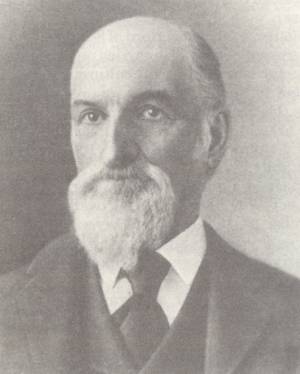
Edwin Alling was born in Oxford on March 18, 1834, the son of Eli and Maria Alling. He was one of eight children - four
boys and four girls. He lived at his parents' farm until he reached the age of 19 years, when he went to New Haven. There he learned the guilder's trade, staying for 4 years. He then returned to Oxford and worked on his parents' farm.
He enlisted for Civil War service in June, 1862. He held the rank of private in Company B, 20th Conn. V.1., and participated in numerous battles. He served at both Chancellorsville and Gettysburg. In operations before Atlanta, he was wounded by an explosive ball which struck him in the back. Two pieces went upward and three pieces went downward. As the Oxford man was returning to the rear for medical help, he was again wounded by buckshot. This hit him in the back of his head and passed through the skull and was never removed.
He was confined in military hospitals for several months, eventually getting a furlough and returning to Oxford. He rejoined his regiment later that year, but was unable to withstand the physical rigors of active service. He was honorably discharged in January, 1865. He again returned to Oxford, where he resided the remainder of his life, with the exception of two years.
He established a farm at Oxford of 88 acres, and also owned a 65 acre farm out of town. He carried on general agriculture, with particular success in fruit culture. He had 18 acres of land devoted to apples, peaches, plums, strawberries and raspberries. He took his produce mainly to Naugatuck for sale and marketing. By 1900 he produced as much as 1,000 bushels of handpicked apples and 150 bushels of strawberries annually.
Alling married Laura Biegelow, a granddaughter of a Revolutionary War hero from Colchester. They were married November 30, 1854, and had seven children.
Alling was a staunch supporter of the local Republican party and served as an assessor, a road inspector, a constable and a grand juror.
He died on July 16, 1924, and was buried at Oxford Congregational Church Cemetery on Governors Hill Road.
COLONEL WILLIAM BURR WOOSTER
Colonel William Burr Wooster was prominent in civic, legal and military circles in Birmingham and Ansonia. He was born August 22, 1821 in Oxford, son of Russell and Avis Burr Wooster,
who were farmers of that town. His education was in the local district school and the academy. At 19 years of age he began to teach during the winters and farm during the summer. After a few years he entered Yale Law School, where he graduated in 1846. He was admitted to the bar and began a successful legal career.
In 1858 he represented Derby in the State Legislature and was re-elected in 1861. In 1859 he served in the State Senate. In 1867 he became paymaster general in the state.
Wooster is best known for his military work. He served as part of the Military Committee which directed the formation of Connecticut's Volunteer Army of the Civil War. He drew up many of the acts and resolutions of the legislature, supporting them in their passage. At the same time he was enlisting volunteers and making many patriotic speeches.
When President Lincoln issued his famous call for 300,000 volunteers, Wooster himself joined the Connecticut Volunteers. He was commissioned August 22, 1862 as Lieutenant colonel of the 20th Connecticut Volunteer Infantry and went to the front. He served at the Battle of Chancellorsville, and was made colonel by brevet for distinguished gallantry.
He was captured and taken to Libby Prison. On his release from that place, Colonel Wooster rejoined his regiment and later led the command at Gettysburg.
In March, 1864, Wooster was assigned the command of a black regiment, the 29th Connecticut Volunteer Infantry and made colonel of it.
At the close of the Civil War, Wooster returned to Connecticut and opened a law office in Birmingham. He also served as president of the Derby Gas Company and the Birmingham Water Company.
Wooster married Miss J.A. Wallace, daughter of Thomas Wallace of Ansonia, and they resided on Clifton Avenue.
At the time of his death on September 20, 1900, the Hartford Courant wrote, "His name has stood for many years on Connecticut's roll of honor. He was a patriot and a gentleman. He was Derby's first citizen."
HONORABLE DAVID TORRANCE OF DERBY
David Torrance was born March 3, 1840 in Edinburgh, Scotland, the son of Walter and Ann Sharp Torrance. His father died, leaving his widow with five children. The mother took Torrance and his brothers and sisters to the United States when he was five years old and settled in Norwich, Connecticut.
At age 14, David began to work in a cotton mill and the following year he began to work in a paper mill. He continued in that position until the Civil War broke out. On July 17, 1862, he enlisted as a private in Company A of the 18th Connecticut Volunteer Infantry.
He was captured by the rebels after the battle at Winchester, Virginia, and sent to Libby Prison. Later he was sent to Belle Island, and on July 1863 was paroled and returned to the north.
Torrance was then assigned captain of a black organization commanded by Hon. William B. Wooster of Derby. Torrance advanced to the position of Major in July, 1864. Later, in November of that year, he advanced to the rank of Lieutenant Colonel. He was mustered out with his regiment in October, 1865.
Returning to Connecticut, Torrance entered the office of his superior officer, Colonel Wooster, as a law student. He continued in his studies until 1868, when he was admitted to the bar.
Soon afterward he entered into partnership with Wooster, and a large and prosperous law firm was the result of this alliance.
Torrance joined the Republican party and in 1871 was elected to represent the Town of Derby in the General Assembly. He was re-elected to the post in 1872. In 1878 he was elected to serve as Secretary of State, and in 1881 was appointed Judge of the Court of Common Pleas in New Haven. He later advanced to Judge of the Superior Court of the state, and in 1890 he was named to the Supreme Court of Errors.
He was elected a member of the faculty at Yale.
Torrance, the father of three children and a member of the Congregational Church in Birmingham, was prominent in the social life of the community.
-
EDMUND DAY, LOCAL BUSINESS LEADER
Edmund Day was a prominent pro Union sympathizer at the time of the Civil War. His role as a private citizen in Seymour during that struggle would entitle him to a place in Seymour's history, regardless of his personal achievements in local business. His business success and his leadership in the growing economy of Seymour adds to his stature as an historic citizen of Seymour. Among his many interests were manufacturing, banking and community development of public facilities.
Edmund's life story is closely intertwined with that of his three brothers. Their parents were Julius and Lois (Goodyear) Day. Mr. Day traced his ancestry back to Robert and Mary Day, who came from Ipswich, England to America in April 1634 on the bark Elizabeth. They were part of a group of about 100 followers of the Rev. Thomas Hooker. They landed at Boston and settled for a time in Cambridge, Massachusetts. In 1636 the company walked through the forests to Hartford and settled there. Julius Day was a farmer who resided in West Springfield, where his four children were born. There was one daughter, Lois Ann, who was born in March, 1834, and three sons. The sons were Austin Goodyear, born November 24, 1824; Henry Perdy, born March 12, 1829; and Edmund, born December 12, 1831. The business interests of the three brothers in Seymour were intertwined and no account of any one of the brothers can leave out the roles played by the other two.
Edmund attended school in West Springfield, and graduated from Westfield Academy. He entered Yale University but stayed only five months, when he left the school to go into business with his brother Henry in Seymour.
The H. P. & E. Day Company, Incorporated was founded in 1852, when Edmund was 21 years old and his brother Henry was 23 years old. From this beginning, the men were to attain high standing in the business community, with their interests extending across state boundaries and felt in many areas.
The two brothers specialized in the manufacture of hard rubber products. They began the manufacture of fountain pens, being among the first in the country to take up that industry. At first, they made pens for various inventors. During the middle 1850's they began to make pens for L.E. Waterman; and by 1916, the firm was devoted exclusively to the manufacture of the rubber part of the Waterman Pen. It was the only plant in the country so engaged by Waterman, and the parts were shipped to New York, where the pens were assembled.
The success of the business was due to the business success of the other brother, Austin Goodyear Day. This brother established the Kerite Insulated Wire and Cable Works in 1854 and purchased the property and set up machinery to manufacture hard rubber goods and insulated electric wires.
Even in the establishment of the Kerite Company, there was another family influence. Austin Goodyear Day was introduced to the rubber business when his cousin took him to Northampton to see the process of manufacturing rubber goods. The cousin - Charles Goodyear, a name now internationally known for its connections with rubber manufactures - employed Austin G. Day at his factory in Woburn, Massachusetts for several years.
Austin G. Day became interested in experimenting with new processes of rubber manufacture. He studied the methods then in use and became a leading authority on rubber processing. He started a business in New Haven and moved it to Seymour in 1854, when he purchased the factory in Seymour from Bassett & Lodge. In this building he began the manufacture of Kerite for the insulation of electric cables for telegraph and other uses.
The building burned in March, 1864 and was rebuilt. The rebuilt building was arranged to conduct the submarine telegraph works of Austin G. Day on the lower floors, and the upper floors were retained for the use of H.P. & E. Day Company, Inc.
Austin G. Day continued in his own business, and in support of his brothers' business until his death on December 28, 1889.
The H.P. & E. Day Company, Inc., later moved to larger quarters, and by 1918 it completed three main factories, a power house, and an office. The 1918 edition of Waterbury and the Naugatuck Valley, said of H. P. & E. Day Company, Inc., "The factories are all of reinforced concrete and are splendidly equipped with the latest improved machinery for carrying on work of that character. They employ three hundred and eighty people, all skilled labor, mostly men. They have developed a splendid organization, officered by men of well-known business ability and executive force. Theirs is the largest rubber turning plant in the United States. The officers at the present time are: Edmund Day, President; Julius G. Day, Treasurer; Walter Randall, secretary and general manager. The importance of the business to Seymour is readily recognized, for it employs a large force of workmen and greatly promotes trade conditions in many ways. The city may feel proud that it has in its midst the leading establishment of this kind in the United States."
Incidentally, the Julius P. Day listed as treasurer was the nephew of Edmund Day and the son of Henry Perdy and Frances (Gilbert) Day.
Edmund Day had numerous other business interests in the community of Seymour. He was the first president of the Seymour Trust Company, as well as president of R.D. Rising Paper Company at Housatonic, Massachusetts. He was also the first president of Seymour Electric Light Company. In addition, he served as director in the H. A. Matthews Manufacturing Company, the Rimmon Manufacturing Company - both of Seymour - and the Crocker McElwain Paper Company of Holyoke Mass. and the Fourth National Bank of Holyoke Mass. and the Fourth National Bank of Waterbury, Connecticut. He was also the owner of a citrus grove business in Florida.
The Seymour Trust Company was an outgrowth of the Valley National Bank. The Valley National Bank was organized in 1900 with a charter granted on July 16th, and the bank opened for business on August 14, 1900. The bank was located on the corner of Main and Bank Streets, which is now occupied by Rogols Store. The first officers of the bank were W. L. Ward, President; F. A. Rugg, vice president; S. C. Boies, cashier.
Just five years later, to the day, August 44, 1 905, the Valley National Bank was dissolved and replaced by the Seymour Trust Company.
Business was carried on one day under the first name, and re-opened the next day with the new title, without any break in service. Those who headed the Seymour Trust Company in 1905 were Edmund Day, President; William L. Ward, vice president; G. E. Matthies, Secretary, and S. C. Boies, treasurer.
The bank capital was listed in 1902 at $50,000, under the Valley National Bank. At the time of its incorporation as Seymour Trust Company, it had a balance sheet of $310,000.
It is remarkable that Edmund Day served as the first president of two Seymour institutions which played a vital role in the growth of Seymour's economy. The Seymour Electric Light Company was organized and incorporated in 1889 with Edmund Day as its first president. By 1902, the company had a capital of $28,000. At that time the company had a contract for town lighting as well as furnishing arc or incandescent lights to factories, stores, public buildings and residences.
The plant occupied by the firm was a 30 x 80 ft. brick building, equipped with what William C. Sharpe described as "the latest improved electric appliances, including an arc dynamo of thirty lights and two incandescent dynamos of 1,650 lights."
Day served as president of this firm at the time of its incorporation. He was succeeded by James Swan as president in 1902. The company was purchased by George E. Matthies and L. T. & W. H. H. Wooster in 1904. At that time the voltage was changed, auxiliary power was added and the business expanded.
Edmund Day was also a director of the H. A. Matthews Manufacturing Company of Seymour. This business enterprise was organized in 1890 with a capital of $85,000 to manufacture stove trimmings and other hardware. In 1885 it was expanded to make bicycle parts.
Sharpe said of the firm in 1902, "Their works at the mouth of the Little River have been enlarged and greatly improved, and now include the main building 36 x 125, an annex, 24 x 89, an office and stock room and a boiler house. The machinery is of the most improved patterns and includes mammoth presses the largest of which has a weight of nine tons. The works turn out numerous specialties in brass, steel and composition metal. The officers of the company are James Swan, president; Carlos French, vice president; George E. Matthies, secretary; and F.H. Beecher, treasurer and manager."
Edmund Day was a director of the Rimmon Manufacturing Company which was organized January 10, 1900, with a capital of $30,000. The plant was located at the corner of Main and Day Streets and covered more than an acre of ground. The company manufactured brass and other metal goods, including eyelets for shoes, corsets and other uses. The eyelets were sold in both foreign and domestic trade, with some of the eyelets sold as far away as Australia.
So wide were Day's interests and influence that he became a director for the Fourth National Bank of Waterbury. This bank was organized under the United States Banking Law in 1887, some 3 years prior to the organization of the Valley National Bank and 8 years prior to the organization of the Seymour Trust Company. Day became a director in the Waterbury bank later in its history, being a director of this firm in 1908, when he was also president of the Seymour Trust Company.
In addition to these local enterprises, Day was in two Massachusetts paper companies. He was president of the B.D. Rising Paper Company at Housatonic, Massachusetts, and director in the Crocker McElwain Paper Company of Holyoke.
In addition to these manufacturing endeavors, Edmund Day owned several citrus groves. They included one hundred and thirty acres of orange and grapefruit groves, located at Rockledge and Oak Hill, Florida. He was at the time one of the largest individual fruit growers in the state.
Edmund Day was a staunch Republican and served in several elected positions. In 1877 he was elected to the Seymour Board of Education, where he served six years. He served as State Representative from Seymour in 1884. In 1885 and 1886 he served as state senator, and while in this position, he was the chairman of the State Legislature's Joint Committee on Manufactures.
He was also an active member of the Seymour High School Building Committee, where he served with James Swan, W.H.H. Wooster, Carlos French, Thomas James and Frank H. Beecher. The building was begun in June, 1884 and opened in the fall of 1886.
The Seymour Public Library owes much to C.B. Wooster and the brothers H.P. and E. Day. Mr. Wooster died in 1914 and left an endowment of more than $55,000 for a library.
At the same time, the Day brothers gave the town a site located near the present site of the Seymour Congregational Church and promised enough money to build an equip a suitable library. The gift was made on condition that the town obtain land overlooking the falls and turn it into a public park. This was to assure that the proposed library would always have a beautiful location.
By special town meeting action on September 3, 1914, the town accepted the gift and agreed to purchase the park land. The library had previously been housed on the second floor of a town-owned building on Second Street, whose first floor was then used as the town court.
The library continued at the Day brothers' location until the flood of August, 1955, when it was destroyed. The library was temporarily housed at the Civil Defense headquarters location, while the new library was constructed at its present site on Church Street.
Although the library has moved, the town still owns the park area by the falls, where the replica of the old covered bridge now stands opposite the Congregational Church.
Edmund Day was a staunch Union supporter during the Civil War - which was a time of high sentiment and great controversy in Seymour. The following statement from Sharpe's Seymour Past and Present illustrates Day's commitment to the cause:
"Mr. Day was one of the most prominent in local endeavor on the side of the Union in the early years of the War of the Rebellion, and in the first year of the war, when local sympathizers with the South threatened to burn the property of the Union men, he obtained a grant of arms from the state, and had them brought here so quietly that the first of his opponents knew of the move was when the weapons were seen in the hands of men who were patrolling the streets at night. The leader of the pro slavery party was notified that if any buildings were burned he would be held personally responsible The result was as intended, and there was no further talk of destroying the property of the upholders of the Union."
-
BUSINESS AND ECONOMIC DEVELOPMENT IN THE VALLEY
In the years between the Civil War and the First World War, the Valley was growing in its industry and economics. Factories were built and employed large numbers of citizens in the area. This concluding chapter examines some of the leading persons of that era.
DR. GOULD A. SHELTON
Dr. Gould Abijah Shelton was a well-known physician in the Valley area. The town of Shelton was named for him, in appreciation and recognition for his many works.
Dr. Shelton was born August 9, 1841, the son of Judson C. and Hannah (Lewis) Shelton, at the family homestead in Huntington. He was educated in the common schools and then enrolled in Staples University at Easton, Connecticut. In 1862 he went to Yale College, but during his junior year he left to take a teaching position. Late in 1864 he accepted a different teaching position at Mountain View Seminary and the following year was made the principal of a school at Port Washington, Long Island.
In 1866 he began his medical studies, attending courses in New York City and then attending Yale College. He received his M.D. on January 14, 1869, and immediately took up the practice of his uncle who had died the previous year.
Besides his medical practice, Dr. Shelton was known for his community interests. He served as an active member of the local school board and a trustee of the Plumb Memorial Library.
Active in politics, he was elected to the General Assembly. He was chairman of the Committee on Public Health.
Shelton served three terms on the board of burgesses of Shelton and for three terms as warden of the borough.
Shelton served as president of the Shelton Water Company and as director of the Shelton Savings Bank. He was also secretary and director of the Silver Plate Company.
In 1881, Yale awarded him the degree of A.M., and he was elected as president of the Yale Medical Society in 1894.
He was active in fraternal work, as a member of the 1.0. O.F. and the F & A M.
CHARLES HAWKINS
Charles Hawkins lived in Quaker Farms in Oxford. He was born March 30, 1828 in the house which was originally built by his grandfather, Captain Zachariah Hawkins.
The background of this family is so interesting that a slight digression is needed. Captain Zachariah Hawkins was a prominent man in Oxford's early days and was a captain in His Majesty's Militia and very active in local affairs. He served as selectman and in various town offices. He was by trade a shoemaker. His tombstone at the Hillside Cemetery, not far from the old homestead, is one of the most interesting stones in Oxford. It recites his family's growth, including his four wives' names, and those of his 14 children. It notes that his children all survived him, and at the time of his death he had 14 children, 82 grandchildren, and 95 great-grandchildren.
One of his sons, Silas, married first Sibyl Perry and second Sarah Minere Loveland. In the second marriage the son Charles was born.
Charles Hawkins was educated in the Oxford public schools. At the age of 16, after his father's death, he went to Newtown where he learned the hatter's trade. He worked later at shoemaking for several years. When his brother Silas died, the Hawkins property was deeded to Charles. Charles Hawkins farmed a large area, owning several tracts of land which totaled more than 170 acres. He carried on general farming, with a special interest in dairying. He also owned considerable city property located at Hawkins Street, Waterbury.
Hawkins married Miss Louise Jane Johnson of Watertown on December 17, 1848. The couple had six children - Sarah M., who died at age 10; Mary, who died at age 20; Charles Nathan, who died at age 6; Ira L., who became a tack manufacturer in Waterbury; Grace A., who married Frank Roberts; and Robert, who remained home with his parents to work the family farm. Charles Hawkins was a Republican and a member of the Episcopal Church at Quaker Farms.
ROBERT LIMBURNER: OXFORD BLACKSMITH
Robert Limburner was born in Oxford on March 20, 1821. Orphaned at the age of nine years, he was placed in the care of a married sister, Mrs. John Wooster of Oxford. He remained in that house until he was 16 and attended the public schools of Oxford. He was sent out as an apprentice to a blacksmith at Washington, Connecticut. He spent four years as an apprentice and worked three years in that trade as a journeyman. He then became a machinist, working for seven years in Washington. For a few years he operated a foundry and machine shop, under his own name, but later went into another business. He owned a wood turning company which had a large business in the Washington area. He moved to Southford in 1863 where he made straw paper boards, and he was reportedly very successful at this business. In 1870 he sold his interests and retired from business, residing at Oxford Center.
He became extremely active in community affairs as well as church activities. He was a Deacon of the Oxford Congregational Church, as well as Sunday School Superintendent. In addition, he supported that parish liberally with his financial backing.
He was elected the first selectman of Oxford 12 times, and held many other offices. He served as a representative to the State Legislature, being elected in Oxford to that post, after it had been held for 21 years by the opposition party. He had previously been a representative in 1860 from the town of Washington. He was a member of the Republican party, joining soon after the party was formed.
He was married to Emeline Williams of Washington. They had but one child, Josephine E., who married Samuel Buckingham.
Limburner died on September 3, 1905 and was buried in the Congregational Cemetery on Governor's Hill Road, Oxford.
HERBERT C. BALDWIN, CIVIL WAR VETERAN
Herbert C. Baldwin was born in Oxford, in that portion which later became part of Beacon Falls when it was incorporated
in 1871. He was the son of Lucian Baldwin, who was an area farmer who taught schools during the winter.
Herbert C. Baldwin's public career began with his enlistment into Company K, 13th Connecticut Volunteer Infantry in 1861, at the age of 21. He served in the battles of Georgia Landing, Irish Bend, Cane River, Mansuary Plains, Port Hudson and the Red River Campaign. He was under Sheriden in the battle of Cedar Creek, where he was wounded.
He reached the rank of first lieutenant, given him for gallant and meritorious service at Port Hudson.
Baldwin's business interests were mainly agricultural. He was elected assessor of the town and served several terms in that capacity. He was also elected to the post of fence viewer at the town's first town meeting. This position was elected to provide someone to check on farmer's fences when disputes arose over wandering livestock or fence repair.
First elected selectman in 1873, he held that post continuously until 1890, and was chairman of that board all but two years of that time span. He also represented the town in the State Legislature in 1876,1880,1883 and 1891 as a Republican.
He was married to Josephine H. Jones, by whom he had seven children.
JOHN. COE, A BEACON FALLS TANNER
John Coe was born in Bethany in the area which later became Beacon Falls, on August 18, 1815. He spent his early years there and learned the tannery business from his father. He operated the family business for a time before selling it and moving to Derby He later returned and built a new tannery in the area which is now occupied by the Homer D. Bronson Company in Beacon Falls. This tannery was maintained bv his sons when he went into the leather business in New Haven under the name Ensign and Coe. He eventually sold his interest to Ensign and returned to Derby. He became Treasurer of the Housatonic Water Company. He was superintendent of a building project to construct a reservoir at the time of his death.
His son, Julius Curtiss Coe. was born in Bethany on August 3, 1838, in the area which later became Beacon Falls. He was the sixth generation of that famIly to carry on the leather
business. He and his brother John Coe carried on the tannery business when their father left for New Haven.
Julius C. Coe was also prominent in local government after the formation of the new town of Beacon Falls. He was the first town clerk and treasurer of Beacon Falls, as well as State Representative in 1877. In politics he was identified as a Republican and in religion he participated actively and generously in the Methodist Church at Pine's Bridge, which later moved into the center and eventually became the United Church on Wolfe Avenue.
He moved from the town in 1878, going to West Haven. His brother, John Coe, maintained the firm in Beacon Falls until 1882, when the land was sold to John Bronson of Waterbury. Alterations were made to the building, and it was used for the manufacture of brass novelties.
JOHN WOLFE: WORKED FOR THE INCORPORATION OF BEACON FALLS
John Wolfe was the agent of the Home Woolen Company. In 1863, this Hartford based firm purchased the Rubber Company property after that enterprise moved to Long Island. The place had been unused for three years, and the area was hard hit economically. The Home Woolen Company purchased the factory, water power privileges and about 30 houses, and considerable undeveloped land. The buildings were repaired under Wolfe's direction. Eight sets of machinery were put into the factory, and 40,000 yards of cloth were manufactured each month. The company increased its capacity and began to manufacture woolen shawls in 1864. At its peak, the company manufactured 13,000 shawls per month.
Wolfe, having been closely associated with the people of the area through his business enterprise, became one of the leaders for the creation of a separate town, which was achieved in 1871. It should be noted that this was a time of peak prosperity for the Home Woolen Mill in Beacon Falls. That company had employed practically all the population of the community. There was some sentiment that the new town should be called "Home," in honor of the part the plant played in the creation of the new town.
However, other minds prevailed, and the village took the
name of Beacon Falls, a sectional name which had been associated with the area for many years.
Work was suspended at the mill in 1876, due to economic conditions in the industry.
The mills stood vacant until 1879, when Wolfe purchased some of the factory and machinery and operated the firm.
WILLIAM C. SHARPE: SEYMOUR PUBLISHER
William C. Sharpe was born October 3, 1839, and he became noted as the publisher of the Seymour Record. He was born in Southbury, the son of Mary and Lugrand Sharpe. He was a grandson of Thomas Sharpe 3rd, who was a Revolutionary Was soldier who died in Oxford in 1805. Sharpe came to Seymour in 1842 and received his elementary education at Bell School, later going to Wesleyan Academy in Wilbraham, Massachusetts.
His training was in the field of education, and he taught in Connecticut, Massachusetts, Pennsylvania and New
Jersey. At one time he taught at the Quaker Farms School in Oxford. His last teaching position was principal of the Derby Grade School in 1868.
In 1865 he married Miss Vinie E. Lewis, and the couple had two children, one son and a daughter.
In 1869, Sharpe opened a printing office in Seymour. His paper was not the first local paper in the area. It was preceded by the Valley Messenger, which was published in Birmingham, beginning in 1855. J.W. Storrs was the editor, but the publication was not well sustained and eventually was discontinued. A competing paper was established in Seymour in 1885, when J.H. Whitney began publication of the Seymour Times. This venture failed, largely because the readers and advertisers of the Sharpe publication remained loyal to the Seymour Record. From that time on, Sharpe had the field of Seymour news almost to himself. Although the Evening Sentinel of Ansonia carried some local news, no paper could offer Seymour residents the depth and width of local reporting which Sharpe provided his readers.
His paper grew and by 1890 it was an 8 page sheet, wholly printed in the Record office, devoted entirely to local matters. The paper included, Seymour, Oxford, Beacon Falls and Bethany news. It contained many sketches of village material, and now provides a wealth of information to the local historian.
His own interest in the towns he served and his love of history led to the publication of numerous history volumes.
He is best remembered for his Seymour, Past and Present, but earlier works are vital reference tools. His History of Seymour, Seymour and Vicinity, History of Oxford, Part I; Oxford Sketches and Records, Part II, and South Britain Sketches, are repositories of much local historical information. He also published several works on area genealogy.
In addition, Sharpe compiled annals of two Seymour churches, the Seymour Methodist Episcopal Church and the Seymour Congregational Church. Sharpe was first a member of the Methodist Church, and was not at all reticent about writing of any disagreements which he had with its clergymen. What appears to be a personality clash shows up in print in Seymour and Vicinity, on comments concerning the Rev. E.J. Dutcher. According to some historians, this was based on a disagreement on the governing structure of the church and a sense of personal grievance over the removal of Sharpe's father from chairmanship of the Missionary Society. These quarrels took place in 1875, but Sharpe remained active in that church until about 1890. At that time Sharpe apparently had personal reasons for transferring to the Seymour Congregational Church. He was apparently welcomed with open arms, as he was almost immediately elected to the Ecclesiastical Society and became its clerk.
Besides his active career in publishing news and history and his church involvement, Sharpe was active within the political circles of the town. He was a school visitor in Seymour, and later served nine years on the Seymour Board of Education. He was at one time Secretary of that board.
ALVA GOODRICH DeWOLFE: INSULATING WITH KERITE
Alva Goodrich DeWolfe was born in Morris on August 25, 1810. He was the youngest of five children. His ancestors played a part in the American Revolution. His maternal grandfather had served in the American cause and died in one of the New York prison ships. Alva's father, Levi Goodrich was four when he was carried away in an Indian raid and held for several years. At the age of 15, Levi joined the patriot forces and served until the end of the war. He achieved the rank of Sergeant and was a body-guard of General LaFayette. He was wounded at Yorktown. He returned home and became a blacksmith.
DeWolfe spent his boyhood in Morris and received a very limited education in the common schools of that community. He was put to work at an early age in his father's shop. He is said to have been a prodigy of sorts, and at the age of 14 years built a lathe without having a pattern to copy after. He became known for his skill at repairing guns, watches and other mechanical items. When he was not yet 16, he built clock manufacturing equipment which later turned out 5,000 clocks per year. He worked in the making of wooden clocks with Eli and Henry Terry.
When he reached the age of majority, he went into business, planning to set up street lamps in Havana, Cuba. But the ship experienced bad weather and finally landed at Charleston harbor. There DeWolfe and his associate changed their plans and set up a gun shop in Georgetown, South Carolina. He later went to New York to work for instrument makers.
He suffered a decline in health and an extended sea voyage was recommended for him. DeWolfe and a companion joined a whaling expedition and spent three years, three months and twenty days on the whaling ship, where he served as the blacksmith on the vessel. He returned to shore in sound health.
He returned to Connecticut and built machinery for Seth Thomas, who manufactured brass clocks. In 1846 he went to Springfield and the Wasson Car Works.
In 1850 he went to Harlem and began making rubber making machinery. He devised a method to shape hard rubber goods out of rubber dust, scraps, or plates. He made the machinery for the Novelty Rubber Company which manufactured rubber buttons in Beacon Falls in 1855. The company later moved to New Brunswick, New Jersey.
About 1860 he began experimenting with insulation of wire. The Day factories in Seymour were burnt in 1864 and rebuilt with equipment which was constructed by DeWolfe. This included machinery to properly cover wire so to be perfectly insulated, with Kerite, a chemical used there starting in 1866.
Levi married to Lucy Ann Hotchkiss of Watertown, and the couple had five daughters. He died August 10, 1896.
RAYMOND FRENCH: PIONEER MANUFACTURER
Raymond French was born January 7, 1805 and died in his native place of Seymour on February 19,1886. During his lifetime he was a pioneer manufacturer, taking prominent positions in many of the enterprises of his day.
He was a descendant of William French of Essex, England, who came to America in the ship "Defense" in 1635. His grandfather, Israel French, was one of the first settlers in the Humphreysville section.
Raymond French rose from humble beginnings in Seymour and did not have the opportunity for much schooling. He was apprenticed at an early age to work for the blacksmith Isaac Kinney, whose shop was near where the Methodist Church is now located in Seymour.
When working for Isaac Kinney, French became proficient in the trade which contributed greatly to his success. Later he began working in an auger shop in Humphreysville and became a skillful toolmaker. He left the area in 1828 to go to the Isle of Trinidad, West Indies. Here he spent six years fitting up sugar mills with machinery. He also worked for the English government in Trinidad.
He returned to the Seymour area in 1834 and went into partnership with John C. Wheeler manufacturing augers. In 1837 he became sole proprietor, but later joined John and Timothy Dwight. They formed Dwights and French, manufacturers of augers, bits, plane irons and other tools. They expanded the operation by opening a new plant at Kenneytown. French built the dam there in 1844 and sold it a year later.
In 1849 the business expanded with the inclusion of more partners, forming Dwights, French and Co., which began manufacturing railroad cars. The firm was split in 1852, with French holding a controlling interest in both corporations. Part of the business, the American Car Company, eventually became the property of the Illinois Central Railroad. The Humphreysville Manufacturing Company continued with Raymond French as president until its dissolution in 1870.
French then secured a third interest in the factories and power of the old Humphreysville Company and engaged in the manufacture of ox shoes. He gave up this business because of failing health, when he retired from active life. Throughout his long business career, he was identified with a variety of other ventures, including the Eagle Silk mills, the Humphreysville Copper Company, the Bank of North America and others.
CHARLES H. NETTLETON
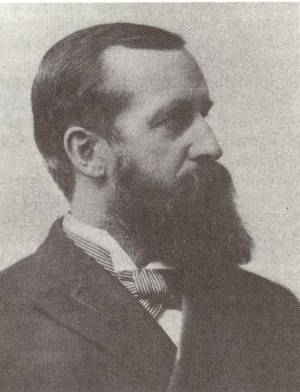
Charles H. Nettleton was born in New Haven, Connecticut in 1850. He moved to New York City at an early age, where he attended the public schools and graduated from the College of New York City, Class of 1870.
The following year he moved to Derby. He was in charge of the construction of the Derby Gas Plant and held the office of treasurer and general manager. This company supplied the electricity and gas both private and public for Ansonia, Derby and Shelton. This included electricity for the use of manufacturing establishments in those communities.
In 1874, Nettleton was named manager of the Birmingham Water Company. He later became treasurer of that organization.
He was elected president of the Bank, located at Derby, in 1894.
An authority on the manufacture and distribution of energy, he was secretary of the New England Gas Association from 1865 to 1891 and Served as president of that group from 1893 to 1894. In 1897 he was chosen president of the American Gaslight Association. He was also named president of the Derby and Shelton Board of Trade.
When Shelton was incorporated as a borough, Nettleton was chosen as its first warden and served two terms in that office.
Nettleton was a staunch Republican. He was a vestry man of Saint James Church in Derby and served as treasurer of that society.
CHARLES F. BROOKER
Charles F. Brooker was president of Coe Brass Works, then a large manufacturing corporation. He was the son of Martin Brooker, a farmer, and was educated in the common schools of Litchfield County. He entered early into the Coe Brass Works and worked his way up.
He made many trips abroad in the interests of the company, traveling in Europe and the West Indies.
The Coe Brass Company, which had a world-wide reputation, was organized in 1864. This firm added mills at Ansonia, which were formerly conducted by Wallace and Sons. The Ansonia mills manufactured braziers, sheeting and bolt copper, and mirror finished cold rolled copper. They also held a patent for a leveled cornice copper and manufactured copper wire for all purposes.
In 1885 he represented the town of Torrington in the Connecticut General Assembly. He was a prominent Republican, serving on the State Central Committee. He was an alternate commissioner to the 1890 Worlds Fair.
EDWARD NELSON SHELTON
Edward Nelson Shelton was born September 4, 1812 in the old Shelton homestead in Huntington, the son of Joseph and Charity Lewis Shelton. He was raised on his father's farm and attended the public schools. He later attended the Derby Academy and the Scientific School at Middletown, spending one year at Yale College.
In the spring of 1836 he joined with Nathan C. Sanford and established a business in the new town of Birmingham. They manufactured tacks and nails at a factory on the north side of Main Street.
Sanford died in 1841, but the business continued under the name E.N. Shelton until 1854, when the Shelton Company was formed. The plant at Birmingham was too small, and a branch factory was opened in Shelton. Later the entire business was transferred to that location. The plant consisted of half a dozen buildings in which were manufactured small bolts, nails and tacks. It was one of the leading industries of the town, employing more than a hundred laborers.
Shelton was a leader of the effort to build a dam across the Housatonic River at Birmingham. The question of damming the river was raised in 1838, and the following year the legislature authorized improvement of the power at Birmingham and Shelton, but would not allow the dam to be built. The charter was finally granted in 1864, and two years later the Housatonic Water Company was organized. It consisted of the leading manufacturers of Birmingham. The work was begun in 1867 and completed in 1870. At the organization of the water company, Shelton was chosen president - a position which he held until his death.
He was also chosen president of the old Manufacturers Bank when it was organized in 1848. This later became Birmingham National Bank. Shelton remained at its head until his death on September 16, 1894.
EMERY L. TERRELL
Emery L. Terrell was born in Colebrook, Connecticut on May 9, 1866. His father, Henry Terrell, was one of the prominent Democrats of that place, serving in the State Legislature in 1876. Emery was reared in Colebrook, the public schools and the Congregational Church there. He attended high school in Winsted.
Terrell came to Beacon Falls in 1883. For a time he was a clerk in a general store, known as Terrell and Bacon. After four years he purchased an interest in the business as a partner of E. J. Terrell. On the death of E. J. Terrell, Emery purchased the interest of his former partner and conducted business himself. The store was located on Main Street, opposite the Beacon Falls Rubber Shoe Company's office.
Terrell was an ardent supporter of the Democratic party, and in 1895 he represented Beacon falls in the State Legislature. At the age of 29, he was then one of the youngest members of that body. In addition, Terrell served locally as town treasurer and was appointed postmaster at Beacon Falls in 1896. He served as Town Clerk in 1889 and 1890 and from 1896 to 1900. He was also a member of the Board of Relief and the Beacon Falls School Board as well as tax collector for three years.
JOHN POPE
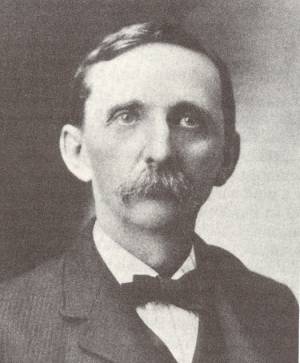
John B. Pope was a first selectman of the Town of Oxford and also represented the town in the State Legislature. He also served as a member of the Board of Relief.
Pope was born in Roxbury on July 13, 1842, his family coming to Oxford when he was one year old. He was educated in the public schools of Oxford and became a farm worker at the age of nineteen. In 1865 he married Jane M. Nichols. Together they had eleven children, including a son, Charles Pope, who later served as first selectman of Oxford.
John B. Pope was a farmer and he purchased a number of Oxford farms, as well as owning several hundred acres in Woodbury and Watertown. He was prominent in Oxford's dairy business and also was interested in the buying and selling of cattle and horses. He also engaged for many years in the lumber business. He operated a steam sawmill and manufactured charcoal in Oxford. He was considered one of the most active and progressive businessmen of Oxford in his time.
He was a Democrat and served in the State Legislature in 1881 and 1882. He was First Selectman of the town in 1900, 1901, 1904, 1905, 1907, 1908, 1910. In those days the selectmen were chosen annually. He was also a member of the Board of Selectmen - but not the first selectman - during the years from 1899 through 1910.
JOHN N. POPP
John N. Popp was born in 1841 in Bavaria, Germany and came to America in 1865. Shortly thereafter he came to Seymour and resided in that town until his death in 1897. He was a merchant tailor by trade, and set up his own business in Seymour.
He was a member of the German Lutheran Church before his arrival in Seymour. At that time he joined the Seymour Congregational Church and remained in that congregation until his death.
He was a member of the Democratic party, up to the campaign of 1896, when he supported William McKinley.
Popp married Miss Sarah E. Wirth, born in Seymour, the only daughter of another Bavarian immigrant.
Socially, Popp was a member of many social and fraternal groups, including the Independent Order of Odd Fellows, the New England Benefit Association and the German Society of Hermanns-Sohne.
CORNELIUS W. MUNSON
Cornelius W. Munson was a native of Waterbury. His father, a mechanic, died six months before the birth of Cornelius. His mother re-married, and the family lived for a time in Wolcott. He returned to Waterbury to learn the carpenter's trade and went into business in the area of Oxford that is now
Beacon Falls. Working as a carpenter, he also maintained a 135 acre farm of his own about a mile and a half from the center of the town
He married Miss Jennie L. Osborn, a native of Bethany.
A member of the Democratic party, Munson served for 30 years on the Beacon Falls Board of Selectmen. He served in 1884-85 as a member of the Board and again in 1886. He was off the board for a number of years, returning as First Selectman in 1891. In 1892, Herbert C. Baldwin took that office, and Munson served as a member of the board. From 1893 to 1898 he held the post of First Selectman, and from 1899 through 1905 he served as a member of the board. In 1906, he was elected First Selectman, but from 1907 until 1909 he had to be content with simply a membership on the board. From 1910 to 1918, he served as First Selectman, uninterrupted by any political defeats. He also was a member of the local school board and twice represented the town in the State Legislature.
He was a member of Court High Rock, Foresters of America, of Beacon Falls and a member of the Episcopal Church.
THE CHURCH FAMILY OF SEYMOUR AND OXFORD
Three generations of the Church family were engaged in local business, and the grandson, S.B. Church is permanently memorialized in Oxford's new town hall, the S.B. Church Memorial Town Hall, having been built in 1976-77 with funds from his estate.
The grandfather, Shelden Church, was a native of Oxford but lived in Seymour during most of his business career. He was active in the lumber business, his chief business being the sale of ship frames. He cut the timber locally and had it carted as far as Derby. There it was loaded on ships and sent to New York. When Ansonia was built, he provided the frames for many of the buildings, factories and homes. He sold Chestnut timber which was cut on his lands and sawed at his own mills. The mills were driven by water power with the old fashioned up and down saws. He also farmed on a large scale.
Sheldon's third son was John Church, born in Oxford on
June 30, 1830. His home was near the Seymour-Oxford town line, and he was active socially in Seymour. He owned vast tracts of land and engaged in the timber and wood business. He married Sarah M. Whiting and had two sons.
Lewis was a warden in Trinity Episcopal Church in Seymour. The other son, Stephen Betts Church established the S.B. Church Company. He became known for his work in suburban water works, the sale of gasoline engines and agricultural equipment. He kept offices locally and in Boston. The business became so large that agents throughout New England were employed. S.B. Church never married.
At the time of his death, he left his fortune in a trust fund to support some relatives of his, with the provision that upon the death of these individuals the fund would be assigned to several specific purposes.
The fortune increased greatly while it was administered by the Seymour Trust Company, and when it was assigned there was nearly one million dollars each for the Trinity Episcopal Church of Seymour, the Griffin Hospital and the Town of Oxford to construct the new town hall.
WILLIAM L. WARD
William L. Ward was born in Naugatuck in October, 1858. His father, a carpenter, died when he was a young man. William received his education in Naugatuck. He began work with the G.I.R. Glove Company and stayed there twelve years. For nine years he worked for F.Q. Tolles, a furniture dealer and undertaker in Naugatuck.
On August 1, 1898, he came to Seymour and bought out E. F. Bassett, who had been in the furniture and undertaking business there for forty-two years. After a time, his business was so successful that he had to expand his store.
Ward was a major influence in the establishment of the Valley National Bank of Seymour, which was instituted in 1900. He served as its president and was also town treasurer. In 1901 he purchased a home on the corner of Church and West Street, which was first occupied by Dr. Stoddard.
Ward descended from an old English family who settled early in Connecticut. He was a descendant of Culpepper Hoadley, a soldier of the American Revolution. William Ward married Lulu Tolles and had two sons, William and Elmer.
The business still exists in Seymour today, in the revised firm, the Miller-Ward Funeral Home. Members of the Miller family now operate the Bank Street business.
GEORGE T. CLARK
George T. Clark was born in Bethany in November 1859. His father was originally a teacher, conducting a select school in Bethany, but later became a farmer.
Sheldon was taken by his parents to Beacon Falls when he was two years of age and raised on his father's farm. Sheldon received his education in the public schools of the town and completed his education at Redding, Connecticut. He returned to the family farm and made that his chief interest in life.
The property included about 150 acres of land, and he used the property to conduct both a milk and ice business. He also provided rental of horse teams to area farmers and businessmen.
Clark married Mary A. Reffelt, the daughter of a German immigrant who was foreman of a woolen shop in South Coventry. They had five children: Frank, Eva, George, Ethel and Rosetta.
The Clarks attended the Methodist Episcopal Church, which later became the United Church of Beacon Falls.
Clark was a staunch Republican and served as a member of the local school board and as a school visitor. He served as selectman in 1897, 1898 and 1899.
ROBERT DOWNS
Robert Downs was an Oxford farmer who lived on Chestnut Tree Hill Road where he engaged in bee farming and dairying.
His farm was located at the corner of Chestnut Tree Hill and the now unused dirt roadway Downs Road, which leads over the hill to Riggs Street in the vicinity of Jack's Hill Road.
Robert Downs was born in Bethany and came to Oxford when his parents bought that farm when he was a year old in 1836. As he grew up, he attended Red Oak School, that school in the joint school district #11 with Naugatuck and Oxford and also worked on the farm to help his father. His father died in 1859 and he took charge of the farm.
Robert Downs owned about 116 acres of land which he devoted to diary, general farming and bee culture.
Downs served in the Civil War, enlisting in August 1862 for three years or the duration and was a private in Company H. 15th Connecticut Volunteers. He participated in the battle of Fredericksburg and the siege of Suffold. He was captured in the battle of Kingston, N.C., and taken to Richmond, Va. He was paroled and taken to Annapolis, Maryland. Returning home on furlough, he was in Oxford at the close of the war but went to Newborn N.C., for his final discharge.
Downs was a firm supporter of the Republican party and served many years as grand juror of Oxford. He was a member of the Methodist Episcopal Church of Naugatuck.
SAMUEL R. DEAN
Samuel R. Dean was a prosperous merchant in Seymour. He was the son of Samuel H. Dean, an immigrant from Ireland. He sailed from that place in 1812, but was captured by the British who took the vessel to Halifax, Nova Scotia. The father escaped from there and traveled on foot to New York where he settled.
Samuel R. Dean was born in 1832. It is said that he earned his own living from the age of ten years. He spent time in Ithaca, New York and then went to Oswego, where he was in the dry goods business as a clerk. From this experience he laid the basis for his future success. He went to Minnesota in 1858, due to problems of ill health. After a year and a half he recovered and returned to Oswego. In 1862 he married Miss Anna Curtis Fairchild, and in 1868 the couple moved to Seymour.
He became associated in business with V.H. McEwen, under the name Dean & McEwen in a store at the corner of
Bank and Second Streets. This partnership was dissolved in 1868, and Dean joined C.B. Wooster and Virgil Buckingham.
In 1882 he became the sole proprietor of the business.
Dean was a Republican and represented Seymour in the State Legislature in 1886-87. He served as chairman of the local Board of Relief for seven years. Socially he was affiliated with the F. & A.M. Morning Star Lodge, No.47; and the I.O.R.M., Nonnawank Lodge No.9. In religious faith he was a Baptist, but attended the Congregational Church.
He died on March 25, 1900.
WILLIAM B. BRISTOL
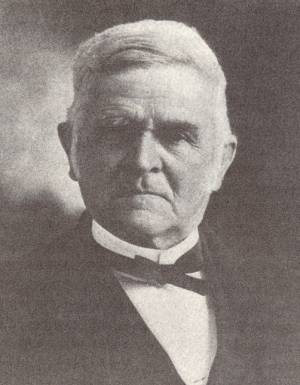
William B. Bristol was born November 21, 1811 in Oxford, the son of Sheldon Bristol, an Oxford farmer and Methodist.
William was the youngest of five children. He was educated in the common schools of Oxford, and at age 16 he was qualified to teach. He taught in Roxbury and Woodbridge, coming to the Bowers Hill District in Oxford in 1829.
He went back to school to study medicine, but his funds ran out and he had to take up the mason's trade. He worked for $2.00 a month for his first year and $3.00 a month for his second, continuing to teach during the winter. He then hired out as a mason in Monticello, New York.
In 1833 he returned to Oxford but went to Charleston, South Carolina to follow the mason's trade. He returned in 1835, and he worked for Harvey Johnson, then building the first factory - a copper mill - in Birmingham. He taught school for some time, while continuing in the masonry business during the summer.
In the summer of 1845 he settled at the site of the present city of Ansonia. There were no dwellings on what is now Main Street, so he had to board half a mile out of the village.
He formed a partnership with Lyman Treat, dealing in masonry. In 1848 he set himself up as an independent businessman in wood and coal. There were no other yards in the village at that time.
In 1862 he was elected president of the Savings Bank, a position he held until his death, June 10, 1900.
He was a director of the Ansonia National Bank which he helped to organize. He was vice president of the bank; in addition, he was director of the Birmingham National Bank, serving as its president in 1870.
Politically, he was a Republican and served on the Board of Selectmen.