Work on the Munn Schoolhouse Suspended but We’re Able to Start Again Now!
History
has been changed by the surprise arrival of a pandemic on the shores of
the United States. The Coronavirus has brought abrupt changes to many
lives across the state, country and world. In response to the enormous
economic and health impacts, charitable groups and foundations have
redirected their fundraising efforts and fund distributions to improve
the lives of the many who have had enormous disruptions.
Members
of the OHS were impressed to see how quickly the Valley Community
Foundation moved to create a new fund and solicit donations to support
the activities. This left the Society with a schoolhouse in need of
work and a major source of funding in the early spring. But that was
not the end of things. It is just that priorities had to be realigned
by both the applicants and the funders. Plans for the next stages of
the schoolhouse renovation have been pared back to two significant
projects. And these have received the necessary funding. The Munn
Schoolhouse will receive urgently needed repairs, thanks to a recent
grant from The Valley Community Foundation and The Community Foundation
for Greater New Haven.
Located
behind the Twitchell-Rowland Homestead Museum at 60 Towner Lane, the
building was moved to the site from Oxford Road in November, 2019, a
donation from Mr. and Ms. Daniel J. Sears. It is Oxford’s last
remaining one-room school, the others having been converted into
private homes, repurposed, or demolished.
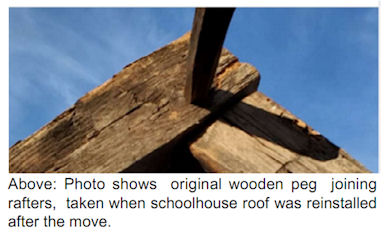
The
monies from The Community Foundations will allow the Society to replace
a damaged corner post, tie it into the roof plates and install new
floor beams. The work will be done by restoration carpenter Eric Iott.
The improvements will make the building safe for volunteers to work
inside the schoolhouse in the coming months.
Renovated to its
present size about 1850 from an earlier building belonging to Elam
Beardsley, the structure was used first as a private school for boys
taught by Marcus Munn. Aged 5 – 15 years, students received their
lessons in the small classroom and boarded in the house beside it at
561 Oxford Road. Using pocket knives, the pupils carved door
jambs, window casings and floor beams. Their initials, names, dates and
hometowns can still be seen in the cellar.
This
private school venture did not last long, but the building was later
used for tutoring Oxford students who wished to go on to high school.
Mr. Munn also taught those children.
The
Historical Society will continue to seek donations and grants and
sponsor fund-raising events to prepare the building for future
use. When the pandemic restrictions are lifted, exterior clapboards,
roofing, and installation of windows and additional door will be added
as funds are received.
Once
the schoolhouse has been restored, the Historical Society intends to
use it to offer children from the Oxford Schools an authentic “Day in a
One Room School” experience.
Keeping Up Appearances:
Thanks to
local contractor Ed Rowland and Guerrera Construction for
arranging for a load of new topsoil to remedy the landscaping flaws
that were created by the heavy equipment last year. Massive trucks,
earth movers, building moving vehicles and stones all left the land
around the newly relocated Munn Schoolhouse in a mess of depressions
and ruts.
Now the surrounding area has been graded and raked to improve the appearance of the area.
New to Museum Collections
June
found a new donation to add rich local flavor to the archives of the
Oxford Historical Society.
Letters, a Victorian photo album (no names), cookbooks, recipes,
almanacs, and a little automotive guide from 1901 plus several diaries
in at least 2 hands, a day book and personal letters were part of the
contents given to the society on June 28, 2020 by Ken and Tom Biondi.
The memorabilia belonged to life-long Oxford resident, Edna Sears.
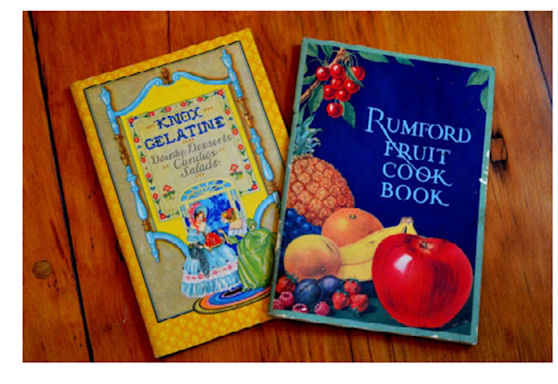
Pictured here
are 2 of the cookbooks: a Rumford Fruit Cook Book from 1927 and a Knox
Gelatin dessert, candy and salad cookbook from 1931. The Rumford
Company produced baking powder.
Edna
Sears was born in 1901, daughter of Clayton and Sarah (Hawley) Sears.
She lived near the intersection of Route 67 and Great Hill Road. Her
father worked for the telegraph company and was later a mechanic.
Edna’s grandmother was Laura Davis Hawley. The society owns an 1856/7
diary from Laura and just received another from 1865.
Edna gave the box of papers to the Biondi brothers’ step-mother for
safe keeping. In cleaning out Mrs. Biondi’s home, the box came to
light. Additionally the Sears’ box offered a Civil War era children’s
game “Visit to Camp.”
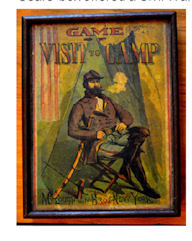
This wooden box
contains “Visit to Camp.” A Civil War era children’s game, it stores
game pieces and a storybook plus an instruction book.
This game is one of many produced by publishing company Mc-Loughlin
Bros. of New York. They made blocks, paper dolls and child-ren’s
toys such as Tiddly-Winks. They also created a long inventory of games
printed with brightly colored illustrations. In 1920 the company was
bought by Milton Bradley.
“Visit to Camp” combines the reading of a convoluted story book and the
featured 12 printed character cards with color illustrations for
Colonel, Captain, farrier, surgeon, rifleman, sutler, sapper, riding
master, musician, artillery man, Zouave and vivandiere.
Many of these terms are no longer in common use. Sapper is a combat
engineer who would build and repair roads and bridges, he was an
infantry member. A sutler is a civilian merchant who sold
provisions to the army and followed the troops into the field or camp.
A farrier is a blacksmith/vet who shod the horses used in moving the
troops and supplies. Vivandiere is a female sutler or canteen keeper
who followed the army to provide support for the troops. She wore a
uniform and often also cared for the wounded on the battlefield.
Zouaves were light infantry in the Union army patterned after the
French troops who wore picturesque uniforms of baggy white trousers and
red jackets. The artillery in the Civil War were cannon and small
mobile guns on wheeled caissons (carriages).
The
game had additional cards representing 6 accoutrements (related
equipment and gear) for each of the 12 characters used in the story.
Sadly the character cards are missing.
The Oxford Historical Society is very grateful to Tom and Ken Biondi for their generous gift.
Milk Bottle Received
Also
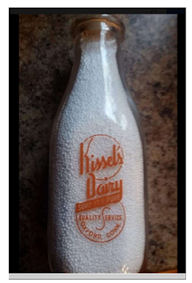
received recently was a milk bottle to add to the Museum’s collection.
This one in collector’s lingo is: Vintage Kisssell’s red pyro
square 1 Quart milk bottle; the red printed label reads ‘Sure it’s Pure
Oxford CT’
We
are grateful to all who donate items related to Oxford’s heritage to
the Society, so that they will be available to future generations to
appreciate and enjoy. If you have old photos, documents, or other
Oxford memorabilia that you would like to donate please contact Nancy
Farnum by phone at 203-888-0230.
Cooking & Baking Stand the Test of Time
Enjoy this bite of history:
This Oxford
heritage recipe came from Flora Olsen who lived her entire life in
Quaker Farms. Flora’s delicious filled cookies were well known at
Christ Church bake sales and holiday fairs
FLORA OLSEN’S FILLED COOKIES
1 cup granulated sugar ½ cup brown sugar
1 cup shortening 2 eggs
1/3 cup
milk
3 ½ cups flour
3 tsp. baking powder ½ tsp salt
1 tsp.
Vanilla
Walnut halves.
Cream sugar and
shortening. Beat in eggs, then milk and vanilla. Add flour, baking
powder and salt. Roll out to ¼ inch thick on lightly floured board. Cut
half the dough into 3 inch circles with a round cutter. Place the
circles on a greased cookie sheet. Place 1 tsp. filling in the center
of each cookie, not allowing it to spread to the edges. Cut the
remaining dough circles with a doughnut cutter with a hole and place
them on top of the filling. Press down the edges of the cookies. Put ½
of a walnut on the filling. Bake at 300 degrees about 15 minutes.
FOR THE FILLING:
Mix ½ cup sugar and 1 tbsp. flour. Add 1 cup raisins and ½ cup water. Cook until thick. Cool before using.
Makes about 24 cookies. These freeze well.
HOMESTEAD OPEN HOUSE:
Previously
held on first and third Sunday afternoons, these tours have been
suspended due to the limits imposed on interior space. The Homestead is
too small a space to allow for adequate social distancing and has other
space constraints.
We
look forward to the future when Open House Sundays can resume and
friends of the Oxford Historical society can visit again.
Honor an Educator
Inspired by a gift of $2500 honoring the teachers who educated the
donor’s daughters to benefit the Munn Schoolhouse Project, the
notecards have become popular with local families.
The gift
cards may be purchased from The Twitchell-Rowland Homestead
Museum. For further information please call 203 888-0230.
Mail donations to Oxford Historical Society, PO Box 582, Oxford, CT
06478. Make checks out to Oxford Historical Society, with “Munn
Schoolhouse” in note field.
Facebook Keeps Society in Touch with Supporters
Many fans of the Oxford Historical Society check in with the society’s
Facebook page regularly to see what has been newly posted. Our daily
posts cover a wide varity of topics and are viewed by several thousand
people. We have over 1800 followers on facebook. Our individual posts
have reached as many 7,000 people.
Our
most popular posts, judging from the number of likes, comments and
shares, include the following topics: 1) The Stevenson Dam and the
history of Lake Zoar. 2) Southford Falls State Park and its
manufacturing history. 3) Railroad stories. Also popular were school
phioto, animal photos, a series of photos and memories of the 1976
Oxford Olde Tyme Fair, and a feature of “Recalling Hard Times in
Oxford,” with a story and a depression era photo each day.
Join the Effort to Preserve Oxford’s Historic Rural Heritage
• Follow us on facebook: @oxfordhistoricalsociety
• Like our Facebook page to let foundations know the Society has your support
• Join the Historical Society. Download a membership form at
http://www.oxford-historical-society.org/membership.pdf