Former Oxford Pastor directed US Operations Mission in Israel
By Dorothy A. DeBisschop
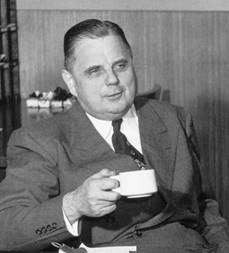
An Oxford pastor in the 1930's went on to lead the U.S. mission providing economic aid to Israel. The Rev. Lincoln Hale was born in Ansonia in 1899 grew up on Franklin Street, and graduated from Ansonia High School in 1916. He married another Ansonia native, Sally Watton.
Before going to college, he went to work as a machinist and draftsman in Farrell Foundry in Ansonia. While studying at Yale, he served as temporary pastor of the Oxford Congregational Church. He earned a bachelor of Divinity degree in 1927, an M.A. in 1933 and a Ph. D. in 1936, all from Yale University.
He went to
Evansville, Indiana where he became president of Evansville College in 1940,
holding that post until 1954. When
Pearl Harbor was bombed, Evansville College had a little less than 500
students. Enrollment fell in half as the
war effort got underway. Most of the
remaining students were women.
College President
Lincoln B. Hale was able to keep the school solvent during the war years, while providing community
and military support for the war. Evansville College trained 335 Navy V-7 naval
pilot cadets during those years.
After the war the
GI Bill was created. As the young
soldiers returned from war, the college grew to more than 1,750 students. Several wooden buildings were quickly put up
on campus to house the influx of new students. The college also built a “tin
city” of Quonset huts for married students.
National leaders recognized Hale’s leadership during the war years and
the college’s successful transition to increased enrollment after the war.
In 1954 Harold E.
Stassen appointed Hale head of the U.S. Operations Mission in Israel to oversee
$52,500,000 in yearly Special Economic Aid.
The following May,
Hale wrote to his friends in the states the following:
"From many of
you has come the question, ‘What are you doing?’ As you know, unexpectedly last
February, a phone call from Governor Stassen’s office asked if I would come to Washington
and review the possibility of accepting a position of leadership and
responsibility in our country’s supreme effort in the cold war to preserve
peace and to build a world where freedom, understanding and brotherhood would
reign. As the full impact of what was involved developed, it seemed that I
could only say ‘yes’ even though my work at and my interest in Evansville
College were of the greatest significance.
"We have found
ourselves here in Israel in a crucial leadership post. We are your representatives seeking to extend
the hand of friendship and understanding to a nation which celebrated its 7th
birthday on April 27th. What a day it
was! I now know what our 4th of July must have meant to the men and women who
brought forth our United States of America. Our first responsibility is to
interpret our American concept of freedom and democracy, and
then working cooperatively with Israelis, help them create economic
independence or economic stability."
Under Hale's
leadership, a staff of 80 experts from the States provided Israel with
$40,000.000 in economic aid. Hale was oversaw use of the funds in Israel.
In addition the
mission provided extra funds for Technical Aid.
Hale wrote: "Personally, I evaluate this program as being of the
greatest importance, although of the lesser monetary value. It brings to Israel Americans with experience
and 'know-how' in Agriculture, Industry, Water Resources, Mineral Resource,
Transportation, Health, Sanitation, Education, Public Administration, Housing,
Labor and Mass Communications."
Part of the work
was the opening of the Yarkon-Negev water
pipeline. It increased the area of
irrigable land in Israel by 25 per cent.
After he left
Israel, he continued to advocate for that country. He spoke throughout the United Sates. On Jan. 23, 1958, he was standing before the
members of the Theodor Herzl Institute in New York, a Christian telling Jews
about Israel. He shared his enthusiasm for the development going on in the young
country. Finishing his speech, in the
middle of a sentence, he died.
Ruth Gruber's wrote
of Hale's passing in the New York Harold Tribune:
"Lincoln Hale
never believed that anything was ever finished, that life was all a process of
beginnings.
"Countless
times at dawn he watched new immigrants who had been brought in by the United
Jewish Appeal, come off the ships at Haifa. He traveled with them to their new
settlements in the Negev to help them with technical aid and with Point 4 money
for houses and roads, for water piped in from the north and for cotton and
crops to seed their land.
"He became a
kind of practical missionary who understood Israel's mission. He saw the
newcomers, broken, illiterate, hungry, riddled with disease -- and he know that no other land in the world would have taken them.
"His name was
Lincoln Hale -- two names that were the essence of America. And inside of two
years Lincoln Hale became the essence of America in Israel. Not all Americans
understood him, but the Israelis did. For them, he was the symbol of America's
compassion, of our desire to help others live a better life, our willingness to
teach them what we know."
Credits: Thanks to the late Myrtle Rowland who preserved
letters from the Hales to Edna and Truman Wheeler.
ABOVE PHOTO: Lincoln B.
Hale, former Oxford pastor and President of Evansville College, directed U.S.
Aid to Israel. Credit: University of
Evansville, Evansville, Indiana